







Question: I don't understand the initial proof Problem 8.12 (the Projection Matrix). If a is a scalar, the function f : R -> R defined as
I don't understand the initial proof
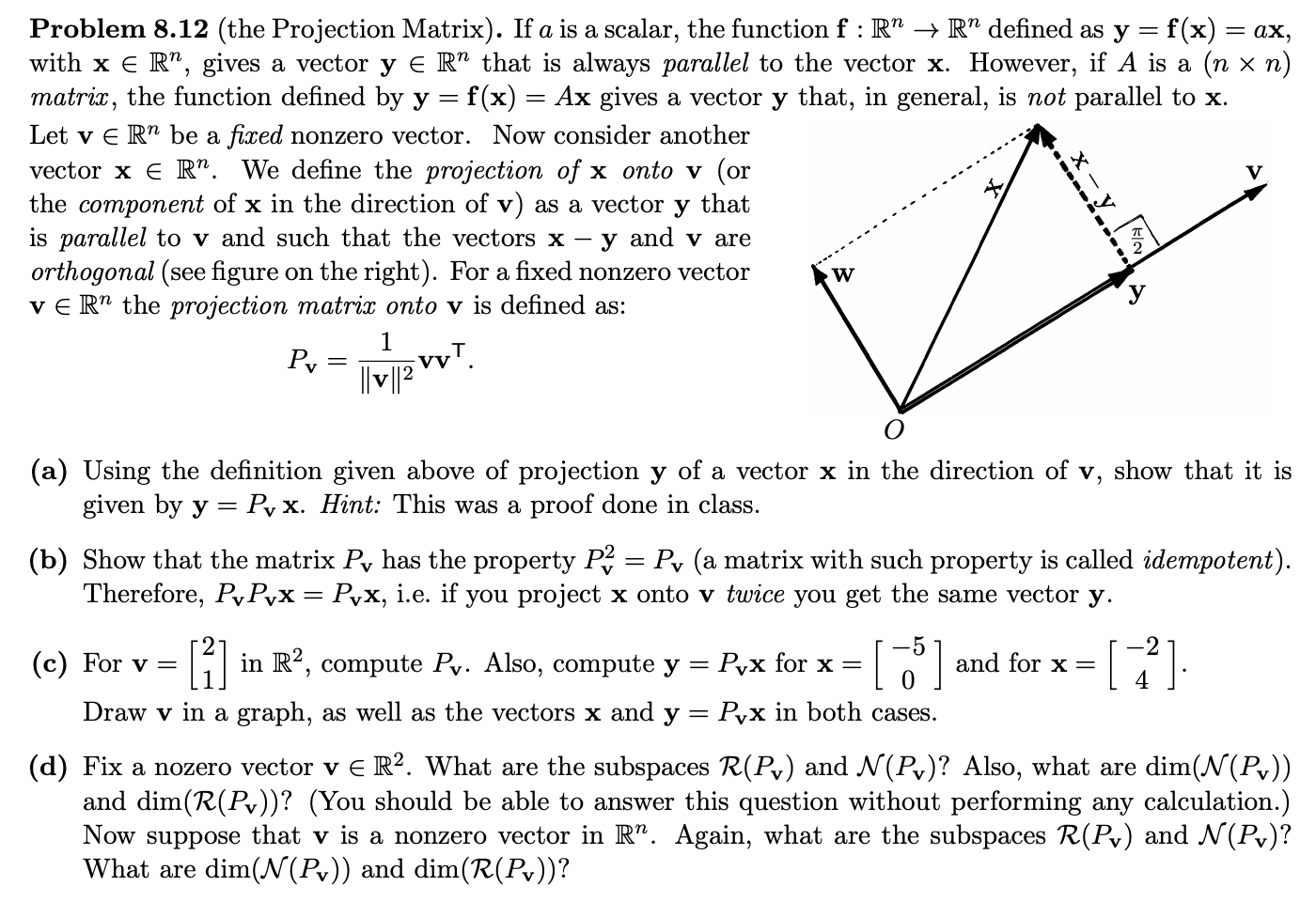
Problem 8.12 (the Projection Matrix). If a is a scalar, the function f : R" -> R" defined as y = f(x) = ax, with x E R", gives a vector y E R" that is always parallel to the vector x. However, if A is a (n x n) matrix, the function defined by y = f(x) = Ax gives a vector y that, in general, is not parallel to x. Let v E R" be a fixed nonzero vector. Now consider another vector x E R". We define the projection of x onto v (or y the component of x in the direction of v) as a vector y that Y is parallel to v and such that the vectors x - y and v are orthogonal (see figure on the right). For a fixed nonzero vector W v E R" the projection matrix onto v is defined as: V Pv = 1 1/ v / / 2 VV. O (a) Using the definition given above of projection y of a vector x in the direction of v, show that it is given by y = Pv X. Hint: This was a proof done in class. (b) Show that the matrix Pv has the property Py = Pv (a matrix with such property is called idempotent). Therefore, PvPvX = Pvx, i.e. if you project x onto v twice you get the same vector y. (c) For v = in R2, compute Pv. Also, compute y = Pvx for x = and for x = [" ] Draw v in a graph, as well as the vectors x and y = Pvx in both cases. (d) Fix a nozero vector v E R2. What are the subspaces R(Pv) and N(Pv)? Also, what are dim(N(Pv)) and dim(R(Pv))? (You should be able to answer this question without performing any calculation.) Now suppose that v is a nonzero vector in R". Again, what are the subspaces R(Pv) and N(Pv)? What are dim(N(Pv) ) and dim(R(Pv))
Step by Step Solution
There are 3 Steps involved in it

Get step-by-step solutions from verified subject matter experts
 Study Help