Question: I have an assignment which is Country Research Project - PowerPoint where, I choose Nepal for my Country Research Project I have attached you my
I have an assignment which is Country Research Project - PowerPoint where, I choose Nepal for my Country Research Project I have attached you my draft Country Research Project below Can you please go through the Country Research Project which is Nepal can you just focus on that article and the links I provided below in order to conclude the PowerPoint. Can you please compose a powerpoint as a bullet point 5 -6 slides: Subject : Country Research Report on Nepal: Management Insights for International Accounting
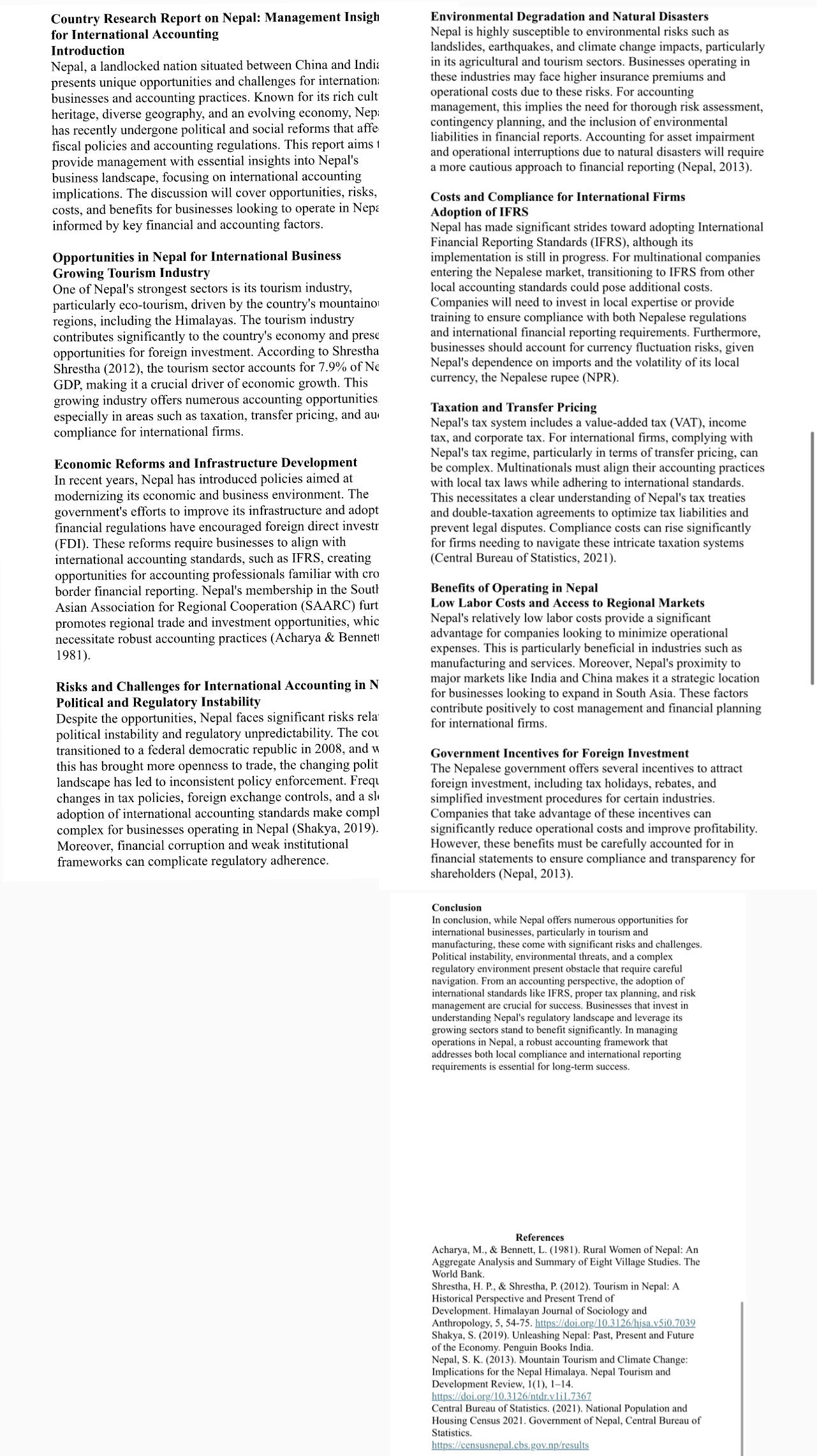
Country Research Report on Nepal: Management Insigh for International Accounting Introduction Nepal, a landlocked nation situated between China and Indiz presents unique opportunities and challenges for internation: businesses and accounting practices. Known for its rich cult heritage, diverse geography, and an evolving economy, Nep: has recently undergone political and social reforms that affe fiscal policies and accounting regulations. This report aims 1 provide management with essential insights into Nepal's business landscape, focusing on international accounting implications. The discussion will cover opportunities, risks, costs, and benefits for businesses looking to operate in Nep: informed by key financial and accounting factors. Opportunities in Nepal for International Business Growing Tourism Industry One of Nepal's strongest sectors is its tourism industry, particularly eco-tourism, driven by the country's mountainor regions, including the Himalayas. The tourism industry contributes significantly to the country's economy and prese opportunities for foreign investment. According to Shrestha Shrestha (2012), the tourism sector accounts for 7.9% of Ne GDP, making it a crucial driver of economic growth. This growing industry offers numerous accounting opportunities especially in areas such as taxation, transfer pricing, and aw compliance for international firms. Economic Reforms and Infrastructure Development In recent years, Nepal has introduced policies aimed at modernizing its economic and business environment. The government's efforts to improve its infrastructure and adopt financial regulations have encouraged foreign direct investr (FDI). These reforms require businesses to align with international accounting standards, such as TFRS, creating opportunities for accounting professionals familiar with cro border financial reporting. Nepal's membership in the Soutt Asian Association for Regional Cooperation (SAARC) furt promotes regional trade and investment opportunities, whic necessitate robust accounting practices (Acharya & Benneti 1981). Risks and Challenges for International Accounting in N Political and Regulatory Instability Despite the opportunities, Nepal faces significant risks rela political instability and regulatory unpredictability. The cou transitioned to a federal democratic republic in 2008, and w this has brought more openness to trade, the changing polit landscape has led to inconsistent policy enforcement. Frequ changes in tax policies, foreign exchange controls, and a sl adoption of international accounting standards make compl complex for businesses operating in Nepal (Shakya, 2019). Moreover, financial corruption and weak institutional frameworks can complicate regulatory adherence. Environmental Degradation and Natural Disasters Nepal is highly susceptible to environmental risks such as landslides, earthquakes, and climate change impacts, particularly in its agricultural and tourism sectors. Businesses operating in these industries may face higher insurance premiums and operational costs due to these risks. For accounting management, this implies the need for thorough risk assessment, contingency planning, and the inclusion of environmental liabilities in financial reports. Accounting for asset impairment and operational interruptions due to natural disasters will require a more cautious approach to financial reporting (Nepal, 2013). Costs and Compliance for International Firms Adoption of IFRS Nepal has made significant strides toward adopting International Financial Reporting Standards (IFRS), although its implementation is still in progress. For multinational companies entering the Nepalese market, transitioning to IFRS from other local accounting standards could pose additional costs, Companies will need to invest in local expertise or provide training to ensure compliance with both Nepalese regulations and international financial reporting requirements. Furthermore, businesses should account for currency fluctuation risks, given Nepal's dependence on imports and the volatility of its local currency, the Nepalese rupee (NPR). Taxation and Transfer Pricing Nepal's tax system includes a value-added tax (VAT), income tax, and corporate tax. For international firms, complying with Nepal's tax regime, particularly in terms of transfer pricing, can be complex. Multinationals must align their accounting practices with local tax laws while adhering to international standards. This necessitates a clear understanding of Nepal's tax treaties and double-taxation agreements to optimize tax liabilities and prevent legal disputes. Compliance costs can rise significantly for firms needing to navigate these intricate taxation systems (Central Bureau of Statistics, 2021). Benefits of Operating in Nepal Low Labor Costs and Access to Regional Markets Nepal's relatively low labor costs provide a significant advantage for companies looking to minimize operational expenses. This is particularly beneficial in industries such as manufacturing and services. Moreover, Nepal's proximity to major markets like India and China makes it a strategic location for businesses looking to expand in South Asia. These factors contribute positively to cost management and financial planning for international firms. Government Incentives for Foreign Investment The Nepalese government offers several incentives to attract foreign investment, including tax holidays, rebates, and simplified investment procedures for certain industries. Companies that take advantage of these incentives can significantly reduce operational costs and improve profitability. However, these benefits must be carefully accounted for in financial statements to ensure compliance and transparency for sharcholders (Nepal, 2013). Conclusion In conclusion, while Nepal offers numerous opportunities for international businesses, particularly in tourism and manufacturing, these come with significant risks and challenges. Political instability, environmental threats, and a complex regulatory environment present obstacle that require careful navigation. From an accounting perspective, the adoption of international standards like IFRS, proper tax planning, and risk management are crucial for success. Businesses that invest in understanding Nepal's regulatory landscape and leverage its growing sectors stand to benefit significantly. In managing operations in Nepal, a robust accounting framework that addresses both local compliance and international reporting requirements is essential for long-term success. References Acharya, M., & Bennett, L. (1981). Rural Women of Nepal: An Aggregate Analysis and Summary of Eight Village Studies. The World Bank. Shrestha, H. P, & Shrestha, P, (2012). Tourism in Nepal: A Historical Perspective and Present Trend of Development. Himalayan Journal of Sociology and Anthropology, 5, 54-75. hu, 10.3126/hjsa.v5i0.703 Shakya, S. (2019). Unleashing Nepal: Past, Present and Future of the Economy. Penguin Books India Nepal, S. K. (2013). Mountain Tourism and Climate Change: Implications for the Nepal Himalaya. Nepal Tourism and Development Review, 1(1), 1-14 https://doi.org/10.3126idr.v1 Central Burcau of Statistics, (2021). National Population and Housing Census 2021. Government of Nepal, Central Bureau of doi.or