







Question: I included an example of sample code for a problem like this that we did in class hoping it helps solve this problem. You can
I included an example of sample code for a problem like this that we did in class hoping it helps solve this problem. You can use the same parameters that are in my code to solve this problem. For example, my sample code has uL = t and uR = t +1. See problem below code. Thanks.
Sample Code:
clear;
n = 4;
dt = 0.1; tsteps = 30; alpha = 0.5; uL = @(t) t; %BC L uR = @(t) t+1; %BC R u0 = @(x) x.^2; %IC
dx = 1; beta = alpha*dt/(dx^2); x = linspace(0, 1, n+1); t= linspace (0, tsteps*dt, tsteps+1);
%IC u(1, 1:n+1) = u0(x);
for m = 1:tsteps u(m+1,1) = uL(t(m+1)); u(m+1,n+1) = uR(t(m+1)); for j = 2:n u(m+1,j) = u(m,j) + beta*(u(m,j-1)-2*u(m,j)+u(m,j+1)); end end
contourf (x,t,u); colorbar; xlabel('space'); ylabel('time');
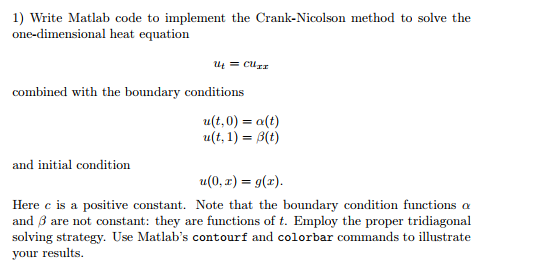
1) Write Matlab code to implement the Crank-Nicolson method to solve the one-dimensional heat equation combined with the boundary conditions a(t, 0) = a(t) u(t, 1) = (t) and initial condition u(0, g( Here c is a positive constant. Note that the boundary condition functions a and are not constant: they are functions of t. Employ the proper tridiagonal solving strategy. Use Matlab's contourf and colorbar commands to illustrate your results. 1) Write Matlab code to implement the Crank-Nicolson method to solve the one-dimensional heat equation combined with the boundary conditions a(t, 0) = a(t) u(t, 1) = (t) and initial condition u(0, g( Here c is a positive constant. Note that the boundary condition functions a and are not constant: they are functions of t. Employ the proper tridiagonal solving strategy. Use Matlab's contourf and colorbar commands to illustrate your results
Step by Step Solution
There are 3 Steps involved in it

Get step-by-step solutions from verified subject matter experts
 Study Help