







Question: I need a program that follows these guidlines. I can only use #include and #include I already have an incomplete code that needs some modifying
I need a program that follows these guidlines. I can only use #include
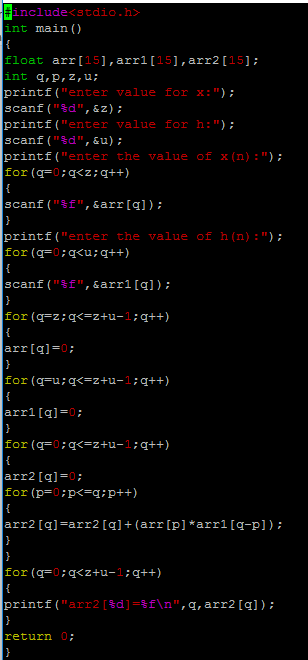
I already have an incomplete code that needs some modifying or complete revision.
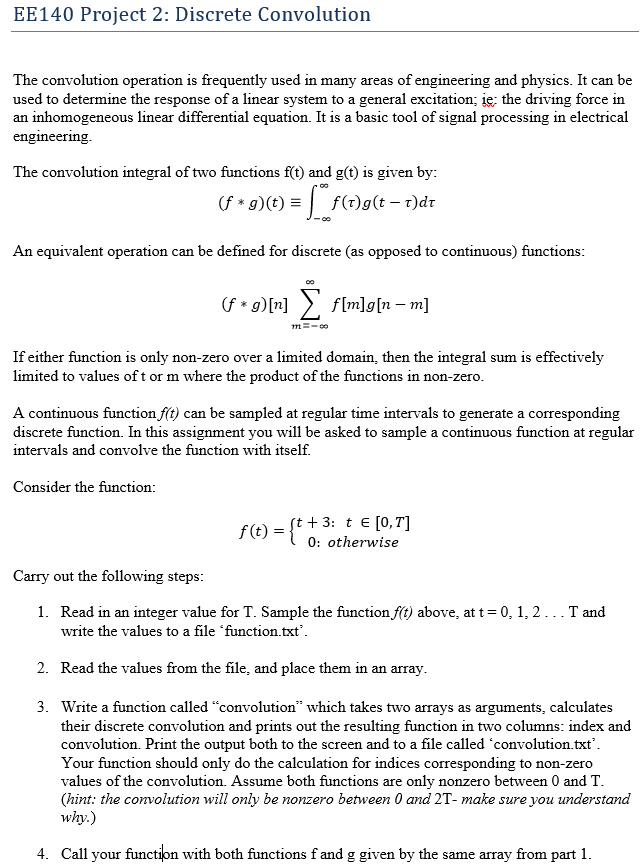
EE140 Project 2: Discrete Convolution The convolution operation is frequently used in many areas of engineering and physics. It can be used to determine the response of a linear system to a general excitation; ie; the driving force in an inhomogeneous linear differential equation. It is a basic tool of signal processing in electrical engineering The convolution integral of two functions f(t) and g(t) is given by: (f * g)(t) | f(t)g(t-t)dr An equivalent operation can be defined for discrete (as opposed to continuous) functions (f * g)[n] ? f[m]g[n-m] If either function is only non-zero over a limited domain, then the integral sum is effectively limited to values of t or m where the product of the functions in non-zero A continuous function f(t) can be sampled at regular time intervals to generate a corresponding discrete function. In this assignment you will be asked to sample a continuous function at regular intervals and convolve the function with itself Consider the function: f (t) - t+3: t E [O, T] 0: otherwise Carry out the following steps 1. Read in an integer value for T. Sample the function f(t) above, at t-0,1,2... T and write the values to a file 'function.txt 2. Read the values from the file, and place them in an array 3. Write a function called "convolution" which takes two arrays as arguments, calculates their discrete convolution and prints out the resulting function in two columns: index and convolution. Print the output both to the screen and to a file called 'convolution.txt Your function should only do the calculation for indices corresponding to non-zero values of the convolution. Assume both functions are only nonzero between 0 and T (hint: the convolution will only be nonzero between 0 and 2T- make sure you understand 4. Call your functijon with both functions fand g given by the same array from part 1 EE140 Project 2: Discrete Convolution The convolution operation is frequently used in many areas of engineering and physics. It can be used to determine the response of a linear system to a general excitation; ie; the driving force in an inhomogeneous linear differential equation. It is a basic tool of signal processing in electrical engineering The convolution integral of two functions f(t) and g(t) is given by: (f * g)(t) | f(t)g(t-t)dr An equivalent operation can be defined for discrete (as opposed to continuous) functions (f * g)[n] ? f[m]g[n-m] If either function is only non-zero over a limited domain, then the integral sum is effectively limited to values of t or m where the product of the functions in non-zero A continuous function f(t) can be sampled at regular time intervals to generate a corresponding discrete function. In this assignment you will be asked to sample a continuous function at regular intervals and convolve the function with itself Consider the function: f (t) - t+3: t E [O, T] 0: otherwise Carry out the following steps 1. Read in an integer value for T. Sample the function f(t) above, at t-0,1,2... T and write the values to a file 'function.txt 2. Read the values from the file, and place them in an array 3. Write a function called "convolution" which takes two arrays as arguments, calculates their discrete convolution and prints out the resulting function in two columns: index and convolution. Print the output both to the screen and to a file called 'convolution.txt Your function should only do the calculation for indices corresponding to non-zero values of the convolution. Assume both functions are only nonzero between 0 and T (hint: the convolution will only be nonzero between 0 and 2T- make sure you understand 4. Call your functijon with both functions fand g given by the same array from
Step by Step Solution
There are 3 Steps involved in it

Get step-by-step solutions from verified subject matter experts
 Study Help