







Question: I need an answer for this question after reading the following case. Question :If the contextual knowledge and conceptual skills of the engineers were developed
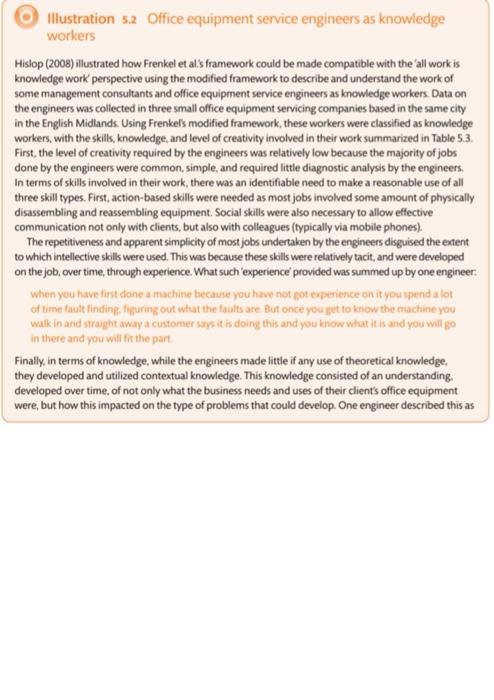
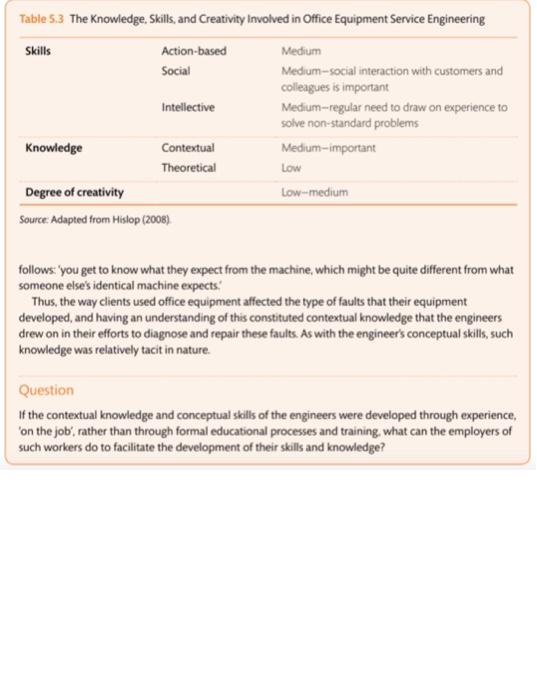
workers Hislop (2008) illustrated how Frenkel et al's framework could be made compatible with the all work is knowledge work perspective using the modified framework to describe and understand the work of some management consultants and office equipment service engineers as knowledge workers. Data on the engineers was collected in three small office equipment servicing companies based in the same city in the English Midlands. Using Frenkels modified framework, these workers were classified as knowledge workers, with the skills, knowledge, and level of creativity involved in their work summarized in Table 5.3. First, the level of creativity required by the engineers was relatively low because the majority of jobs done by the engineers were common, simple, and required little diagnostic analysis by the engineers. In terms of skills involved in their work, there was an identifiable need to make a reasonable use of all three skill types. First, action-based skills were needed as most jobs involved some amount of physically disassembling and reassembling equipment. Social skills were also necessary to allow effective communication not only with clients, but also with colleagues (typically via mobile phones). The repetitiveness and apparent simplicity of most jobs undertaken by the engineers disguised the extent to which intellective skills were used. This was because these skills were relatively tacit, and were developed on the job, over time, through experience. What such 'experience' provided was summed up by one engineer: When you have first done a machine because you have not got expenence on it you spend a lot of time fault finding, figuring out what the faults are. But once you get to know the machine you walk in and straight away a customer says it is doing this and you know what it is and you will go in there and you will fit the part. Finally, in terms of knowledge, while the engineers made little if any use of theoretical knowledge, they developed and utilized contextual knowledge. This knowledge consisted of an understanding. developed over time, of not only what the business needs and uses of their client's office equipment were, but how this impacted on the type of problems that could develop. One engineer described this as Table 5.3 The Knowledge, Skills, and Creativity involved in Office Equipment Service Engineering Source: Adapted from Hislop (2008) follows: 'you get to know what they expect from the machine, which might be quite different from what someone else's identical machine expects: Thus, the way clients used office equipment affected the type of faults that their equipment developed, and having an understanding of this constituted contextual knowledge that the engineers drew on in their efforts to diagnose and repair these faults. As with the engineer's conceptual skills, such knowledge was relatively tacit in nature. Question If the contextual knowledge and conceptual skills of the engineers were developed through experience, 'on the job', rather than through formal educational processes and training. what can the employers of such workers do to facilitate the development of their skills and knowledge
Step by Step Solution
There are 3 Steps involved in it

Get step-by-step solutions from verified subject matter experts
 Study Help