Question: I need guidance on what I am doing wrong. The wbitadd function is supposed to implement 2's compliment on m and n then add those
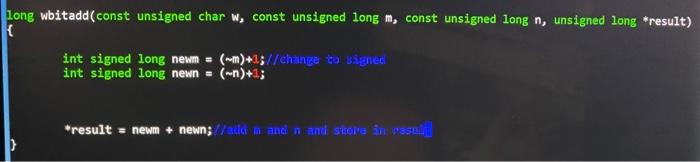
I need guidance on what I am doing wrong. The wbitadd function is supposed to implement 2's compliment on m and n then add those two integers together. Some results are correct, some are correct but wrong format and others are completely wrong.
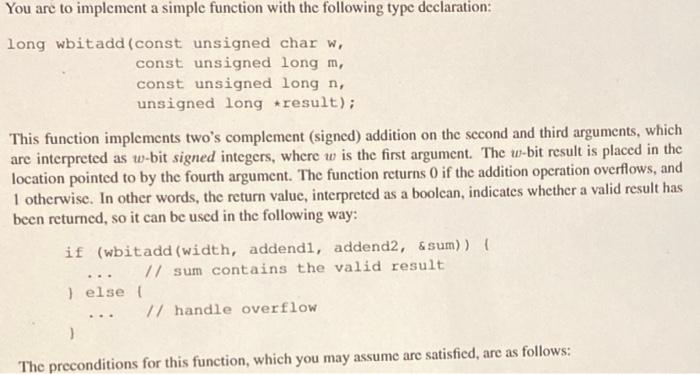
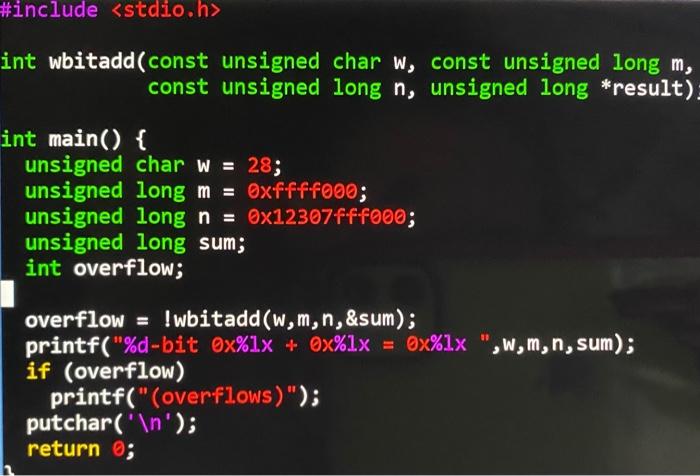
long wbitadd(const unsigned char W, const unsigned long m, const unsigned long n, unsigned long result) { int signed long newm = (mm)+1;//change to signed int signed long newn - (n)+1; *result = newm + newn;/add m and n and store in veseid #include int wbitadd(const unsigned char W, const unsigned long m, const unsigned long n, unsigned long *result). int main() { unsigned char w = 28; unsigned long m = Oxffff000; unsigned long n = 0x12307fff000; unsigned long sum; int overflow; overflow = ! wbitadd(w,m,n,&sum); printf("%d-bit Ox%1% + 0x%1x = 0x%1x ",w, m, n, sum); -1x if (overflow) printf("(overflows)"); putchar(' '); return 0; You are to implement a simple function with the following type declaration: long wbitadd(const unsigned char w, const unsigned long m, const unsigned long n, unsigned long result); This function implements two's complement (signed) addition on the second and third arguments, which are interpreted as w-bit signed integers, where w is the first argument. The w-bit result is placed in the location pointed to by the fourth argument. The function returns 0 if the addition operation overflows, and 1 otherwise. In other words, the return value, interpreted as a boolean, indicates whether a valid result has been returned, so it can be used in the following way: if (wbitadd (width, addendi, addend2, &sum)) { // sum contains the valid result } else // handle overflow ) The preconditions for this function, which you may assume are satisfied, are as follows









 Study Help