







Question: I need help answering question 6. please!! As seen in Chapter 6, we can summarize the quantitative data on heart rates using averages or means.
I need help answering question 6. please!!
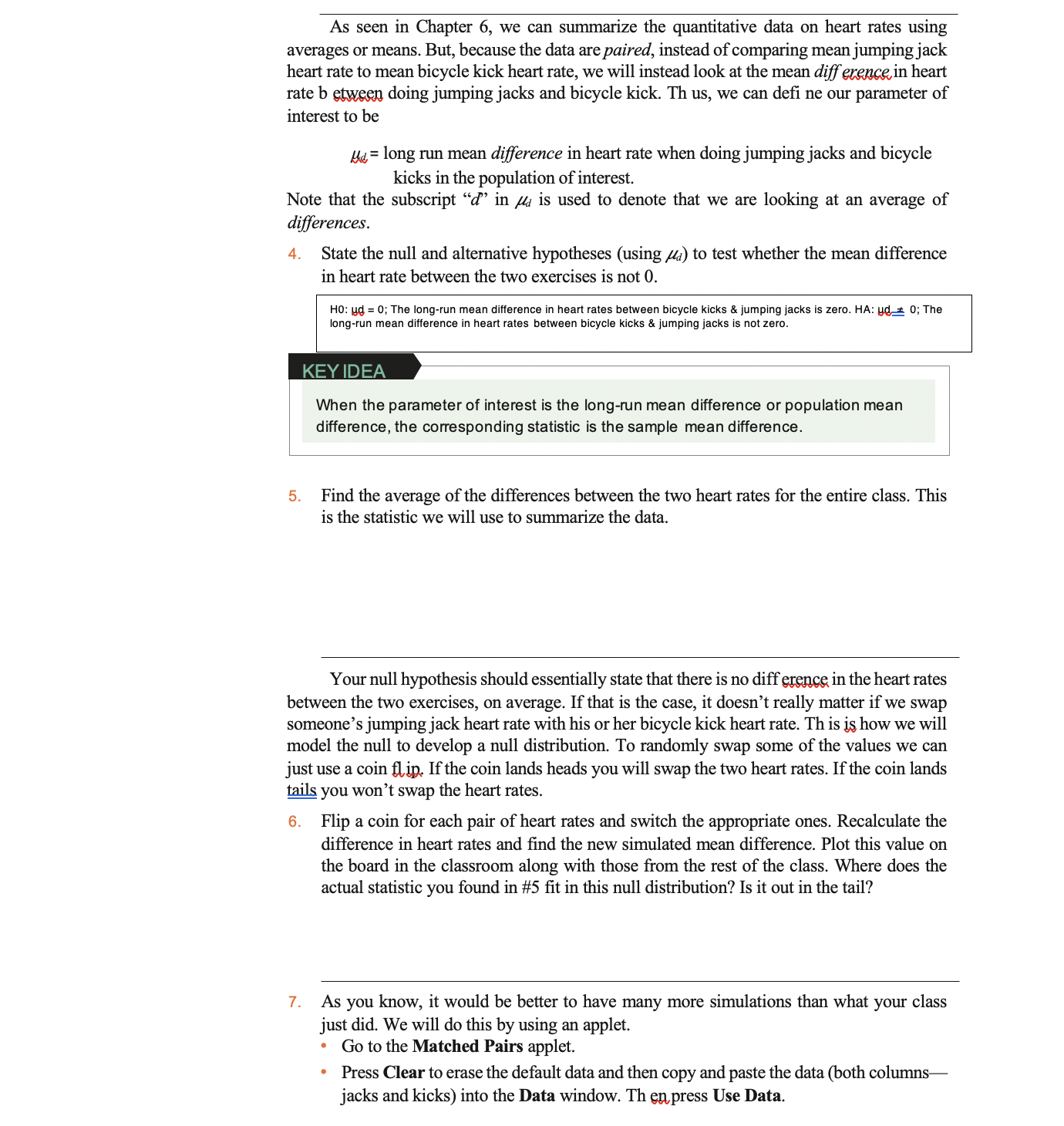
As seen in Chapter 6, we can summarize the quantitative data on heart rates using averages or means. But, because the data are paired, instead of comparing mean jumping jack heart rate to mean bicycle kick heart rate, we will instead look at the mean difference, in heart rate between doing jumping jacks and bicycle kick. Th us, we can defi ne our parameter of interest to be Me = long run mean difference in heart rate when doing jumping jacks and bicycle kicks in the population of interest. Note that the subscript "d" in / is used to denote that we are looking at an average of differences. 4. State the null and alternative hypotheses (using Ma) to test whether the mean difference in heart rate between the two exercises is not 0. 10: yd = 0; The long-run mean difference in heart rates between bicycle kicks & jumping jacks is zero. HA: yd_ 0; The long-run mean difference in heart rates between bicycle kicks & jumping jacks is not zero. KEY IDEA When the parameter of interest is the long-run mean difference or population mean difference, the corresponding statistic is the sample mean difference. 5. Find the average of the differences between the two heart rates for the entire class. This is the statistic we will use to summarize the data. Your null hypothesis should essentially state that there is no difference in the heart rates between the two exercises, on average. If that is the case, it doesn't really matter if we swap someone's jumping jack heart rate with his or her bicycle kick heart rate. This is how we will model the null to develop a null distribution. To randomly swap some of the values we can just use a coin flip. If the coin lands heads you will swap the two heart rates. If the coin lands tails you won't swap the heart rates. 6. Flip a coin for each pair of heart rates and switch the appropriate ones. Recalculate the difference in heart rates and find the new simulated mean difference. Plot this value on the board in the classroom along with those from the rest of the class. Where does the actual statistic you found in #5 fit in this null distribution? Is it out in the tail? 7. As you know, it would be better to have many more simulations than what your class just did. We will do this by using an applet. . Go to the Matched Pairs applet. Press Clear to erase the default data and then copy and paste the data (both columns- jacks and kicks) into the Data window. Th en press Use Data
Step by Step Solution
There are 3 Steps involved in it

Get step-by-step solutions from verified subject matter experts
 Study Help