







Question: I need help developing the code and answering 1a- c based on the code.. plz include graphs and a code that can run, thank you!
I need help developing the code and answering 1a- c based on the code.. plz include graphs and a code that can run, thank you! Plz only answer if you have codes and graphs!! Thanks
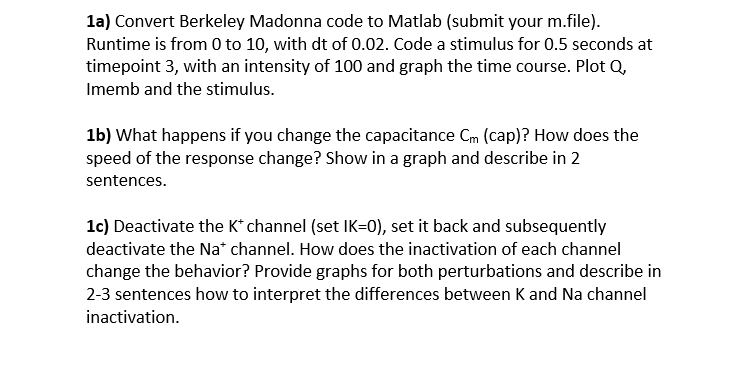
1a) Convert Berkeley Madonna code to Matlab (submit your m.file). Runtime is from 0 to 10, with dt of 0.02. Code a stimulus for 0.5 seconds at timepoint 3, with an intensity of 100 and graph the time course. Plot Q, Imemb and the stimulus. 1b) What happens if you change the capacitance Cm (cap)? How does the speed of the response change? Show in a graph and describe in 2 sentences. 1c) Deactivate the K+ channel (set IK=0), set it back and subsequently deactivate the Na+ channel. How does the inactivation of each channel change the behavior? Provide graphs for both perturbations and describe in 2-3 sentences how to interpret the differences between K and Na channel inactivation.
Here is the Berkeley Madonna code:
{Top model}
{Reservoirs}
d/dt (Q) = + Stimulus - Imemb
INIT Q = -65/cap
{Flows}
Stimulus = Intensity*SquarePulse(3,.5) {at t=3 of 0.5 duration}
Imemb = IL+IK+INa
{Functions}
Intensity = 100 {microamps}
cap = 1
E = Q/cap
{Submodel "INa_"}
{Functions}
ENa = 50
INa = gNa*(E-ENa)
GNaMax = 120
gNa = GNaMax*m*m*m*h
{Submodel "m_gates"}
{Reservoirs}
d/dt (m) = + m_prod - m_decay
INIT m = am/(am+bm)
{Flows}
m_prod = am*(1-m)
m_decay = bm*m
{Functions}
am = 0.1*(E+40)/(1-exp(-(E+40)/10))
bm = 4*exp(-(E+65)/18)
{Submodel "h_gates"}
{Reservoirs}
d/dt (h) = + h_prod - h_decay
INIT h = ah/(ah+bh)
{Flows}
h_prod = ah*(1-h)
h_decay = bh*h
{Functions}
ah = 0.07*exp(-(E+65)/20)
bh = 1/(exp(-(E+35)/10)+1)
{Submodel "IK_"}
{Functions}
EK = -77
IK = gK*(E-EK)
gK_max = 36
gK = gK_max*n*n*n*n
{Submodel "n_gates"}
{Reservoirs}
d/dt (n) = + n_prod - n_decay
INIT n = an/(an+bn)
{Flows}
n_prod = an*(1-n)
n_decay = bn*n
{Functions}
an = 0.01*(E+55)/(1-exp(-(E+55)/10))
bn = 0.125*exp(-(E+65)/80)
{Submodel "IL_"}
{Functions}
IL = gL*(E-EL)
EL = -54.4
gL = .3
{Globals}
{End Globals}
One way to code a square pulse in Matlab:
___________________________________________________
% % Generate Pulse between 3 and 3.5 seconds
if t>3 && t
else squarepulse = 0;
end
Thank you, will only thumbs up if I receive real help with this.. this is my third time posting because I haven't received real help... only half explanations. I need a code that will produce a real graph, thank you!
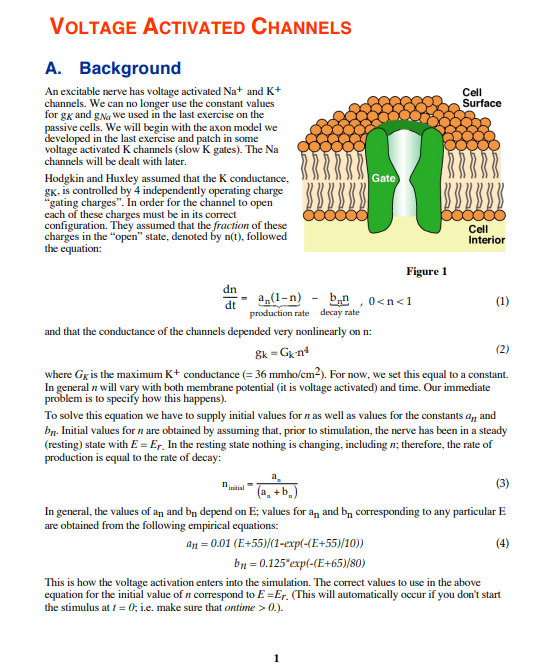
1a) Convert Berkeley Madonna code to Matlab (submit your m.file). Runtime is from 0 to 10 , with dt of 0.02 . Code a stimulus for 0.5 seconds at timepoint 3, with an intensity of 100 and graph the time course. Plot Q, Imemb and the stimulus. 1b) What happens if you change the capacitance Cm (cap)? How does the speed of the response change? Show in a graph and describe in 2 sentences. 1c) Deactivate the K+channel (set IK=0 ), set it back and subsequently deactivate the Na+channel. How does the inactivation of each channel change the behavior? Provide graphs for both perturbations and describe in 2-3 sentences how to interpret the differences between K and Na channel inactivation. Voltage ACtivated Channels A. Background An excitable nerve has voltage activated Na+and K+ channels. We can no longer use the constant values passive cells. We will begin with the axon model we developed in the last exercise and patch in some voltage activated K channels (slow K gates). The Na channels will be dealt with later. Hodgkin and Huxley assumed that the K conductance, gK, is controlled by 4 independently operating charge "gating charges". In order for the channel to open each of these charges must be in its correct configuration. They assumed that the fraction of these charges in the "open" state, denoted by n(t), followed the equation: Figure 1 dtdn=productionratean(1n)decayratebnn,0
Step by Step Solution
There are 3 Steps involved in it

Get step-by-step solutions from verified subject matter experts
 Study Help