Question: I need help figuring out how to write a discourse community analysis essay based on my annotated bibliography information. I am struggling on how I
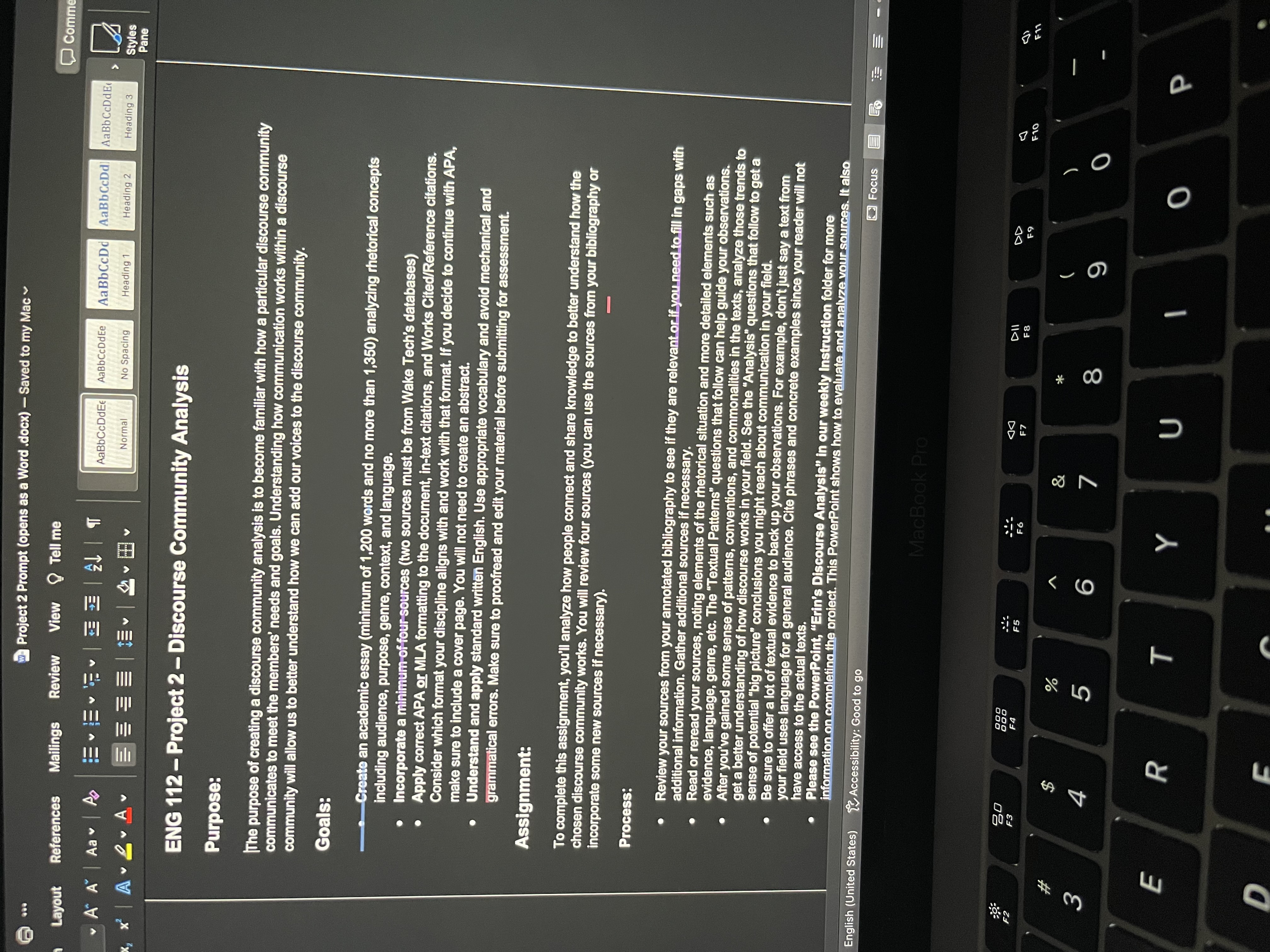
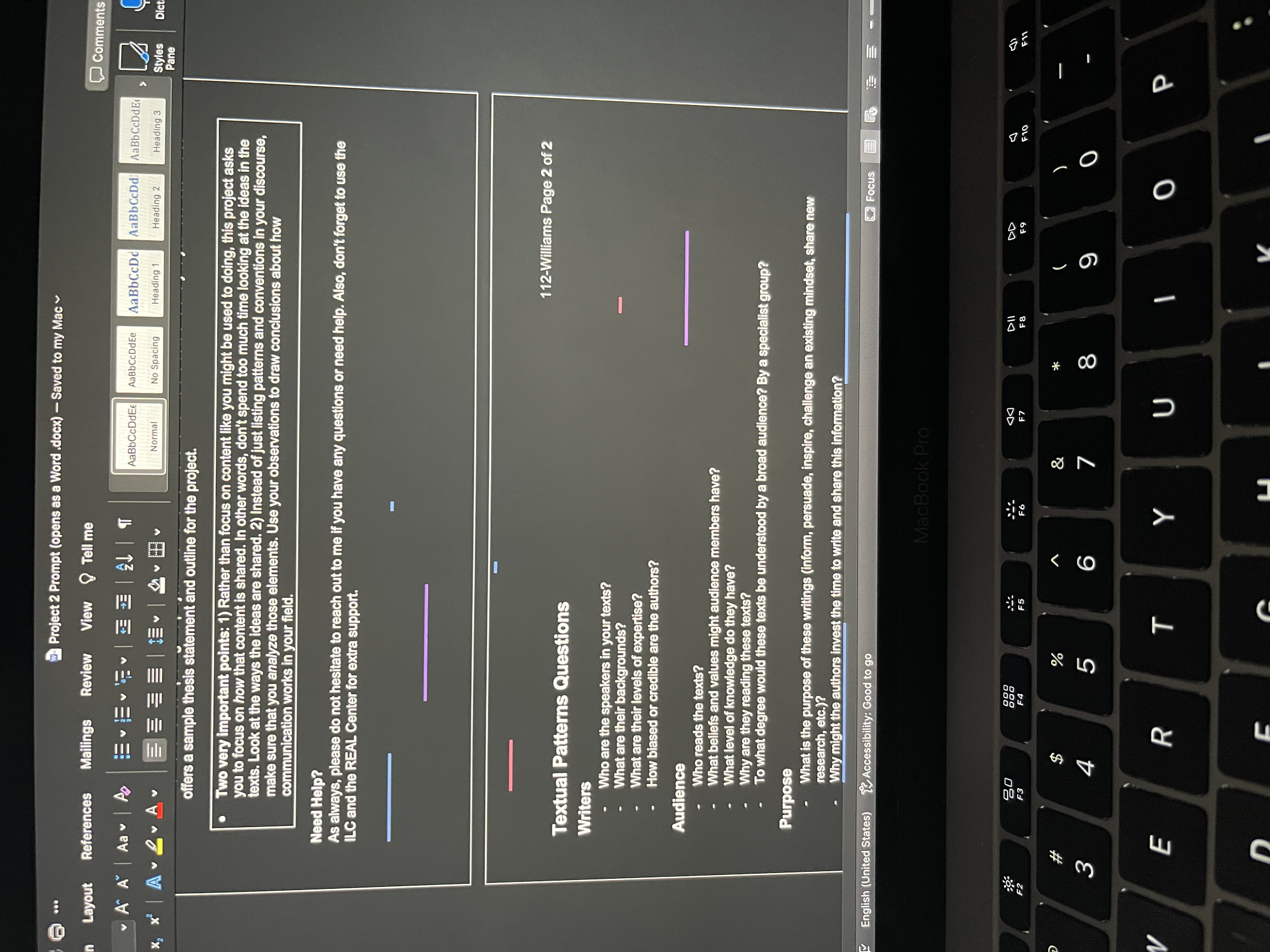
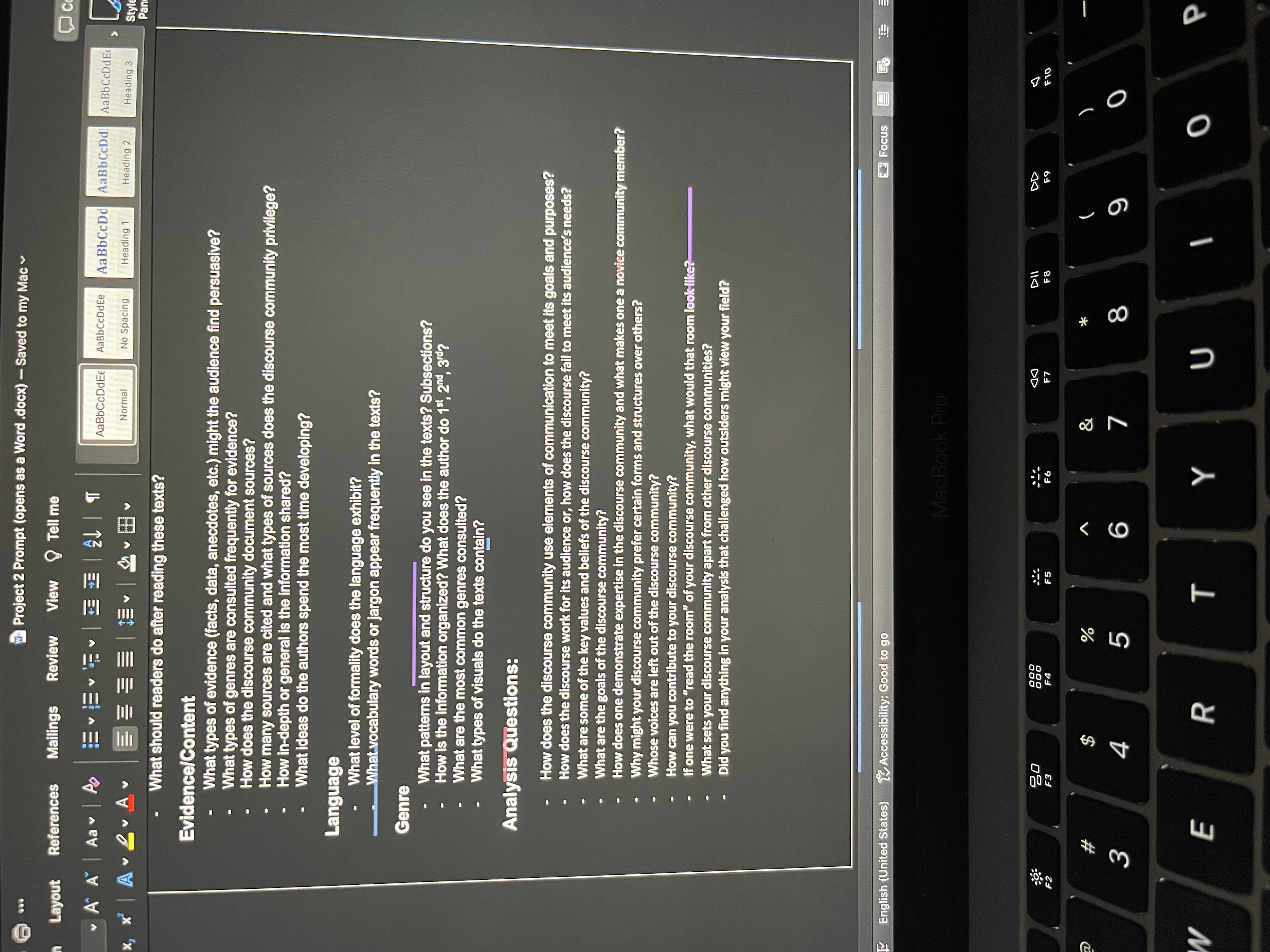
I need help figuring out how to write a discourse community analysis essay based on my annotated bibliography information. I am struggling on how I should start the essay and what exactly the essay is supposed to be about. Linked below is the essay prompt as well as my annotated bibliography. If there is anyway you can help me that would be great. Thank you.
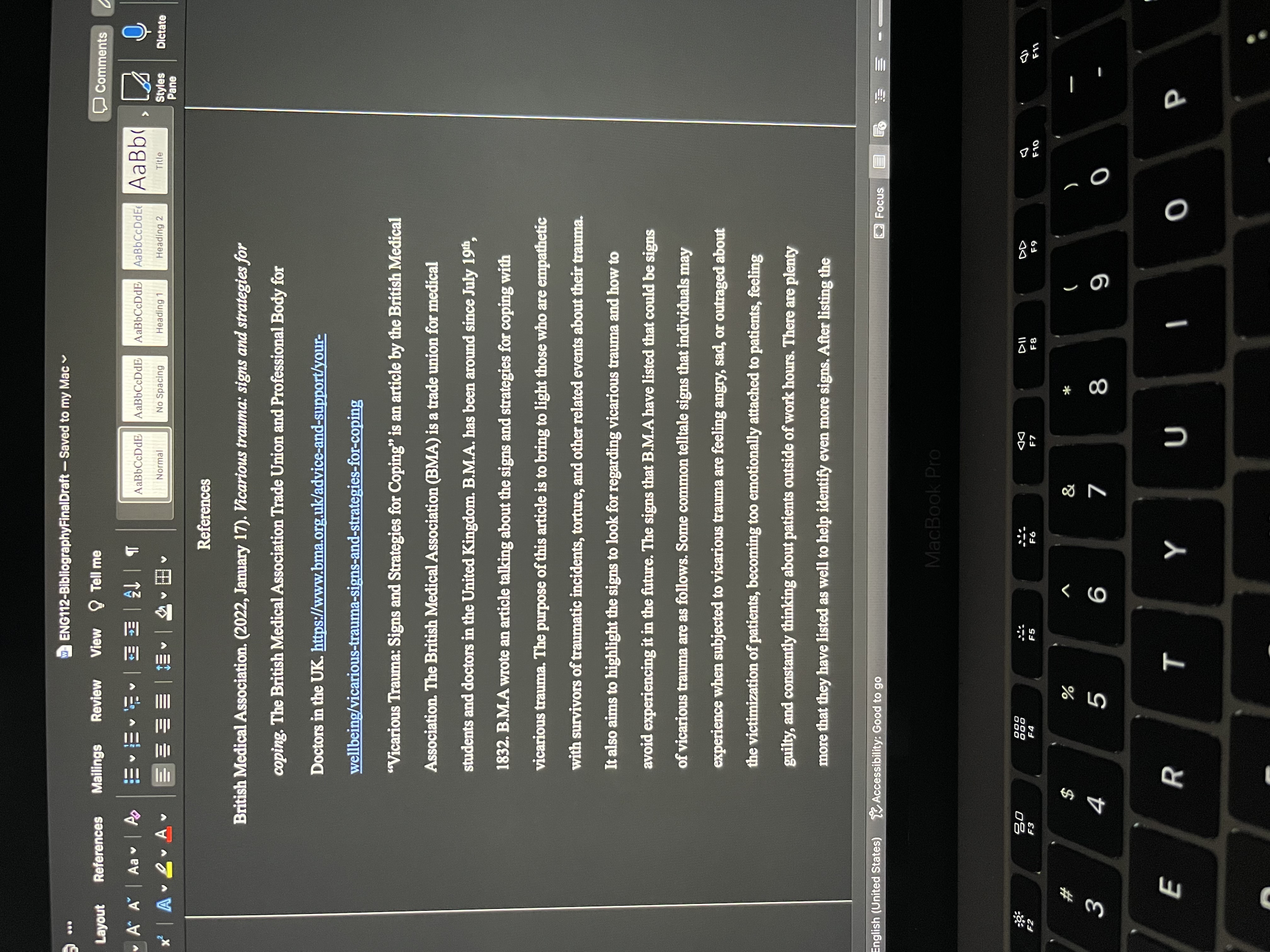
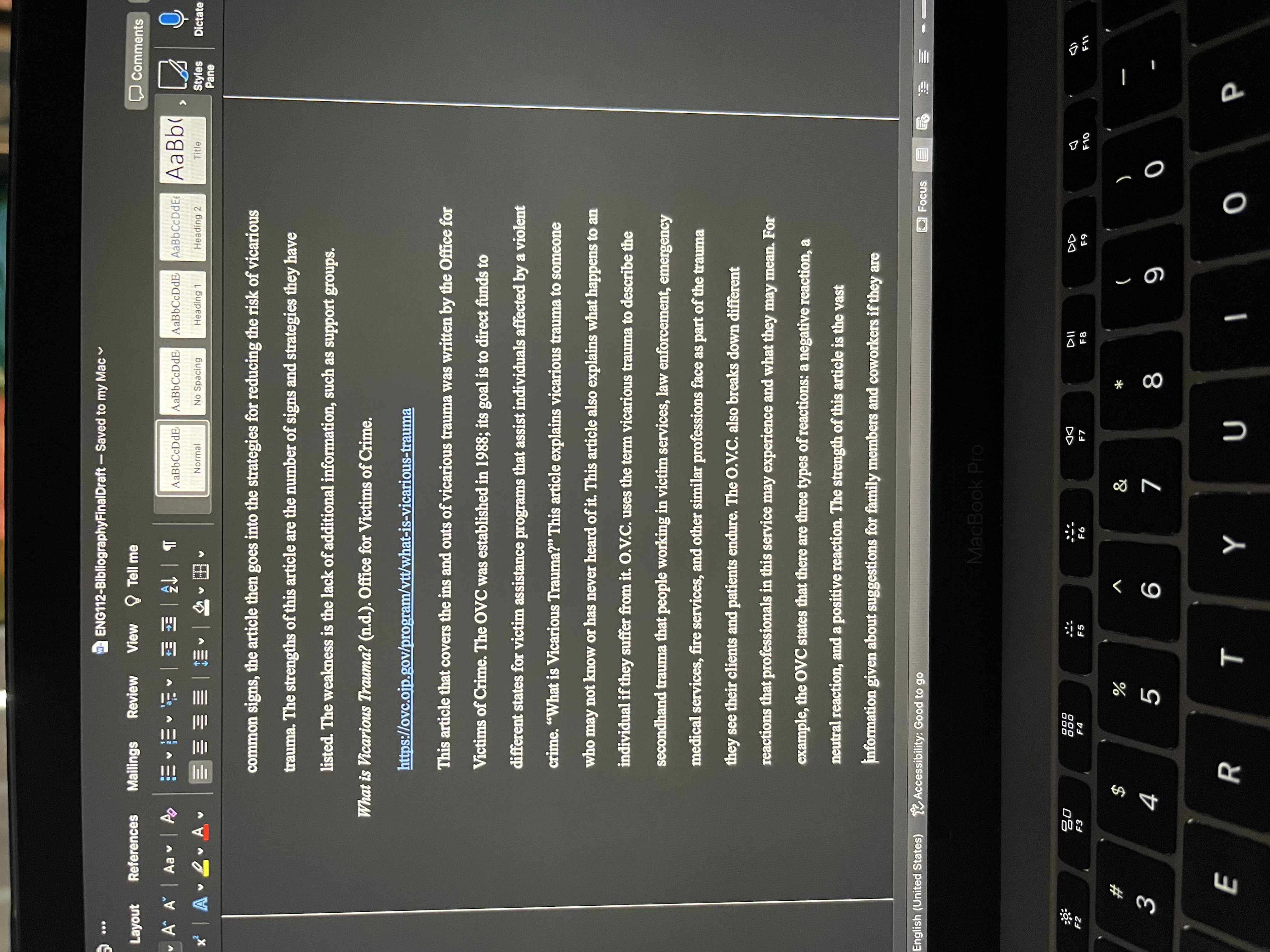
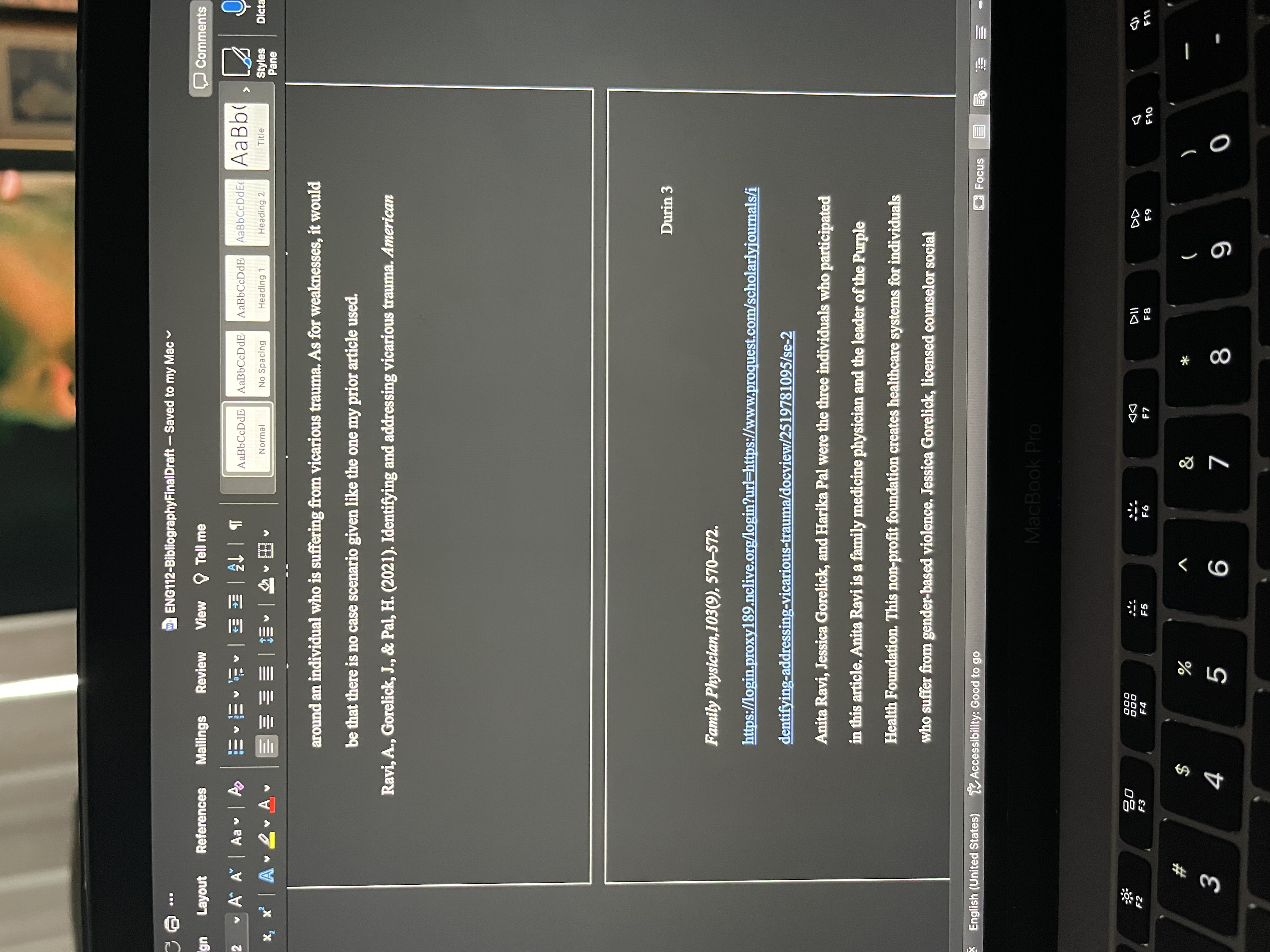
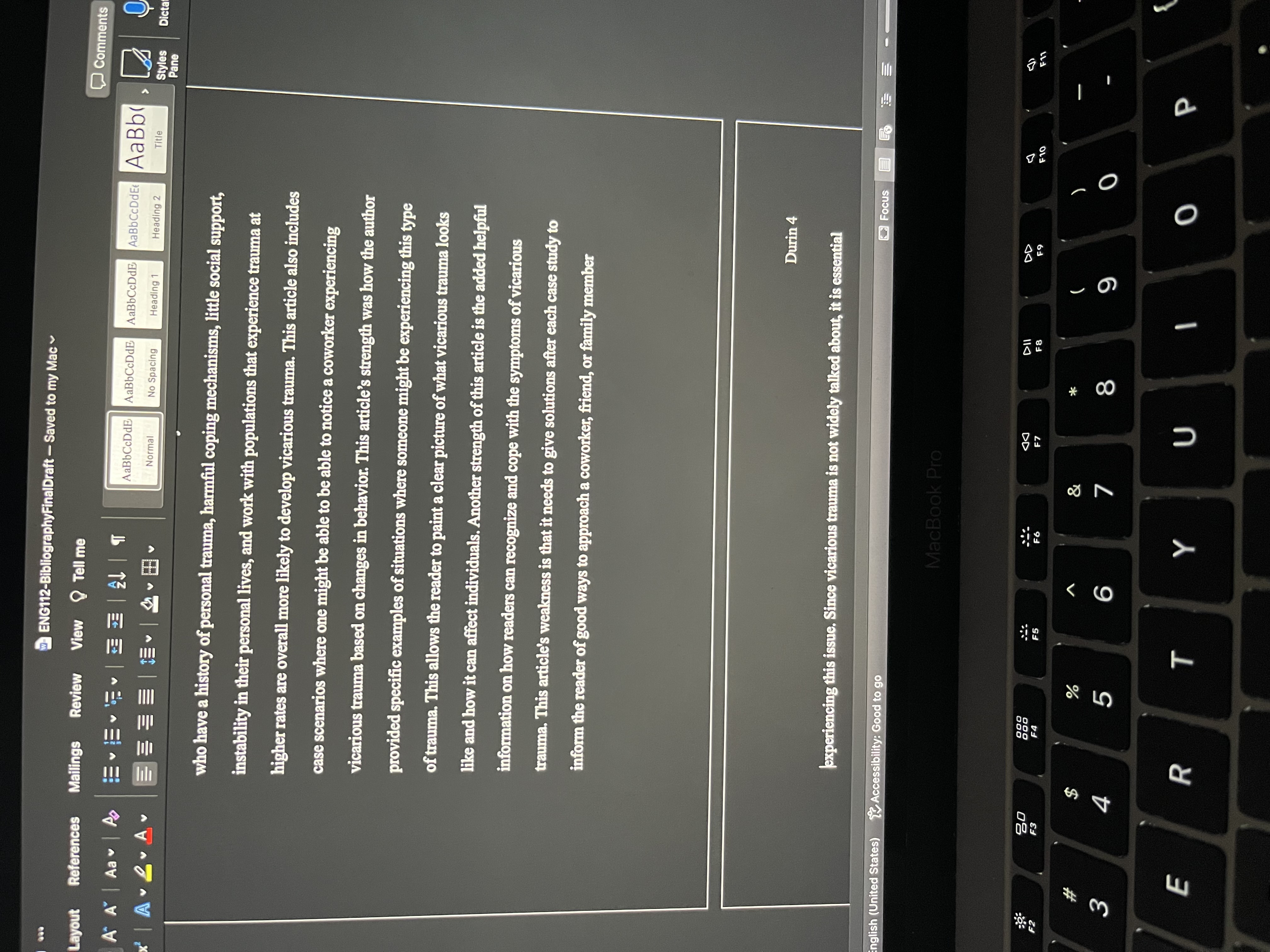
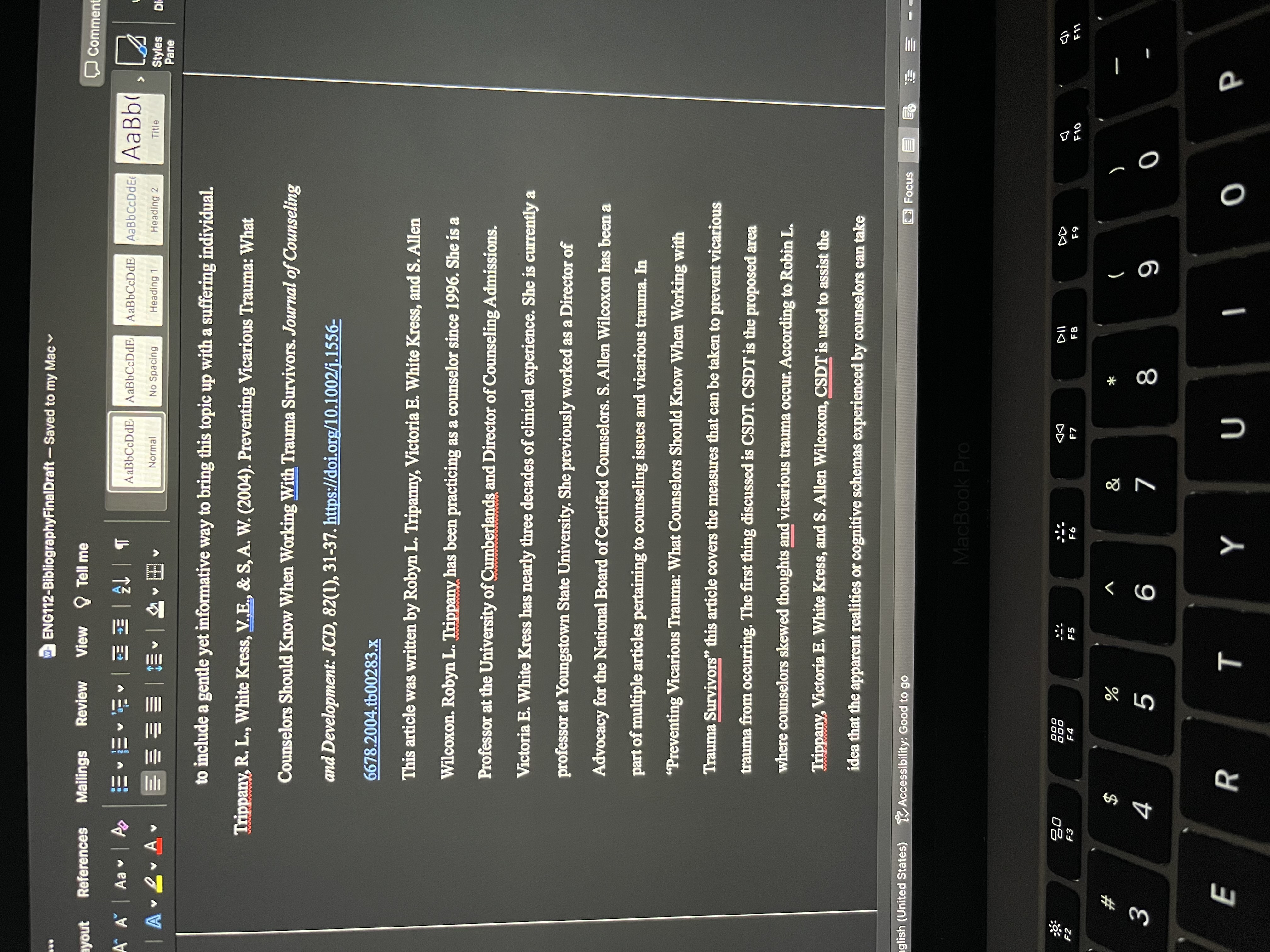
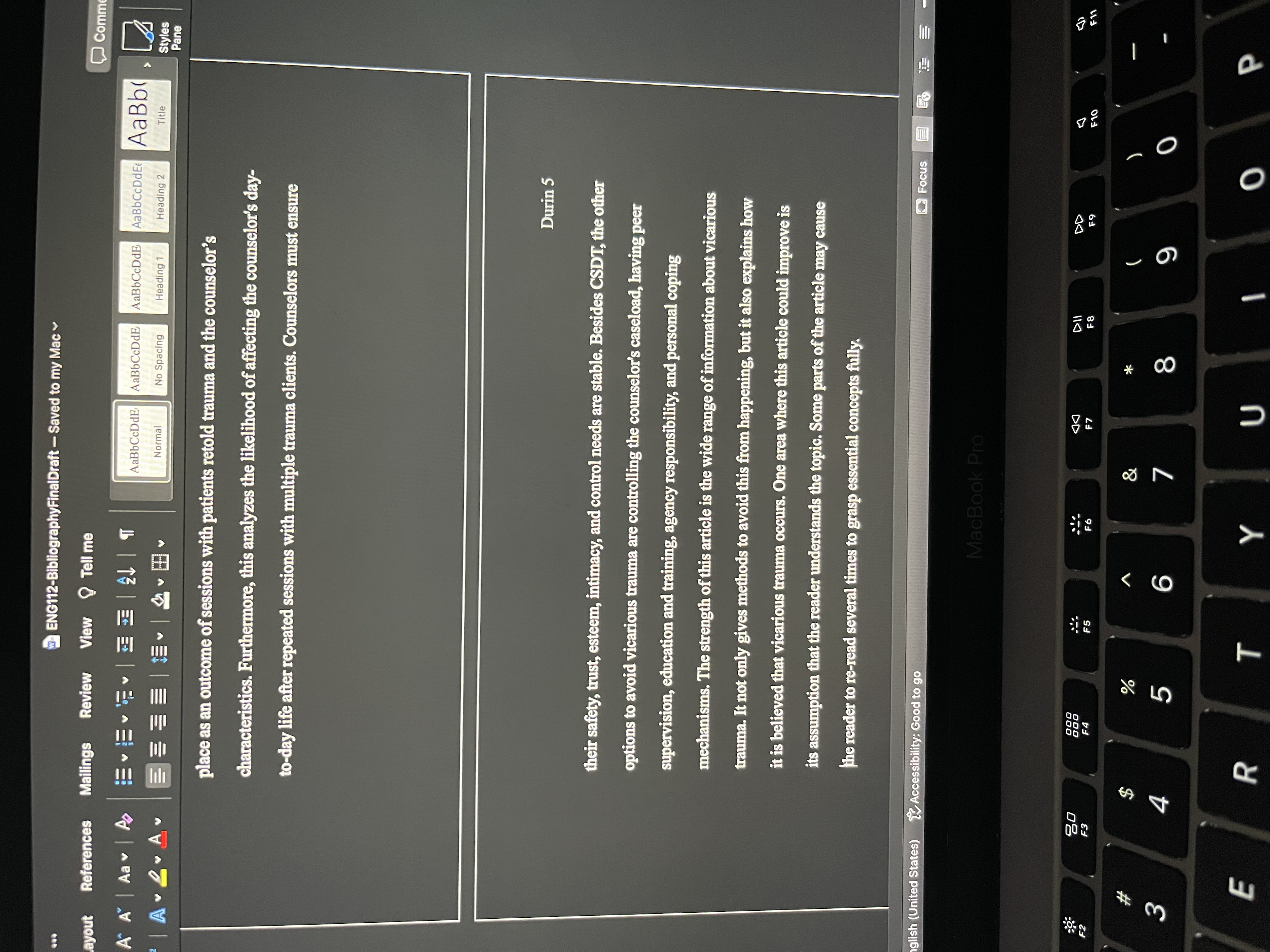
... ENG112-BibliographyFinalDraft - Saved to my Mac Layout References Mailings Review View ? Tell me Comments A" A | Aav Ap AaBbCcDdE AaBbCcDdE AaBbCcDdE AaBbCcDdE AaBb( Av LV Av Normal No Spacing Heading 1 Heading 2 Title Styles Dictate Pane References British Medical Association. (2022, January 17). Vicarious trauma: signs and strategies for coping. The British Medical Association Trade Union and Professional Body for Doctors in the UK. https://www.bma.org.uk/advice-and-support/your- wellbeing/vicarious-trauma-signs-and-strategies-for-coping "Vicarious Trauma: Signs and Strategies for Coping" is an article by the British Medical Association. The British Medical Association (BMA) is a trade union for medical students and doctors in the United Kingdom. B.M.A. has been around since July 19th, 1832. B.M.A wrote an article talking about the signs and strategies for coping with vicarious trauma. The purpose of this article is to bring to light those who are empathetic with survivors of traumatic incidents, torture, and other related events about their trauma. It also aims to highlight the signs to look for regarding vicarious trauma and how to avoid experiencing it in the future. The signs that B.M.A have listed that could be signs of vicarious trauma are as follows. Some common telltale signs that individuals may experience when subjected to vicarious trauma are feeling angry, sad, or outraged about the victimization of patients, becoming too emotionally attached to patients, feeling guilty, and constantly thinking about patients outside of work hours. There are plenty more that they have listed as well to help identify even more signs. After listing the English (United States) Accessibility: Good to go Focus Co E - - MacBook Pro 80 889 DD F3 F6 DII F8 $ % 8 W 4 5 6 7 8 9 O E R T Y U O PDENG112-BibliographyFinalDraft - Saved to my Mac Layout References Mailings Review View ? Tell me Comments A" A | Aa | Ap AaBbCcDdE AaBbCcDdE AaBbCcDdE AaBbCcDdEE AaBb( X' | Av L Av Normal No Spacing Heading 1 Heading 2 Title Styles Dictate Pane common signs, the article then goes into the strategies for reducing the risk of vicarious trauma. The strengths of this article are the number of signs and strategies they have listed. The weakness is the lack of additional information, such as support groups. What is Vicarious Trauma? (n.d.). Office for Victims of Crime. https://ovc.ojp.gov/program/vtt/what-is-vicarious-trauma This article that covers the ins and outs of vicarious trauma was written by the Office for Victims of Crime. The OVC was established in 1988; its goal is to direct funds to different states for victim assistance programs that assist individuals affected by a violent crime. "What is Vicarious Trauma?" This article explains vicarious trauma to someone who may not know or has never heard of it. This article also explains what happens to an individual if they suffer from it. O. V.C. uses the term vicarious trauma to describe the secondhand trauma that people working in victim services, law enforcement, emergency medical services, fire services, and other similar professions face as part of the trauma they see their clients and patients endure. The O. V.C. also breaks down different reactions that professionals in this service may experience and what they may mean. For example, the OVC states that there are three types of reactions: a negative reaction, a neutral reaction, and a positive reaction. The strength of this article is the vast information given about suggestions for family members and coworkers if they are English (United States) Accessibility: Good to go Focus - - MacBook Pro DO DD F8 % 3 4 5 6 V 8 9 O E R T Y U O P... ENG112-BibliographyFinalDraft - Saved to my Mac ~ gn Layout References Mailings Review View ? Tell me Comments A A | Aa | Ap AaBbCcDdE AaBbCcDdE AaBbCcDdE AaBbCcDdE AaBb( No Spacing Title Styles X X | Av L Av Normal Heading 1 Heading 2 Dicta Pane around an individual who is suffering from vicarious trauma. As for weaknesses, it would be that there is no case scenario given like the one my prior article used. Ravi, A., Gorelick, J., & Pal, H. (2021). Identifying and addressing vicarious trauma. American Durin 3 Family Physician, 103(9), 570-572. https://login.proxy189.nclive.org/login?url=https://www.proquest.com/scholarlyjournals/i dentifying-addressing-vicarious-trauma/docview/2519781095/se-2 Anita Ravi, Jessica Gorelick, and Harika Pal were the three individuals who participated in this article. Anita Ravi is a family medicine physician and the leader of the Purple Health Foundation. This non-profit foundation creates healthcare systems for individuals who suffer from gender-based violence. Jessica Gorelick, licensed counselor social English (United States) 1Accessibility: Good to go Focus MacBook Pro 20 DD F3 F7 F 11 # $ % 8 W 4 5 6 8 9 OENG112-BibliographyFinalDraft - Saved to my Mac Layout References Mailings Review View ? Tell me Comments A A | Aav | Pp AaBbCcDdE AaBbCcDdE AaBbCcDdE AaBbCcDdE AaBb( O | Av DAV Normal No Spacing Heading 1 Heading 2 Title Styles Dicta Pane who have a history of personal trauma, harmful coping mechanisms, little social support, instability in their personal lives, and work with populations that experience trauma at higher rates are overall more likely to develop vicarious trauma. This article also includes case scenarios where one might be able to be able to notice a coworker experiencing vicarious trauma based on changes in behavior. This article's strength was how the author provided specific examples of situations where someone might be experiencing this type of trauma. This allows the reader to paint a clear picture of what vicarious trauma looks like and how it can affect individuals. Another strength of this article is the added helpful information on how readers can recognize and cope with the symptoms of vicarious trauma. This article's weakness is that it needs to give solutions after each case study to inform the reader of good ways to approach a coworker, friend, or family member Durin 4 experiencing this issue. Since vicarious trauma is not widely talked about, it is essential nglish (United States) 1Accessibility: Good to go Focus Co MacBook Pro 30 888 DD FA F6 F11 % & W # 4 5 6 8 9 O E R T Y U O P-ENG112-BibliographyFinalDraft - Saved to my Mac ~ yout References Mailings Review View ? Tell me Commen A A Aa A AaBbCcDdE AaBbCcDdE AaBbCcDdE AaBbCcDdE AaBb( Av LAV Normal No Spacing Heading 1 Heading 2 Title Styles Pane to include a gentle yet informative way to bring this topic up with a suffering individual. Trippany, R. L., White Kress, V.,E., & S, A. W. (2004). Preventing Vicarious Trauma: What Counselors Should Know When Working With Trauma Survivors. Journal of Counseling and Development: JCD, 82(1), 31-37. https://doi.org/10.1002/j.1556- 6678.2004.tb00283.x This article was written by Robyn L. Tripanny, Victoria E. White Kress, and S. Allen Wilcoxon. Robyn L. Trippany has been practicing as a counselor since 1996. She is a Professor at the University of Cumberlands and Director of Counseling Admissions. Victoria E. White Kress has nearly three decades of clinical experience. She is currently a professor at Youngstown State University. She previously worked as a Director of Advocacy for the National Board of Certified Counselors. S. Allen Wilcoxon has been a part of multiple articles pertaining to counseling issues and vicarious trauma. In "Preventing Vicarious Trauma: What Counselors Should Know When Working with Trauma Survivors" this article covers the measures that can be taken to prevent vicarious trauma from occurring. The first thing discussed is CSDT. CSDT is the proposed area where counselors skewed thoughts and vicarious trauma occur. According to Robin L. Trippany, Victoria E. White Kress, and S. Allen Wilcoxon, CSDT is used to assist the idea that the apparent realities or cognitive schemas experienced by counselors can take glish (United States) 1 Accessibility: Good to go FocusCo MacBook Pro DII DD A F10 F11 % 3 A b 6 8 9 O E R T Y U O PENG112-BibliographyFinalDraft - Saved to my Mac ayout References Mailings Review View ? Tell me Comm A" A | Aav | Po AaBbCcDdE AaBbCcDdE AaBbCcDdE AaBbCCDdE AaBb( | Av LAV Normal No Spacing Heading 1 Heading 2 Title Styles Pane place as an outcome of sessions with patients retold trauma and the counselor's characteristics. Furthermore, this analyzes the likelihood of affecting the counselor's day- to-day life after repeated sessions with multiple trauma clients. Counselors must ensure Durin 5 their safety, trust, esteem, intimacy, and control needs are stable. Besides CSDT, the other options to avoid vicarious trauma are controlling the counselor's caseload, having peer supervision, education and training, agency responsibility, and personal coping mechanisms. The strength of this article is the wide range of information about vicarious trauma. It not only gives methods to avoid this from happening, but it also explains how it is believed that vicarious trauma occurs. One area where this article could improve is its assumption that the reader understands the topic. Some parts of the article may cause the reader to re-read several times to grasp essential concepts fully. glish (United States) 1 Accessibility: Good to go Focus MacBook Pro 20 DD F3 FA F5 F6 F7 FQ F 10 # & PK 4 5 6 8 9 O E R T Y U O Pw.Project 2 Prompt (opens as a Word .docx) - Saved to my Mac ... Layout References Mailings Review View ? Tell me Comme A A | Aa | Ap AaBbCcDdEE AaBbCcDdEe AaBbCcDd AaBbCcDd AaBbCcDdE No Spacing Heading 1 Heading 2 Heading 3 Av LAV Normal Style Pane ENG 112 - Project 2 - Discourse Community Analysis Purpose: [The purpose of creating a discourse community analysis is to become familiar with how a particular discourse community communicates to meet the members' needs and goals. Understanding how communication works within a discourse community will allow us to better understand how we can add our voices to the discourse community. Goals: Create an academic essay (minimum of 1,200 words and no more than 1,350) analyzing rhetorical concepts including audience, purpose, genre, context, and language. Incorporate a minimum of four sources (two sources must be from Wake Tech's databases) Apply correct APA or MLA formatting to the document, in-text citations, and Works Cited/Reference citations. Consider which format your discipline aligns with and work with that format. If you decide to continue with APA, make sure to include a cover page. You will not need to create an abstract. Understand and apply standard written English. Use appropriate vocabulary and avoid mechanical and grammatical errors. Make sure to proofread and edit your material before submitting for assessment. Assignment: To complete this assignment, you'll analyze how people connect and share knowledge to better understand how the chosen discourse community works. You will review four sources (you can use the sources from your bibliography or ncorporate some new sources if necessary). Process: Review your sources from your annotated bibliography to see if they are relevant or if you need to fill in gaps with additional information. Gather additional sources if necessary. . Read or reread your sources, noting elements of the rhetorical situation and more detailed elements such as evidence, language, genre, etc. The "Textual Patterns" questions that follow can help guide your observations. . After you've gained some sense of patterns, conventions, and commonalities in the texts, analyze those trends to get a better understanding of how discourse works in your field. See the "Analysis" questions that follow to get a sense of potential "big picture" conclusions you might reach about communication in your field. Be sure to offer a lot of textual evidence to back up your observations. For example, don't just say a text from your field uses language for a general audience. Cite phrases and concrete examples since your reader will not have access to the actual texts. Please see the PowerPoint, "Erin's Discourse Analysis" in our weekly Instruction folder for more information on completing the project. This PowerPoint shows how to evaluate and analyze vour sources. It also English (United States) 1Accessibility: Good to go Focus Co E MacBook Pro 24 F5 67 DD F8 FO A F 10 FM1 $ & 3 4 5 6 8 9 O E R T Y U O P DProject 2 Prompt (opens as a Word .docx) - Saved to my Mac v Layout References Mailings Review View ? Tell me Comments A A Aa Ap AaBbCcDdEE AaBbCcDdEe AaBbCcDd AaBbCcDd AaBbCcDdE AvLAV Normal No Spacing Heading 1 Heading 2 Heading 3 Styles Dict Pane offers a sample thesis statement and outline for the project. Two very important points: 1) Rather than focus on content like you might be used to doing, this project asks you to focus on how that content is shared. In other words, don't spend too much time looking at the ideas in the texts. Look at the ways the ideas are shared. 2) Instead of just listing patterns and conventions in your discourse, make sure that you analyze those elements. Use your observations to draw conclusions about how communication works in your field. Need Help? As always, please do not hesitate to reach out to me if you have any questions or need help. Also, don't forget to use the ILC and the REAL Center for extra support. 112-Williams Page 2 of 2 Textual Patterns Questions Writers Who are the speakers in your texts? What are their backgrounds? What are their levels of expertise? How biased or credible are the authors? Audience Who reads the texts? What beliefs and values might audience members have? What level of knowledge do they have? Why are they reading these texts? To what degree would these texts be understood by a broad audience? By a specialist group? Purpose What is the purpose of these writings (inform, persuade, inspire, challenge an existing mindset, share new research, etc.)? Why might the authors invest the time to write and share this information? English (United States) Accessibility: Good to go Focus = MacBook Pro DD F8 A F9 F11 $ % W # 4 5 6 8 9 O E R T Y U O PProject 2 Prompt (opens as a Word .docx) - Saved to my Mac v Layout References Mailings Review View ? Tell me A A Aa Ap AaBbCcDdEE AaBbCcDdEe AaBbCcDd AaBbCcDd AaBbCcDdE X, X' | Av L Av Normal No Spacing Heading 1 Heading 2 Heading 3 Style Pan What should readers do after reading these texts? Evidence/Content What types of evidence (facts, data, anecdotes, etc.) might the audience find persuasive? What types of genres are consulted frequently for evidence? How does the discourse community document sources? How many sources are cited and what types of sources does the discourse community privilege? How in-depth or general is the information shared? What ideas do the authors spend the most time developing? Language What level of formality does the language exhibit? What vocabulary words or jargon appear frequently in the texts? Genre What patterns in layout and structure do you see in the texts? Subsections? How is the information organized? What does the author do 1st, 2nd, 3rd? What are the most common genres consulted? What types of visuals do the texts contain? Analysis Questions: How does the discourse community use elements of communication to meet its goals and purposes? How does the discourse work for its audience or, how does the discourse fail to meet its audience's needs? What are some of the key values and beliefs of the discourse community? What are the goals of the discourse community? How does one demonstrate expertise in the discourse community and what makes one a novice community member? Why might your discourse community prefer certain forms and structures over others? Whose voices are left out of the discourse community? How can you contribute to your discourse community? If one were to "read the room" of your discourse community, what would that room look like?- What sets your discourse community apart from other discourse communities? Did you find anything in your analysis that challenged how outsiders might view your field? English (United States) Accessibility: Good to go Focus MacBook Pro 20 DD F3 F5 F6 F8 F9 F10 # $ % 4 5 6 7 8 9 O E R T Y U O P
Step by Step Solution
There are 3 Steps involved in it
1 Expert Approved Answer
Step: 1 Unlock
Question Has Been Solved by an Expert!
Get step-by-step solutions from verified subject matter experts
Step: 2 Unlock
Step: 3 Unlock
Students Have Also Explored These Related Business Writing Questions!









 Study Help