







Question: I need help in this question. Please do it neat and clean on paper. Please do it 100% correctly - I have posted solution below
I need help in this question. Please do it neat and clean on paper. Please do it 100% correctly - I have posted solution below which i find out but i want to draw diagrams and everything on paper. Please draw it on paper Dear i need to solve on paper THIS IS QUESTION

This is solution which i have already, i posted for your help: PLEASE MUST SOLVE ON paper especially the diagrams, I do not know how to draw them
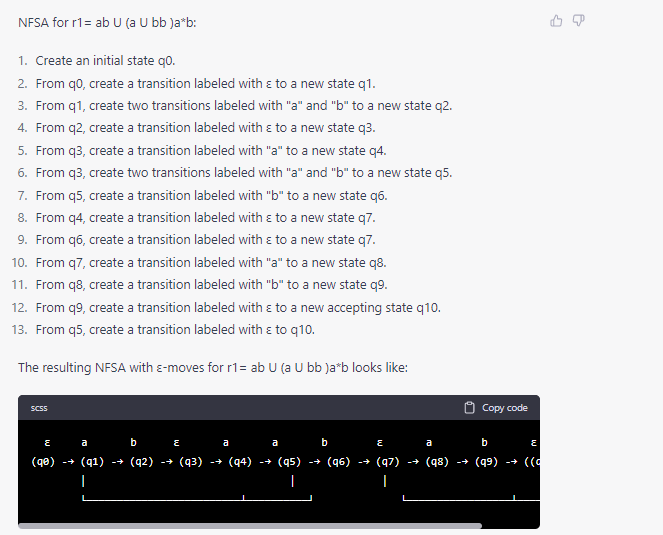
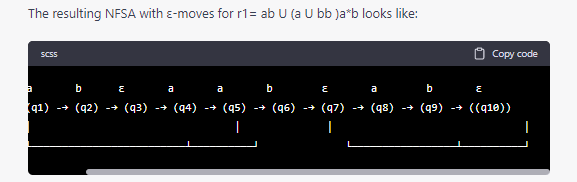
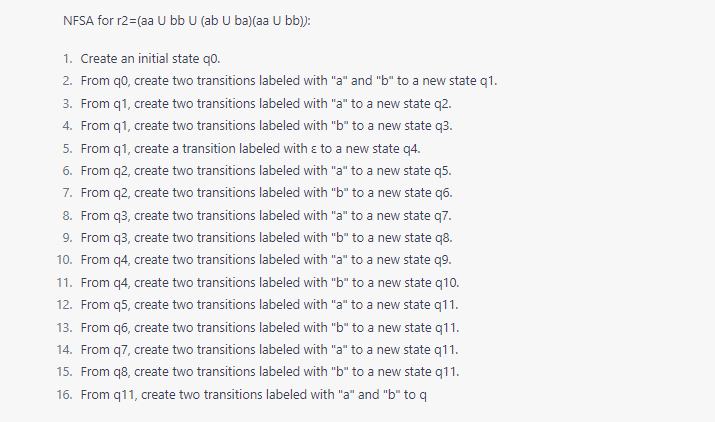
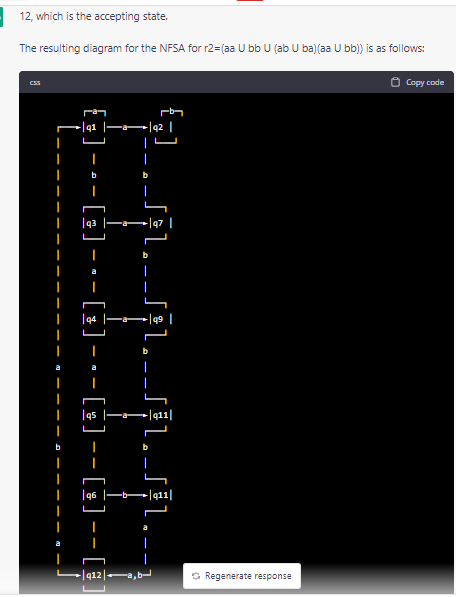
Convert the following regular expression to an NFSA with -moves (using what we studied in class) r1=ab(abb)abr2=(aabb(abba)(aabb)) NFSA for r1=ab(abb)ab : 1. Create an initial state q0. 2. From q0, create a transition labeled with to a new state q1. 3. From q1, create two transitions labeled with "a" and "b" to a new state q2. 4. From q2 2, create a transition labeled with to a new state q3. 5. From q3, create a transition labeled with "a" to a new state q4. 6. From q3, create two transitions labeled with "a" and "b" to a new state q5. 7. From q5, create a transition labeled with " b " to a new state q6. 8. From q4, create a transition labeled with to a new state q7. 9. From q6, create a transition labeled with to a new state q7. 10. From q7, create a transition labeled with "a" to a new state q8. 11. From q8, create a transition labeled with "b" to a new state q9. 12. From q9, create a transition labeled with to a new accepting state q10. 13. From q5, create a transition labeled with to q10. The resulting NFSA with -moves for r1=abU(aUbb)ab looks like: The resulting NFSA with -moves for r1=ab(abb)ab looks like: NFSA for r2=(aabb(abba)(aabb)) : 1. Create an initial state q0. 2. From q0, create two transitions labeled with "a" and "b" to a new state q1. 3. From q1, create two transitions labeled with "a" to a new state q2. 4. From q1, create two transitions labeled with "b" to a new state q3. 5. From q1, create a transition labeled with to a new state q4. 6. From q2, create two transitions labeled with "a" to a new state q5. 7. From q2, create two transitions labeled with "b" to a new state q6. 8. From q3, create two transitions labeled with "a" to a new state q7. 9. From q3, create two transitions labeled with "b" to a new state q8. 10. From q4, create two transitions labeled with "a" to a new state q9. 11. From q4, create two transitions labeled with "b" to a new state q10. 12. From q5, create two transitions labeled with "a" to a new state q11. 13. From q6, create two transitions labeled with "b" to a new state q11. 14. From q7, create two transitions labeled with "a" to a new state q11. 15. From q8, create two transitions labeled with "b" to a new state q11. 16. From q11, create two transitions labeled with "a" and "b" to q 12 , which is the accepting state. The resulting diagram for the NFSA for r2=(aabb(abba)(aabb)) is as follows
Step by Step Solution
There are 3 Steps involved in it

Get step-by-step solutions from verified subject matter experts
 Study Help