







Question: I need help! Much appreciated!!! The graph below depicts the market for rice in the country of India. Price (S] 2 EX Quantity per period
I need help! Much appreciated!!!
![rice in the country of India. Price (S] 2 EX Quantity per](https://s3.amazonaws.com/si.experts.images/answers/2024/07/6686912ab9bc5_0186686912aaa8a4.jpg)
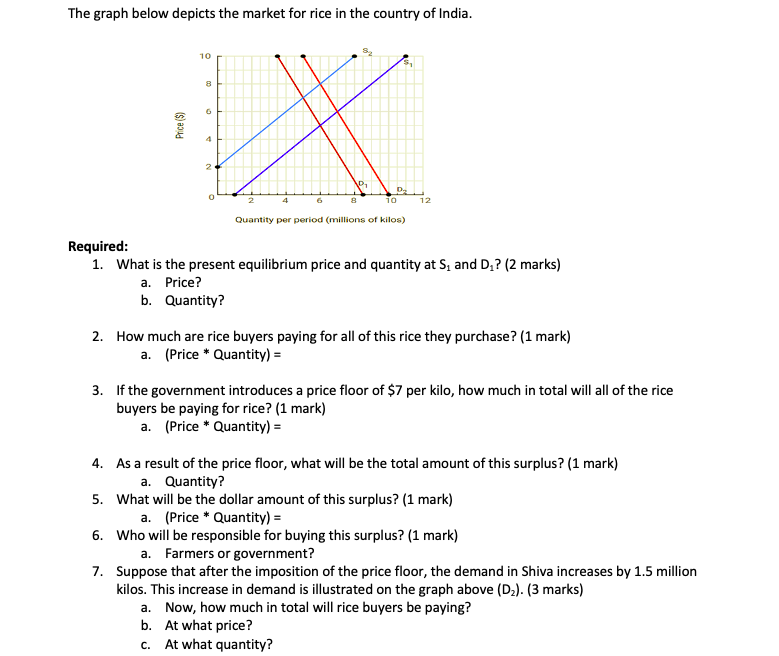
The graph below depicts the market for rice in the country of India. Price (S] 2 EX Quantity per period (millions of kilos) Required: 1. What is the present equilibrium price and quantity at S, and D,? (2 marks) a. Price? b. Quantity? 2. How much are rice buyers paying for all of this rice they purchase? (1 mark) a. (Price * Quantity) = 3. If the government introduces a price floor of $7 per kilo, how much in total will all of the rice buyers be paying for rice? (1 mark) a. (Price * Quantity) = 4. As a result of the price floor, what will be the total amount of this surplus? (1 mark) a. Quantity? 5. What will be the dollar amount of this surplus? (1 mark) a. (Price * Quantity) = 6. Who will be responsible for buying this surplus? (1 mark) a. Farmers or government? 7. Suppose that after the imposition of the price floor, the demand in Shiva increases by 1.5 million kilos. This increase in demand is illustrated on the graph above (D2). (3 marks) a. Now, how much in total will rice buyers be paying? b. At what price? c. At what quantity?8. After the change in demand, what would happen if, as a result of a bad harvest, the supply now decreases by three million kilos? This is illustrated by the new supply curve on the graph above called S2. (3 marks) a. What will be the new price, b. What will be the new quantity traded, c. How much will buyers spend? (Price * Quantity) = 9. What function do price ceilings and price floors have in our economy? Why does the government impose them? (2 marks)
Step by Step Solution
There are 3 Steps involved in it

Get step-by-step solutions from verified subject matter experts
 Study Help