Question: I need help solving these 12 problems 1. Which of the following is an internal control over cash designed to avoid theft or fraud? S
I need help solving these 12 problems
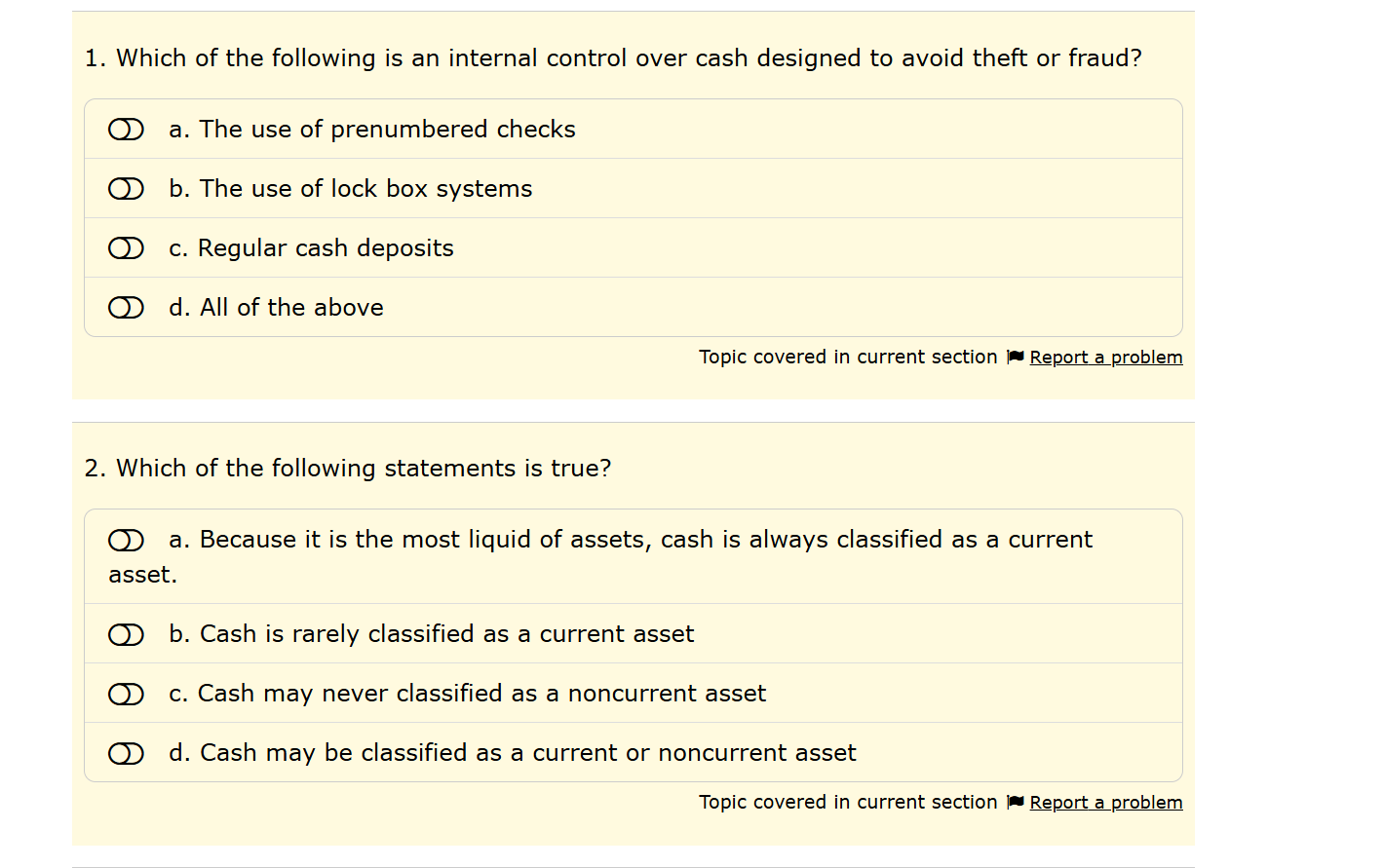
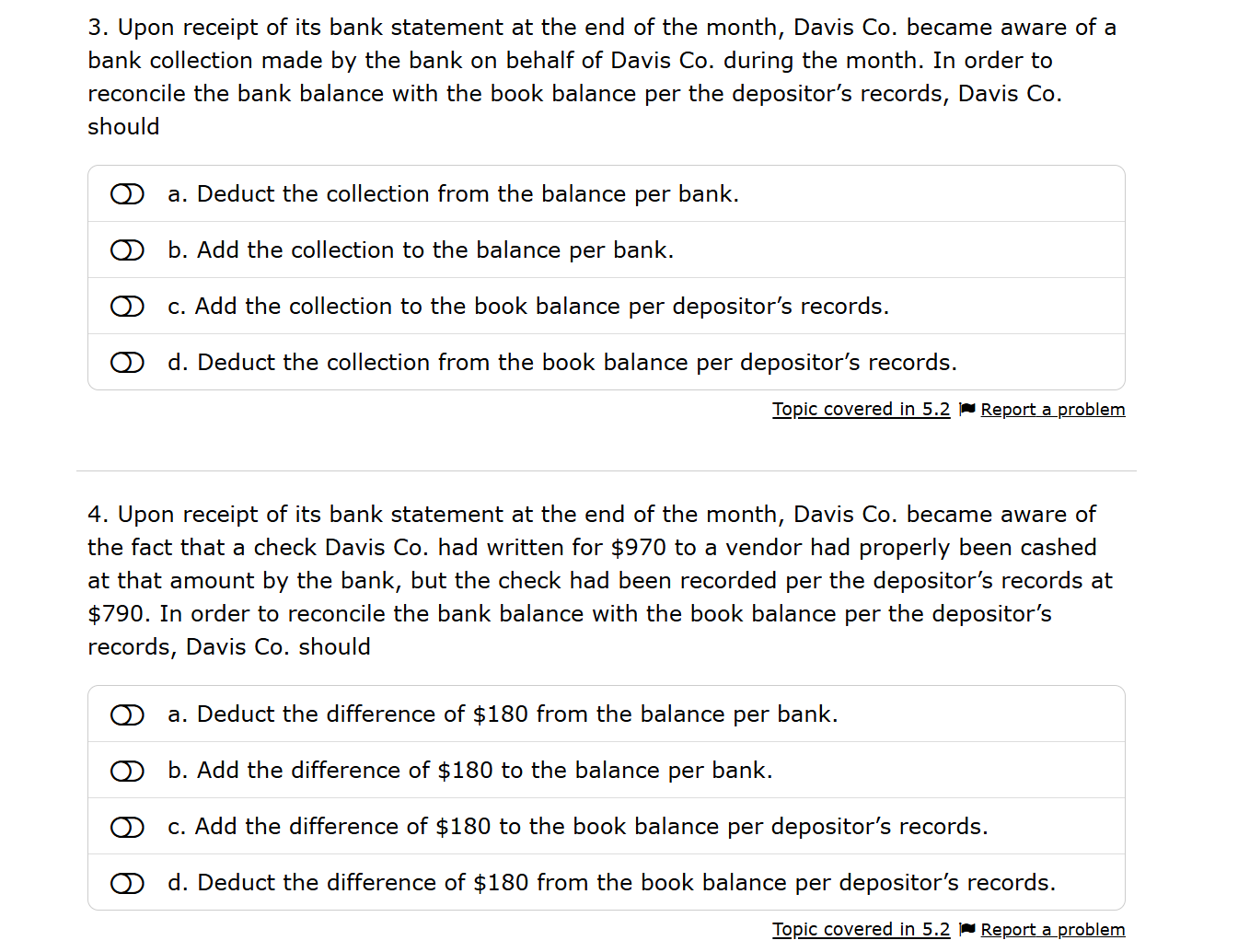
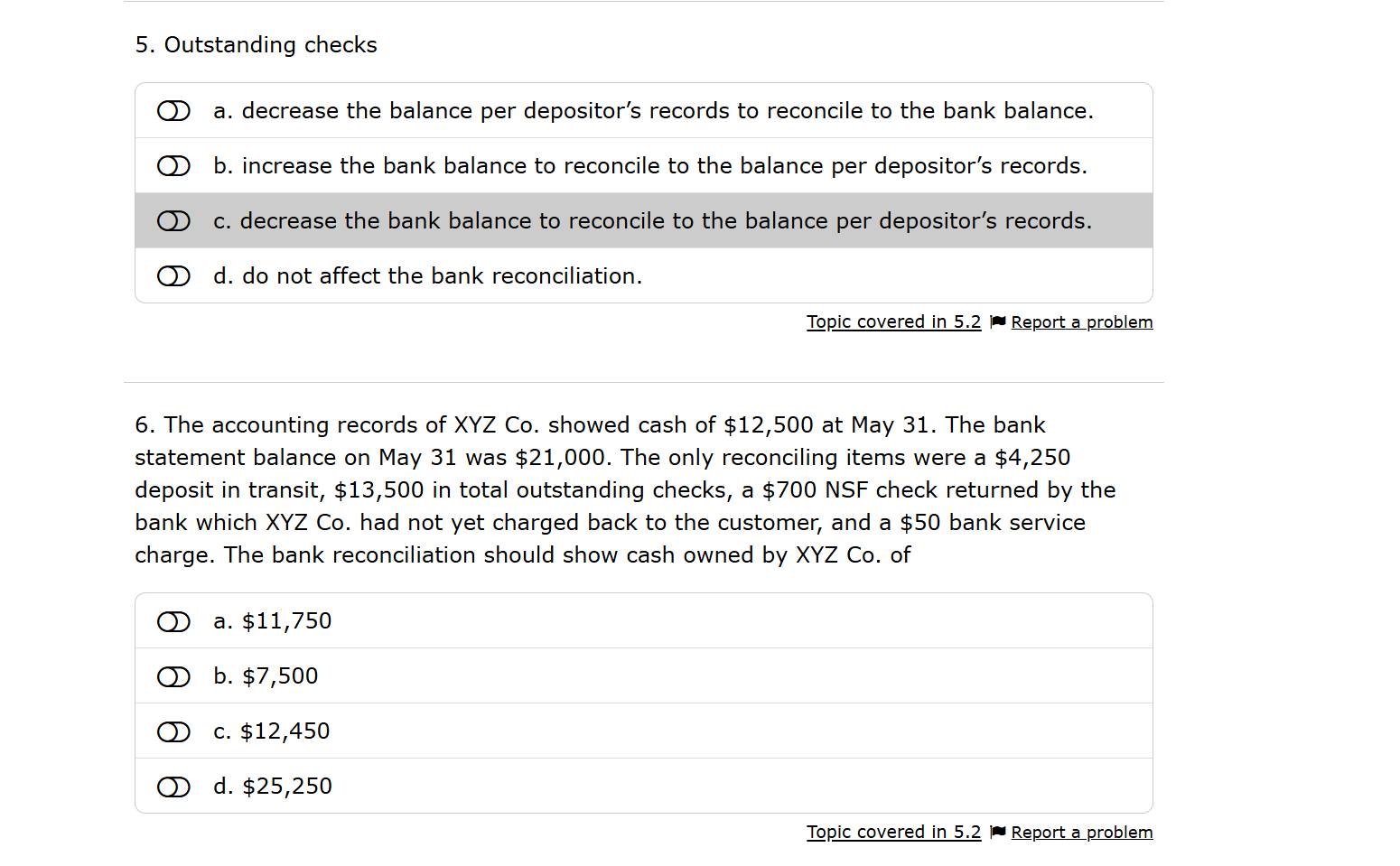
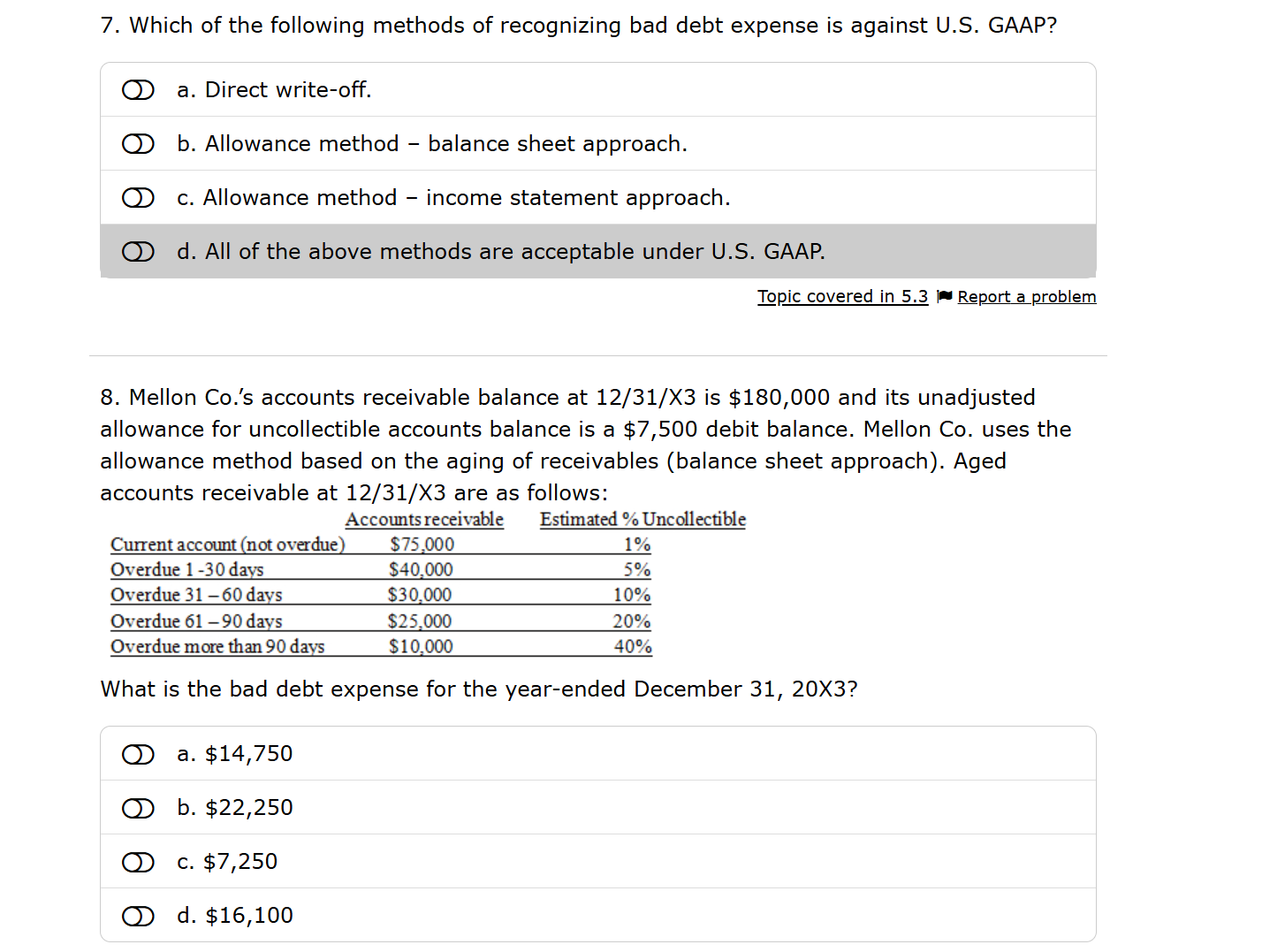
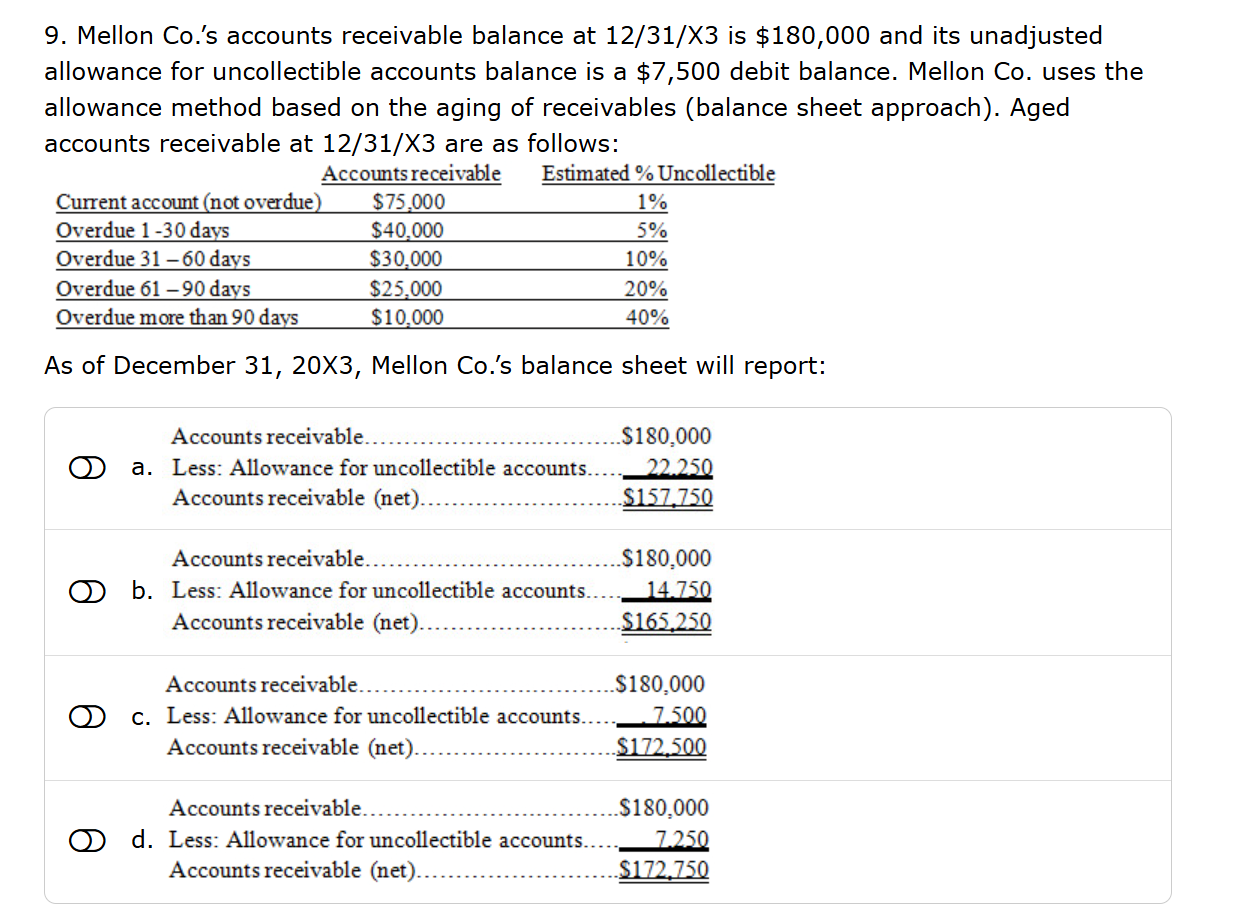
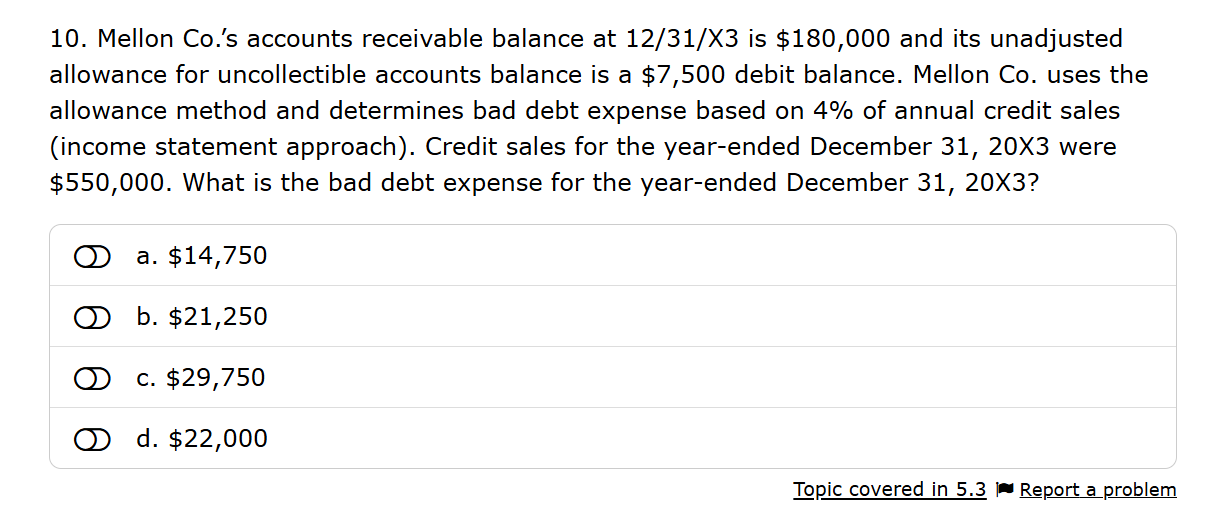
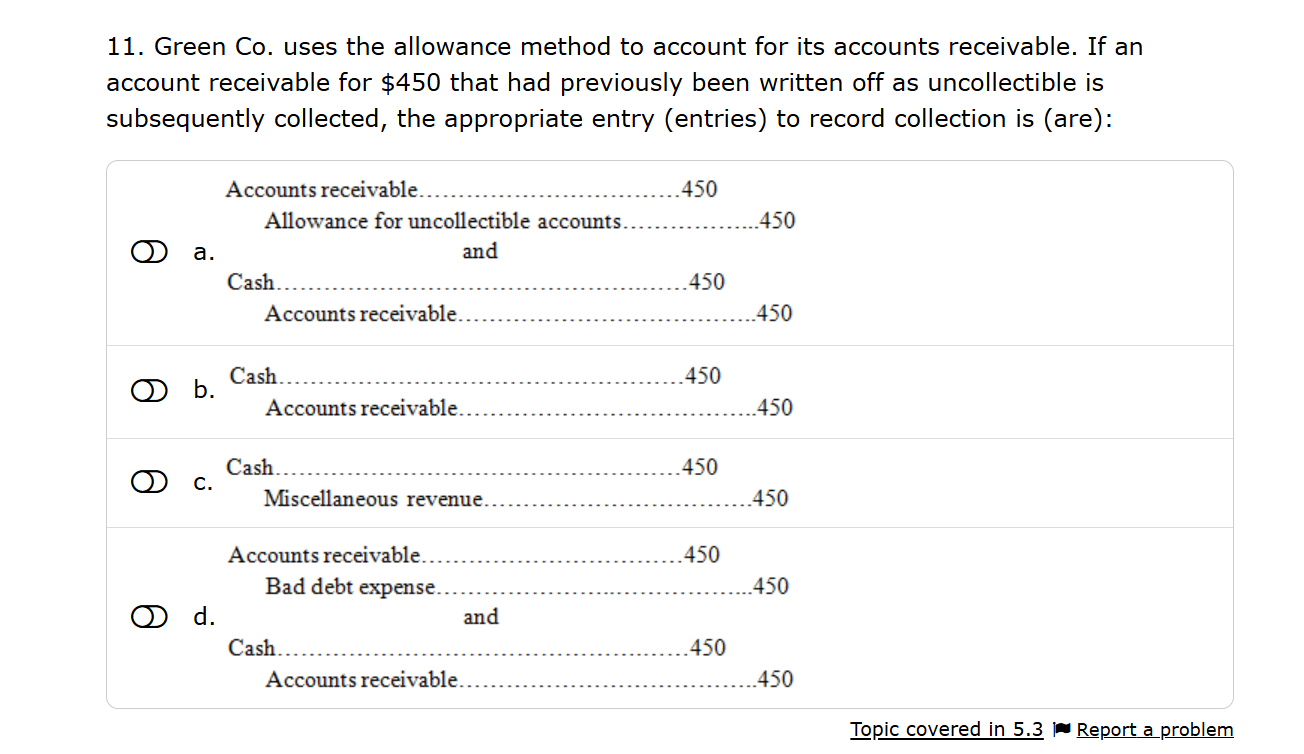
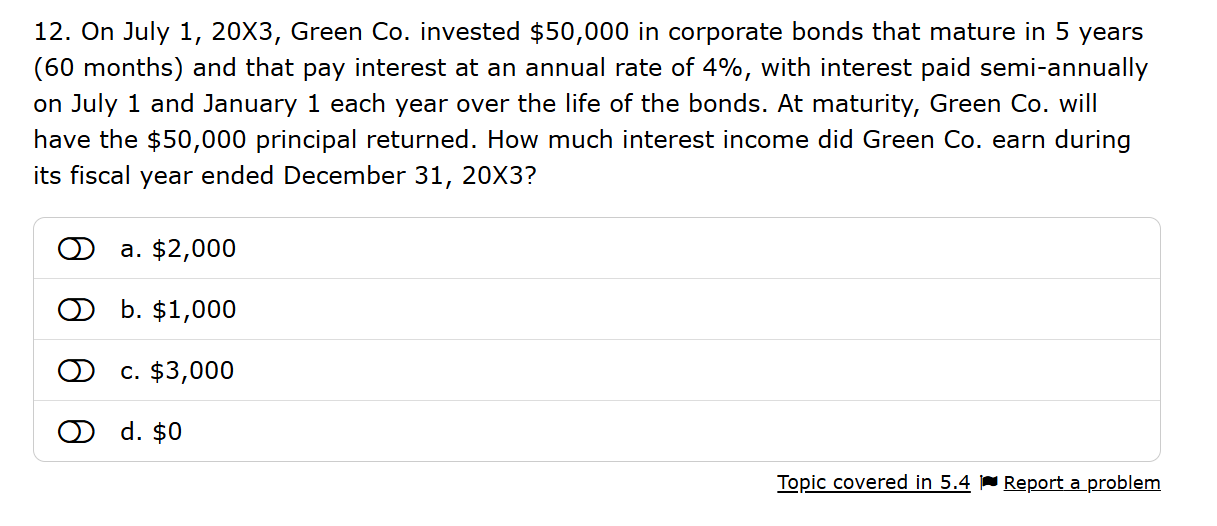
1. Which of the following is an internal control over cash designed to avoid theft or fraud? S a. The use of prenumbered checks b. The use of lock box systems c. Regular cash deposits 0 8 06 d. All of the above Topic covered in current section Report a problem 2. Which of the following statements is true? (> a. Because it is the most liquid of assets, cash is always classified as a current asset. ( b. Cash is rarely classified as a current asset (> c. Cash may never classified as a noncurrent asset (> d. Cash may be classified as a current or noncurrent asset Topic covered in current section Report a problem 3. Upon receipt of its bank statement at the end of the month, Davis Co. became aware of a bank collection made by the bank on behalf of Davis Co. during the month. In order to reconcile the bank balance with the book balance per the depositor's records, Davis Co. should (> a. Deduct the collection from the balance per bank. b. Add the collection to the balance per bank. c. Add the collection to the book balance per depositor's records. 9 8 6 d. Deduct the collection from the book balance per depositor's records. Topic covered in 5.2 / Report a problem 4. Upon receipt of its bank statement at the end of the month, Davis Co. became aware of the fact that a check Davis Co. had written for $970 to a vendor had properly been cashed at that amount by the bank, but the check had been recorded per the depositor's records at $790. In order to reconcile the bank balance with the book balance per the depositor's records, Davis Co. should (O a. Deduct the difference of $180 from the balance per bank. (@ b. Add the difference of $180 to the balance per bank. @ c. Add the difference of $180 to the book balance per depositor's records. (@ d. Deduct the difference of $180 from the book balance per depositor's records. Topic covered in 5.2 / Report a problem 5. Qutstanding checks (@ a. decrease the balance per depositor's records to reconcile to the bank balance. @ b. increase the bank balance to reconcile to the balance per depositor's records. (@ c. decrease the bank balance to reconcile to the balance per depositor's records. () d. do not affect the bank reconciliation. Topic covered in 5.2 Report a problem 6. The accounting records of XYZ Co. showed cash of $12,500 at May 31. The bank statement balance on May 31 was $21,000. The only reconciling items were a $4,250 deposit in transit, $13,500 in total outstanding checks, a $700 NSF check returned by the bank which XYZ Co. had not yet charged back to the customer, and a $50 bank service charge. The bank reconciliation should show cash owned by XYZ Co. of @ a. $11,750 D b. $7,500 D c. $12,450 Q@ d. $25,250 Topic covered in 5.2 Report a problem 7. Which of the following methods of recognizing bad debt expense is against U.S. GAAP? a. Direct write-off. b. Allowance method - balance sheet approach. c. Allowance method - income statement approach. d. All of the above methods are acceptable under U.S. GAAP. Topic covered in 5.3 |~ Report a problem 8. Mellon Co.'s accounts receivable balance at 12/31/X3 is $180,000 and its unadjusted allowance for uncollectible accounts balance is a $7,500 debit balance. Mellon Co. uses the allowance method based on the aging of receivables (balance sheet approach). Aged accounts receivable at 12/31/X3 are as follows: Accounts receivable Estimated % Uncollectible Current account (not overdue $75.000 1% Overdue 1-30 days $40,000 5% Overdue 31 -60 days $30,000 10% Overdue 61 -90 days $25,000 20% Overdue more than 90 days $10,000 40% What is the bad debt expense for the year-ended December 31, 20X3? O a. $14,750 O b. $22,250 O c. $7,250 O d. $16,1009. Mellon Co.'s accounts receivable balance at 12/31/X3 is $180,000 and its unadjusted allowance for uncollectible accounts balance is a $7,500 debit balance. Mellon Co. uses the allowance method based on the aging of receivables (balance sheet approach). Aged accounts receivable at 12/31/X3 are as follows: Accounts receivable Estimated % Uncollectible Current account (not overdue) $ 75.000 1% Overdue 1-30 days $40,000 5% Overdue 31 -60 days $30,000 10% Overdue 61 -90 days $25,000 20% Overdue more than 90 days $10,000 40% As of December 31, 20X3, Mellon Co.'s balance sheet will report: Accounts receivable.. $180,000 a. Less: Allowance for uncollectible accounts..... 22.250 Accounts receivable (net). $157,750 Accounts receivable... $180,000 b. Less: Allowance for uncollectible accounts.... 14.750 Accounts receivable (net). $165,250 Accounts receivable. $180,000 c. Less: Allowance for uncollectible accounts..... 7.500 Accounts receivable (net).. $172,500 Accounts receivable. $180,000 d. Less: Allowance for uncollectible accounts..... 7.250 Accounts receivable (net).. $172,75010. Mellon Co.'s accounts receivable balance at 12/31/X3 is $180,000 and its unadjusted allowance for uncollectible accounts balance is a $7,500 debit balance. Mellon Co. uses the allowance method and determines bad debt expense based on 4% of annual credit sales (income statement approach). Credit sales for the year-ended December 31, 20X3 were $550,000. What is the bad debt expense for the year-ended December 31, 20X3? O a. $14,750 b. $21,250 O c. $29,750 O d. $22,000 Topic covered in 5.3 |~ Report a problem11. Green Co. uses the allowance method to account for its accounts receivable. If an account receivable for $450 that had previously been written off as uncollectible is subsequently collected, the appropriate entry (entries) to record collection is (are): Accounts receivable.. 450 Allowance for uncollectible accounts. 450 O a. and Cash. 450 Accounts receivable. 450 b, Cash. 450 Accounts receivable. 450 c. Cash. .450 Miscellaneous revenue. .450 Accounts receivable.. .450 Bad debt expense. .450 Od. and Cash. 450 Accounts receivable. 450 Topic covered in 5.3 |~ Report a problem12. On July 1, 20X3, Green Co. invested $50,000 in corporate bonds that mature in 5 years (60 months) and that pay interest at an annual rate of 4%, with interest paid semi-annually on July 1 and January 1 each year over the life of the bonds. At maturity, Green Co. will have the $50,000 principal returned. How much interest income did Green Co. earn during its fiscal year ended December 31, 20X3? Q a. $2,000 Q b. $1,000 Q c. $3,000 Q d. $0 Topic covered in 5.4 Report a
Step by Step Solution
There are 3 Steps involved in it
1 Expert Approved Answer
Step: 1 Unlock
Question Has Been Solved by an Expert!
Get step-by-step solutions from verified subject matter experts
Step: 2 Unlock
Step: 3 Unlock
Students Have Also Explored These Related Accounting Questions!









 Study Help