





Question: I need help to understand how to solve for #b? I need help to understand how to solve #d? Data collected on the yearly registrations

I need help to understand how to solve for #b?
I need help to understand how to solve for #b? II need help to understand how to solve #d?I need help to understand how to solve for #b? I
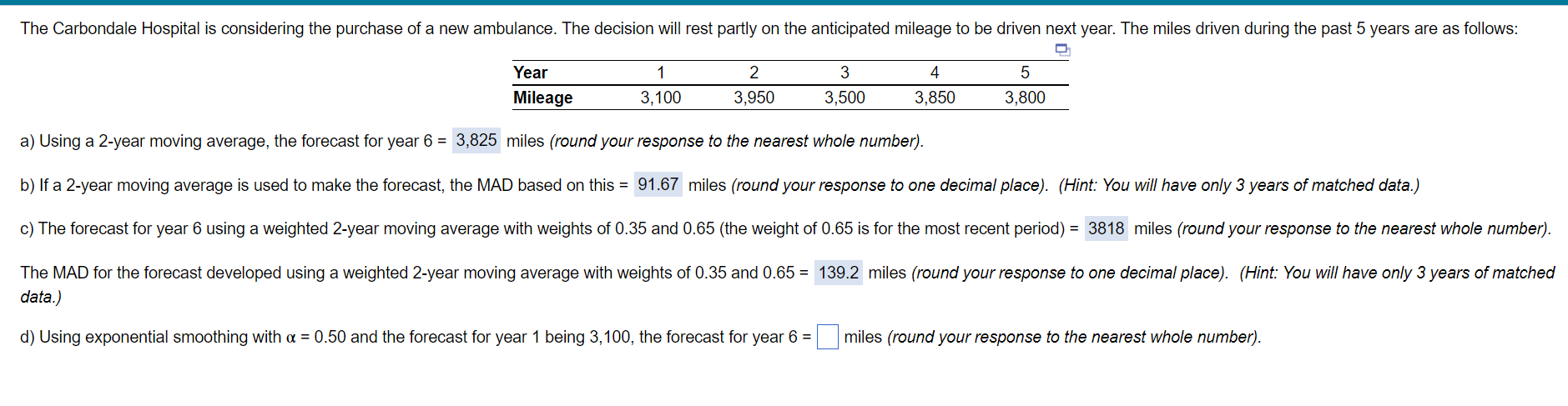
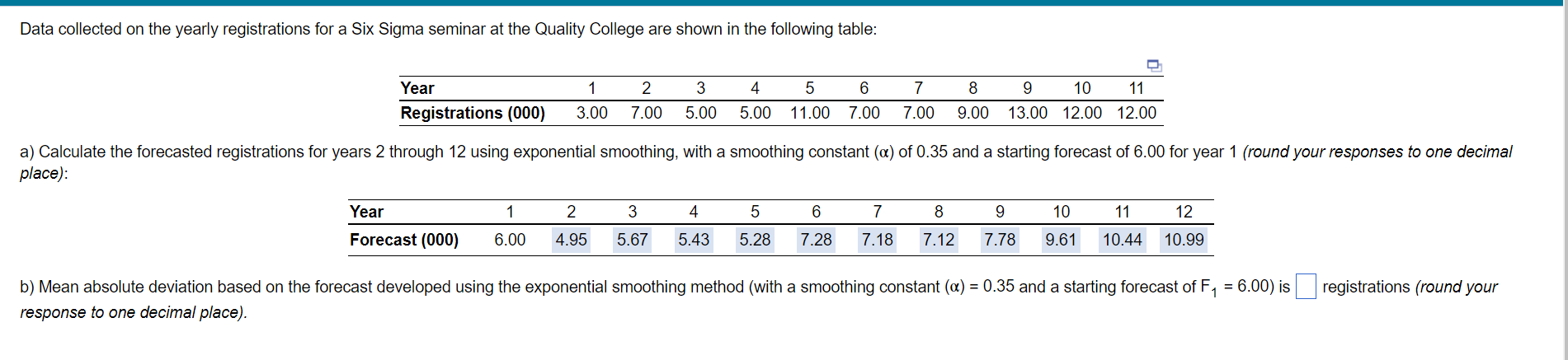
Data collected on the yearly registrations for a Six Sigma seminar at the Quality College are shown in the following table: Year 1 2 3 4 5 6 7 Registrations (000) 3.00 7.00 5.00 5.00 11.00 7.00 7.00 1 2 3 4 Year Forecast (000) 6.00 4.95 5.67 5.43 a) Calculate the forecasted registrations for years 2 through 12 using exponential smoothing, with a smoothing constant (x) of 0.35 and a starting forecast of 6.00 for year 1 (round your responses to one decimal place): 5 5.28 8 9.00 6 7.28 9 10 11 13.00 12.00 12.00 7 8 9 10 11 7.18 7.12 7.78 9.61 10.44 12 10.99 b) Mean absolute deviation based on the forecast developed using the exponential smoothing method (with a smoothing constant (x) = 0.35 and a starting forecast of F = 6.00) is response to one decimal place). registrations (round your The Carbondale Hospital is considering the purchase of a new ambulance. The decision will rest partly on the anticipated mileage to be driven next year. The miles driven during the past 5 years are as follows: D Year Mileage 1 3,100 2 3,950 3 3,500 4 3,850 5 3,800 a) Using a 2-year moving average, the forecast for year 6 = 3,825 miles (round your response to the nearest whole number). b) If a 2-year moving average is used to make the forecast, the MAD based on this = 91.67 miles (round your response to one decimal place). (Hint: You will have only 3 years of matched data.) c) The forecast for year 6 using a weighted 2-year moving average with weights of 0.35 and 0.65 (the weight of 0.65 is for the most recent period) = 3818 miles (round your response to the nearest whole number). The MAD for the forecast developed using a weighted 2-year moving average with weights of 0.35 and 0.65 = 139.2 miles (round your response to one decimal place). (Hint: You will have only 3 years of matched data.) d) Using exponential smoothing with = 0.50 and the forecast for year 1 being 3,100, the forecast for year 6 = miles (round your response to the nearest whole number)

Step by Step Solution

There are 3 Steps involved in it

1 Expert Approved Answer
Step: 1 Unlock blur-text-image

Question Has Been Solved by an Expert!

Get step-by-step solutions from verified subject matter experts

Step: 2 Unlock
Step: 3 Unlock

Students Have Also Explored These Related General Management Questions!