







Question: I need help with the report. How the group made decision and the effectiveness in preparing the presentation? Please thank you! Group Process Report Group
I need help with the report.
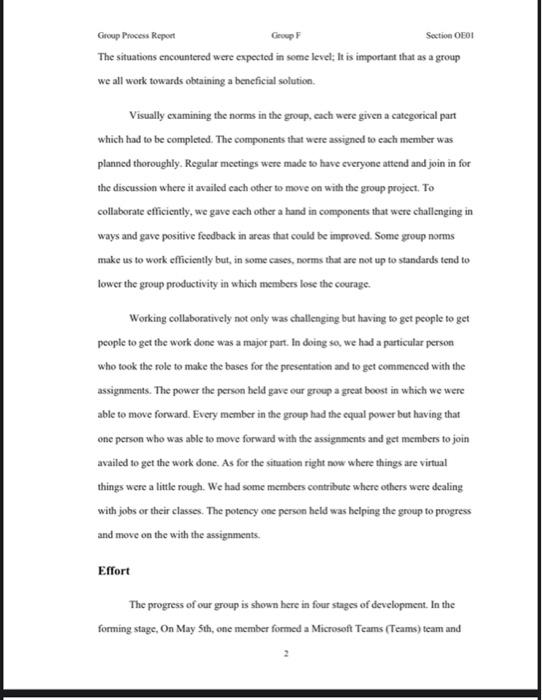
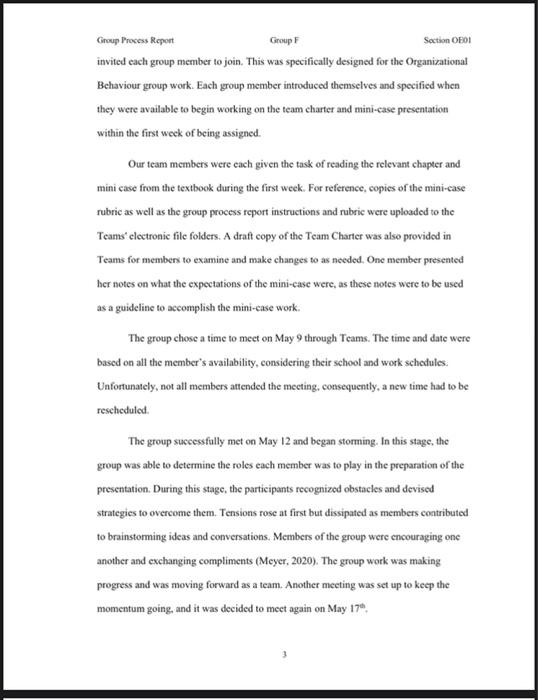
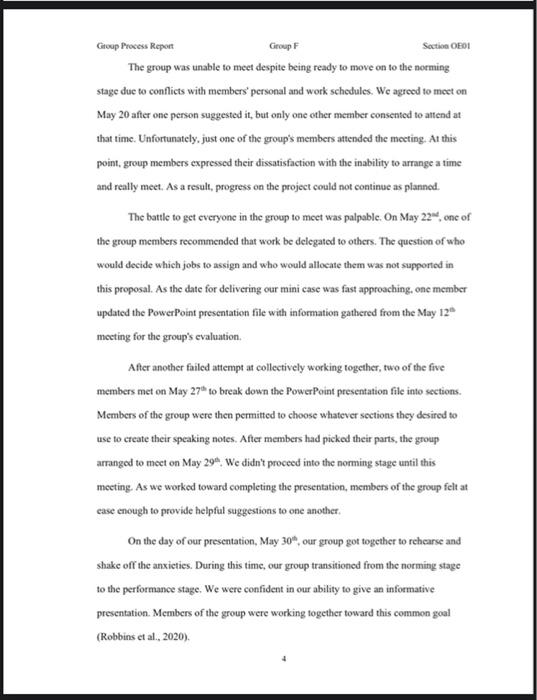
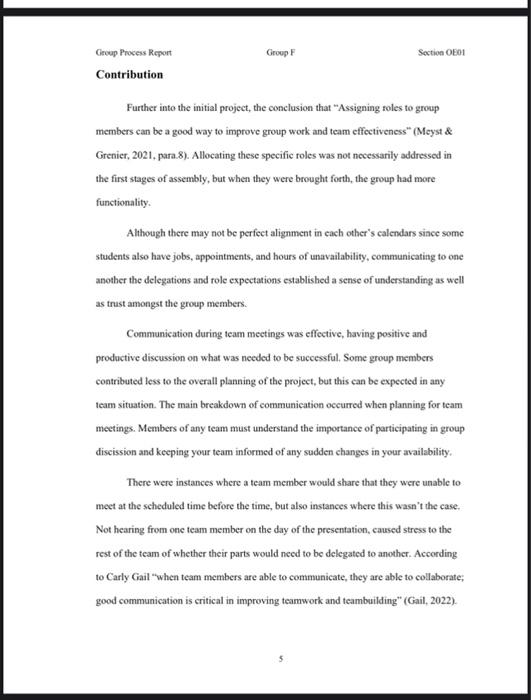
Group Process Report Group F Section OE01 INTRODUCTION Our group, consisting of five students from the Organizational Behaviour class, was formed to deliver two mini-case presentations and produce two group process reports. Group F created a team charter to assist in establishing group-building activities and nurturing group members, starting with the first mini case presentation. The team charter has acted as a roadmap for the group, illustrating concentration and providing direction. The first mini case assignment focused on career planning as a decision-making process. This topic allowed the group to learn more about decision-making and how it impacts individuals and managers in organizations. This report will examine how our group did during the preparation and presentation of the first mini-case presentation. Norms, stages of development, power, communications, and decision-making are the five concepts that our group will study. This report aims to provide the reader with an idea of how the group fared in completing the first mini-case presentation. METHODS AND FINDINGS Attitude Forming a five-member group whilst limited to a virtual classroom and group discussions was challenging. What our group seemed to struggle with the most was having the same schedule to meet at certain times on specific days. Factoring in the late acknowledgment on topics requiring immediate responses. This gave the perception to other members that they did not have the same outlook on what this class meant to them. Group Process Report Group F Section OEO! The situations encountered were expected in some level; It is important that as a group we all work towards obtaining a beneficial solution. Visually examining the norms in the group, each were given a categorical part which had to be completed. The components that were assigned to each member was planned thoroughly. Regular meetings were made to have everyone attend and join in for the discussion where it availed each other to move on with the group project. To collaborate efficiently, we gave each other a hand in components that were challenging in ways and gave positive feedback in areas that could be improved. Some group norms make us to work efficiently but, in some cases, norms that are not up to standards tend to lower the group productivity in which members lose the courage. g Working collaboratively not only was challenging but having to get people to get people to get the work done was a major part. In doing so, we had a particular person who took the role to make the bases for the presentation and to get commenced with the assignments. The power the person held gave our e our group a great boost in which we were able to move forward. Every member in the group had the equal power but having that one person who was able to move forward with the assignments and get members to join availed to get the work done. As for the situation right now where things are virtual things were a little rough. We had some members contribute where others were dealing with jobs or their classes. The potency one person held was helping the group to progress and move on the with the assignments. Effort The progress of our group is shown here in four stages of development. In the forming stage, On May 5th, one member formed a Microsoft Teams (Teams) team and 2 Group Process Report Group F Section OB01 invited each group member to join. This was specifically designed for the Organizational Behaviour group work. Each group member introduced themselves and specified when they were available to begin working on the team charter and mini-case presentation within the first week of being assigned. Our team members were each given the task of reading the relevant chapter and mini case from the textbook during the first week. For reference, copies of the mini-case rubric as well as the group process report instructions and rubric were uploaded to the Teams' electronic file folders. A draft copy of the Team Charter was also provided in Teams for members to examine and make changes to as needed. One member presented her notes on what the expectations of the mini-case were, as these notes were to be used as a guideline to accomplish the mini-case work. The group chose a time to meet on May 9 through Teams. The time and date were based on all the member's availability, considering their school and work schedules. Unfortunately, not all members attended the meeting, consequently, a new time had to be rescheduled. The group successfully met on May 12 and began storming. In this stage, the group was able to determine the roles each member was to play in the preparation of the presentation. During this stage, the participants recognized obstacles and devised strategies to overcome them. Tensions rose at first but dissipated as members contributed to brainstorming ideas and conversations. Members of the group were encouraging one another and exchanging compliments (Meyer, 2020). The group work was making progress and was moving forward as a team. Another meeting was set up to keep the momentum going, and it was decided to meet again on May 17th Group Process Report Group F Section OE01 The group was unable to meet despite being ready to move on to the norming stage due to conflicts with members' personal and work schedules. We agreed to meet on May 20 after one person suggested it, but only one other member consented to attend at that time. Unfortunately, just one of the group's members attended the meeting. At this point, group members expressed their dissatisfaction with the inability to arrange a time and really meet. As a result, progress on the project could not continue as planned. The battle to get everyone in the group to meet was palpable. On May 22, one of the group members recommended that work be delegated to others. The question of who would decide which jobs to assign and who would allocate them was not supported in this proposal. As the date for delivering our mini case was fast approaching, one member updated the PowerPoint presentation file with information gathered from the May 12th meeting for the group's evaluation. After another failed attempt at collectively working together, two of the five members met on May 27th to break down the PowerPoint presentation file into sections. Members of the group were then permitted to choose whatever sections they desired to use to create their speaking notes. After members had picked their parts, the group arranged to meet on May 29, We didn't proceed into the norming stage until this meeting. As we worked toward completing the presentation, members of the group felt at ease enough to provide helpful suggestions to one another. On the day of our presentation, May 30, our group got together to rehearse and shake off the anxieties. During this time, our group transitioned from the norming stage to the performance stage. We were confident in our ability to give an informative presentation. Members of the group were working together toward this common goal (Robbins et al., 2020). Group Process Report Group F Section OE01 Contribution Further into the initial project, the conclusion that "Assigning roles to group members can be a good way to improve group work and team effectiveness" (Meyst & Grenier, 2021, para 8). Allocating these specific roles was not necessarily addressed in the first stages of assembly, but when they were brought forth, the group had more functionality. Although there may not be perfect alignment in each other's calendars since some students also have jobs, appointments, and hours of unavailability, communicating to one another the delegations and role expectations established a sense of understanding as well as trust amongst the group members. Communication during team meetings was effective, having positive and productive discussion on what was needed to be successful. Some group members contributed less to the overall planning of the project, but this can be expected in any team situation. The main breakdown of communication occurred when planning for team meetings. Members of any team must understand the importance of participating in group discission and keeping your team informed of any sudden changes in your availability. There were instances where a team member would share that they were unable to meet at the scheduled time before the time, but also instances where this wasn't the case. Not hearing from one team member on the day of the presentation, caused stress to the rest of the team of whether their parts would need to be delegated to another. According to Carly Gail "when team members are able to communicate, they are able to collaborate; good communication is critical in improving teamwork and teambuilding" (Gail, 2022). Reflection Rubric: Fully describe group reflection: how we got to know each other as a group; what processes we used to develop group presentation, etc. OB Concepts: fully describe team and group interaction terms of OB concepts covered up until the report submitted. Concepts to be presented in correct APA format
How the group made decision and the effectiveness in preparing the presentation?
Please thank you! 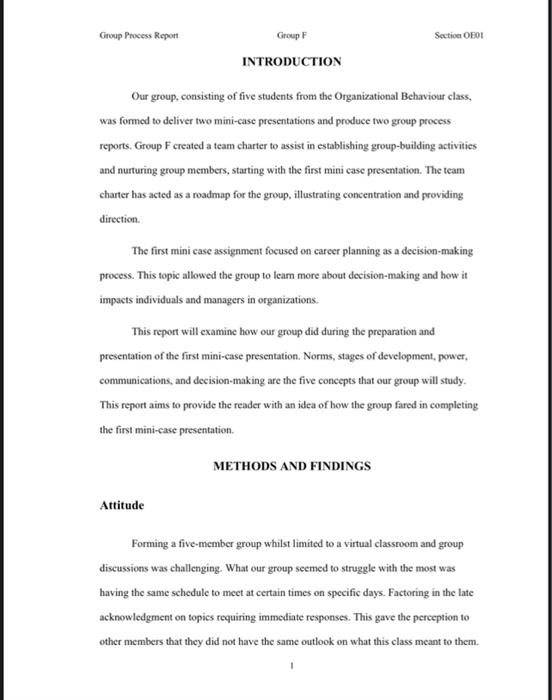


Step by Step Solution
There are 3 Steps involved in it
1 Expert Approved Answer
Step: 1 Unlock

Question Has Been Solved by an Expert!
Get step-by-step solutions from verified subject matter experts
Step: 2 Unlock
Step: 3 Unlock
 Study Help