





Question: I need help with this mathematic program problem. I don't know how to start the coding for it. 2. The atomic orbitals of the H

I need help with this mathematic program problem. I don't know how to start the coding for it.
I need help with this mathematic program problem.
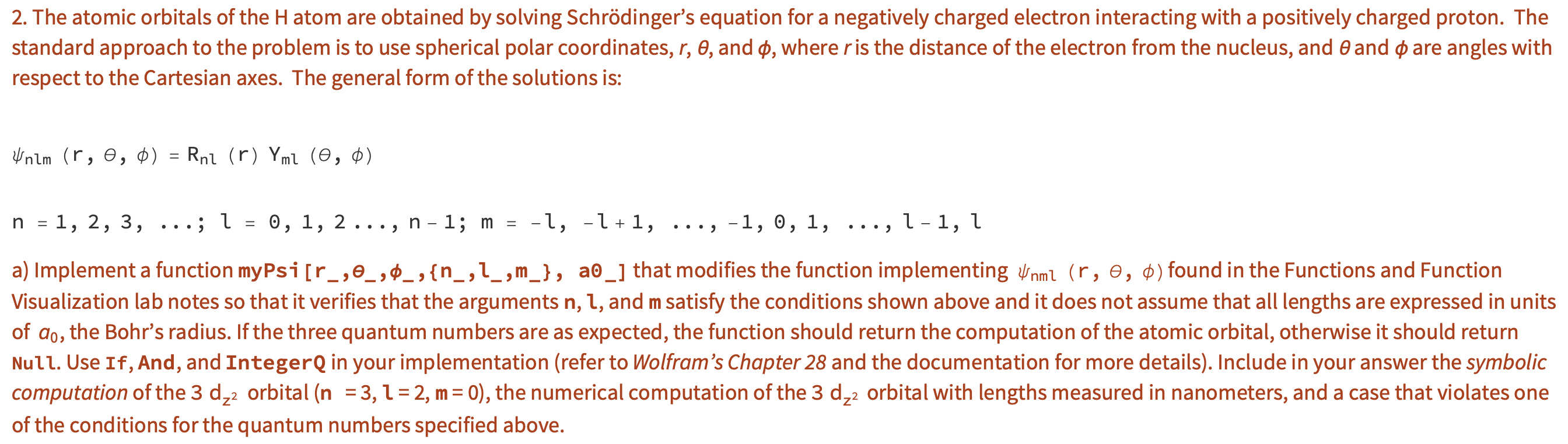
2. The atomic orbitals of the H atom are obtained by solving Schrodinger's equation for a negatively charged electron interacting with a positively charged proton. The standard approach to the problem is to use spherical polar coordinates, r, 0, and d, where r is the distance of the electron from the nucleus, and 0 and o are angles with respect to the Cartesian axes. The general form of the solutions is: Wnlm (r , 0, $ ) = Rni (r) Ymz (0, $) n = 1, 2, 3, . . .; l = 0, 1, 2 . . ., n- 1; m = -l, - l+1, . . ., -1, 0, 1, ..., 1-1, l a) Implement a function myPsi [r_, _, _, {n_, l_, m_}, a0_] that modifies the function implementing Wnmi (r , 0, ) found in the Functions and Function Visualization lab notes so that it verifies that the arguments n, , and m satisfy the conditions shown above and it does not assume that all lengths are expressed in units of do, the Bohr's radius. If the three quantum numbers are as expected, the function should return the computation of the atomic orbital, otherwise it should return Null. Use If, And, and IntegerQ in your implementation (refer to Wolfram's Chapter 28 and the documentation for more details). Include in your answer the symbolic computation of the 3 dz2 orbital (n =3, 1 = 2, m=0), the numerical computation of the 3 dz2 orbital with lengths measured in nanometers, and a case that violates one of the conditions for the quantum numbers specified above

Step by Step Solution

There are 3 Steps involved in it

1 Expert Approved Answer
Step: 1 Unlock blur-text-image

Question Has Been Solved by an Expert!

Get step-by-step solutions from verified subject matter experts

Step: 2 Unlock
Step: 3 Unlock

Students Have Also Explored These Related Mathematics Questions!