Question: *I NEED IT ASAP. DO NOT COPY FROM CHEGG STUDY PLEASE.THEY ARE WRONG You have been hired as an ergonomics consultant to evaluate a lifting

*I NEED IT ASAP. DO NOT COPY FROM CHEGG STUDY PLEASE.THEY ARE WRONG
*I NEED IT ASAP. DO NOT COPY FROM CHEGG STUDY*I NEED IT ASAP. DO NOT COPY FROM CHEGG STUDY*I NEED IT ASAP. DO NOT COPY FROM CHEGG STUDY*I NEED IT ASAP. DO NOT COPY FROM CHEGG STUDY

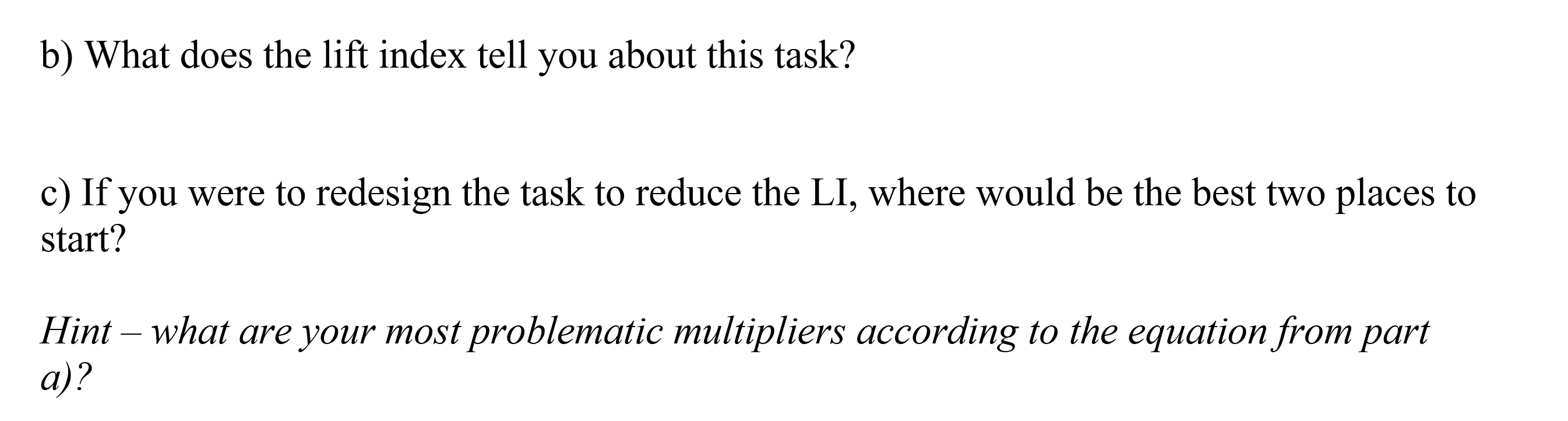
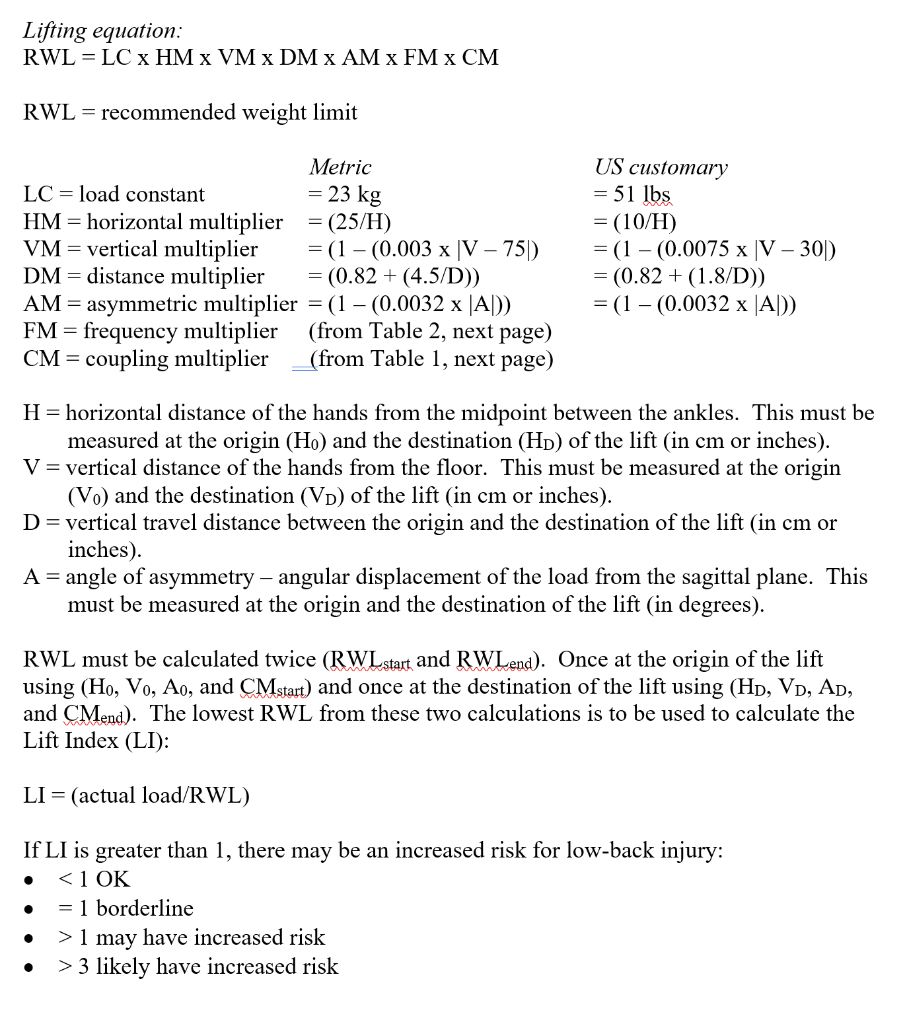
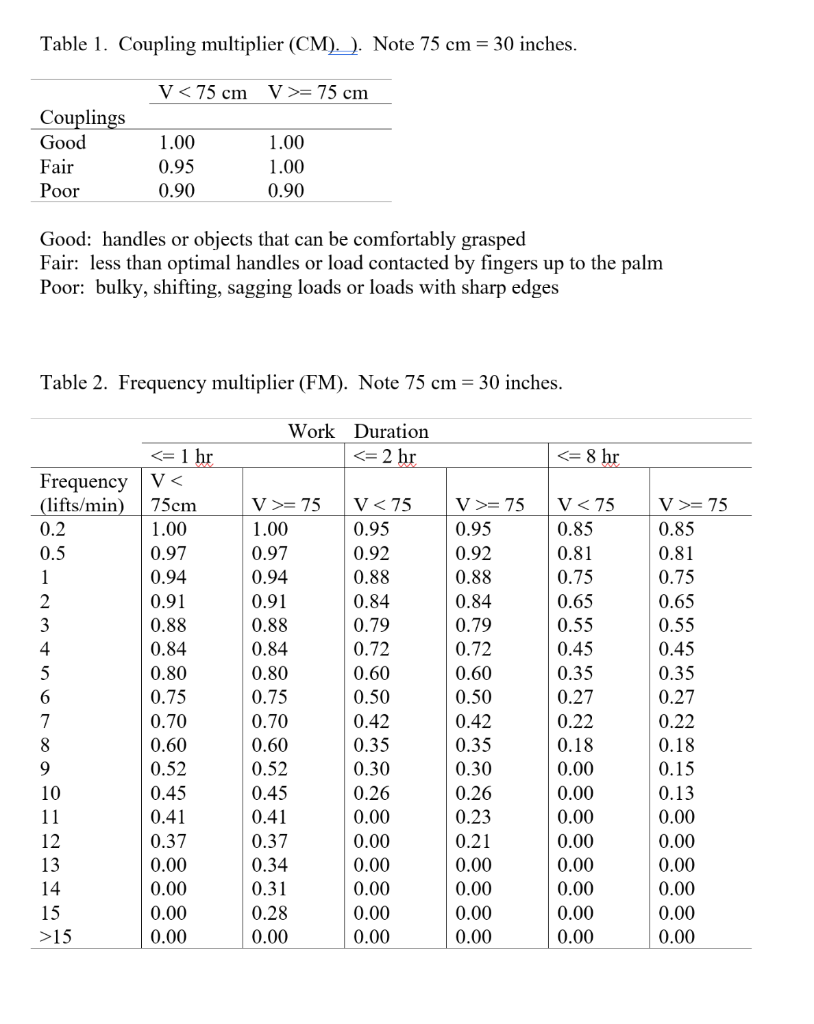
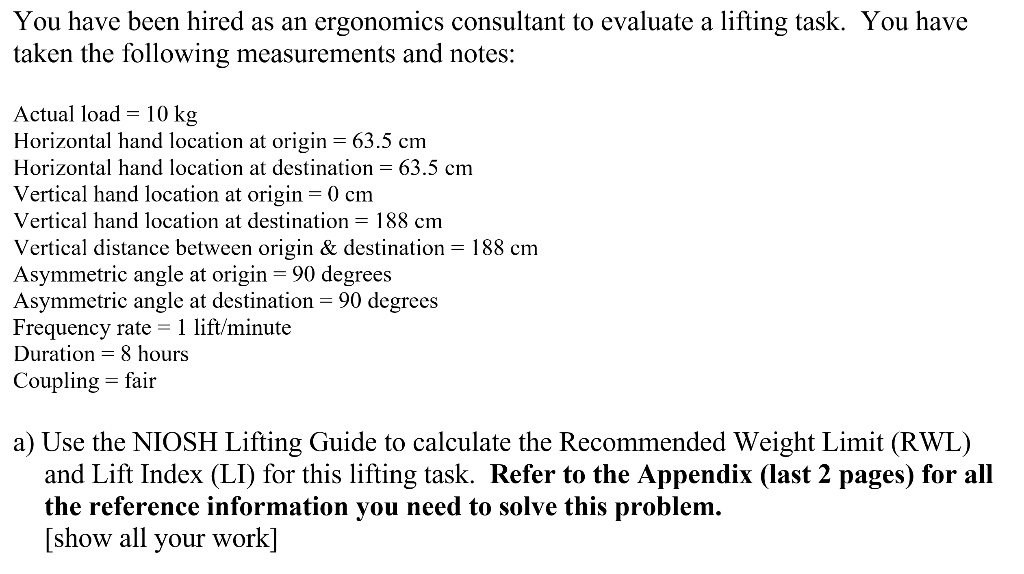
You have been hired as an ergonomics consultant to evaluate a lifting task. You have taken the following measurements and notes: Actual load = 10 kg Horizontal hand location at origin = 63.5 cm Horizontal hand location at destination = 63.5 cm Vertical hand location at origin = 0 cm Vertical hand location at destination = 188 cm Vertical distance between origin & destination = 188 cm Asymmetric angle at origin = 90 degrees Asymmetric angle at destination = 90 degrees Frequency rate = 1 lift/minute Duration = 8 hours Coupling = fair a) Use the NIOSH Lifting Guide to calculate the Recommended Weight Limit (RWL) and Lift Index (LI) for this lifting task. Refer to the Appendix (last 2 pages) for all the reference information you need to solve this problem. [show all your work] b) What does the lift index tell you about this task? c) If you were to redesign the task to reduce the LI, where would be the best two places to start? Hint - what are your most problematic multipliers according to the equation from part a)? Lifting equation: RWL = LC x HM X VM x DM X AM x FM x CM RWL = recommended weight limit Metric LC = load constant = 23 kg HM = horizontal multiplier = (25/H) VM = vertical multiplier = (1 - (0.003 x |V 75) DM = distance multiplier = (0.82 + (4.5/D)) AM = asymmetric multiplier = (1 - (0.0032 x |A])) FM = frequency multiplier (from Table 2, next page) CM = coupling multiplier (from Table 1, next page) US customary = 51 lbs = (10/H) = (1 - (0.0075 x V 30) = (0.82 + (1.8/D)) = (1 - (0.0032 x A)) H = horizontal distance of the hands from the midpoint between the ankles. This must be measured at the origin (Ho) and the destination (HD) of the lift (in cm or inches). V = vertical distance of the hands from the floor. This must be measured at the origin (Vo) and the destination (VD) of the lift (in cm or inches). D = vertical travel distance between the origin and the destination of the lift (in cm or inches). A = angle of asymmetry - angular displacement of the load from the sagittal plane. This must be measured at the origin and the destination of the lift (in degrees). RWL must be calculated twice (RWLstart and RWLend). Once at the origin of the lift using (Ho, Vo, Ao, and CMstart) and once at the destination of the lift using (HD, VD, AD, and CMend). The lowest RWL from these two calculations is to be used to calculate the Lift Index (LI): LI = (actual load/RWL) . . If LI is greater than 1, there may be an increased risk for low-back injury: 1 may have increased risk > 3 likely have increased risk Table 1. Coupling multiplier (CM). ). Note 75 cm = 30 inches. V= 75 cm Couplings Good Fair Poor 1.00 0.95 0.90 1.00 1.00 0.90 Good: handles or objects that can be comfortably grasped Fair: less than optimal handles or load contacted by fingers up to the palm Poor: bulky, shifting, sagging loads or loads with sharp edges Table 2. Frequency multiplier (FM). Note 75 cm = 30 inches. Work Duration 15 0.00 V >= 75 1.00 0.97 0.94 0.91 0.88 0.84 0.80 0.75 0.70 0.60 0.52 0.45 0.41 0.37 0.34 0.31 0.28 0.00 V= 75 0.95 0.92 0.88 0.84 0.79 0.72 0.60 0.50 0.42 0.35 0.30 0.26 0.23 0.21 0.00 0.00 0.00 0.00 V= 75 0.85 0.81 0.75 0.65 0.55 0.45 0.35 0.27 0.22 0.18 0.15 0.13 0.00 0.00 0.00 0.00 0.00 0.00 0.00

Step by Step Solution

There are 3 Steps involved in it

1 Expert Approved Answer
Step: 1 Unlock blur-text-image

Question Has Been Solved by an Expert!

Get step-by-step solutions from verified subject matter experts

Step: 2 Unlock
Step: 3 Unlock

Students Have Also Explored These Related General Management Questions!