







Question: i need justifications for why each person is a different type of decision rule please :) brief descriptions of some common Decision Rules are included
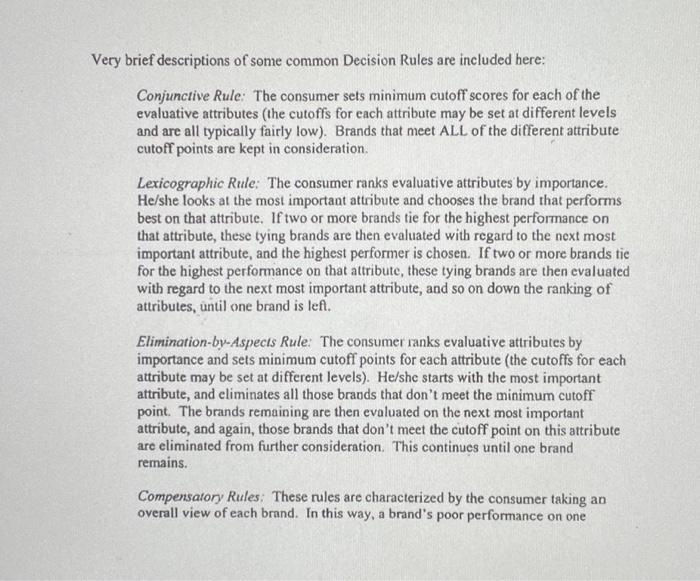
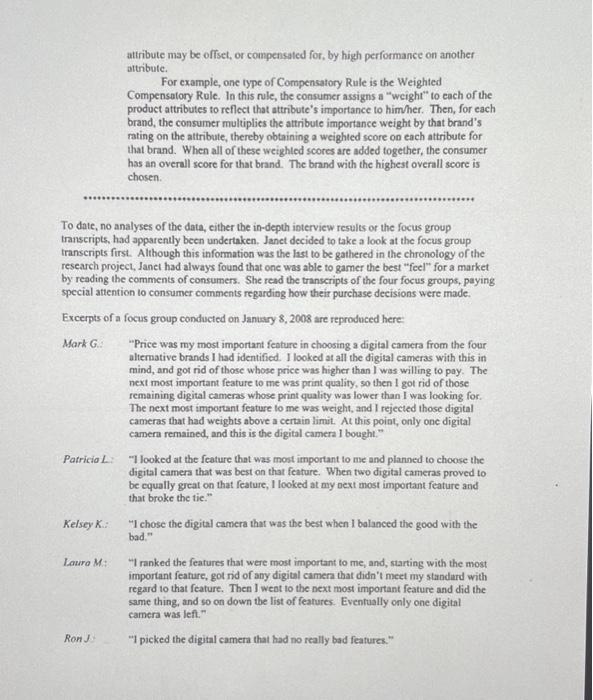
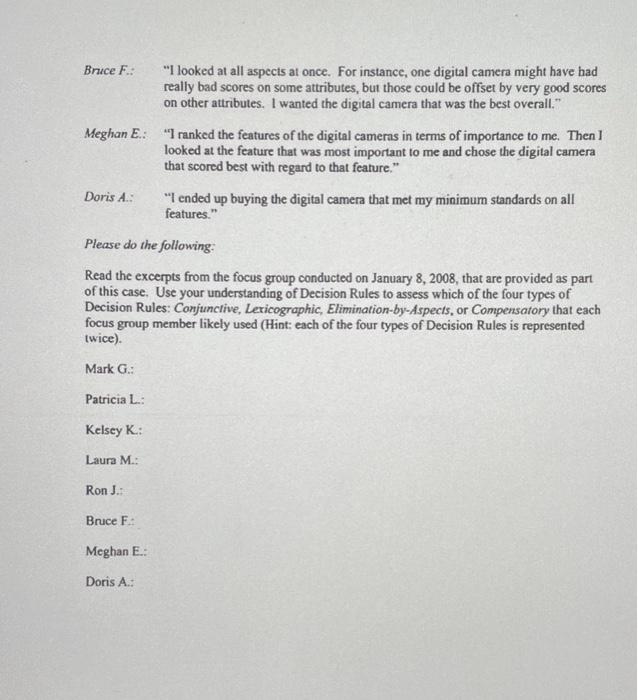
brief descriptions of some common Decision Rules are included here: Conjunctive Rule: The consumer sets minimum cutoff scores for each of the evaluative attributes (the cutoffs for each attribute may be set at different levels and are all typically fairly low). Brands that meet ALL of the different attribute cutoff points are kept in consideration. Lexicographic Rule: The consumer ranks evaluative attributes by importance. He/ she looks at the most important attribute and chooses the brand that performs best on that attribute. If two or more brands tie for the highest performance on that attribute, these tying brands are then evaluated with regard to the next most important attribute, and the highest performer is chosen. If two or more brands tie for the highest performance on that attribute, these tying brands are then evaluated with regard to the next most important attribute, and so on down the ranking of attributes, until one brand is left. Elimination-by-Aspecls Rule: The consumer ranks evaluative attributes by importance and sets minimum cutoff points for each attribute (the cutoffs for each attribute may be set at different levels). He/she starts with the most important attribute, and eliminates all those brands that don't meet the minimum cutoff point. The brands remaining are then evaluated on the next most important attribute, and again, those brands that don't meet the cutoff point on this attribute are eliminated from further consideration. This continues until one brand remains. Compensatory Rules: These rules are characterized by the consumer taking an overall view of each brand. In this way, a brand's poor performance on one attribute may be offset, or compensated for, by high performance on another attribute. For example, one type of Compensatory Rule is the Weighted Compensatory Rule. In this rule, the consumer assigns a "weight" to each of the product attributes to reflect that attribute's importance to him/her. Then, for each brand, the consumer multiplies the attribute importance weight by that brand's rating on the attribute, thereby obtaining a weighted score on each attribute for that brand. When all of these weighted scores are added together, the consumer has an overall score for that brand. The brand with the highest overall score is chosen. To date, no analyses of the data, either the in-depth ioterview results or the focus group transcripts, had apparently been undertaken. Janet decided to take a look at the focus group transeripts first. Although this information was the last to be gathered in the chronology of the research project, lanet had always found that one was able to gamer the best "feel" for a market by reading the comments of consumers. She read the transcripts of the four focus groups, paying special atiention to consumer comments regarding how their purchase decisions were made. Excerpts of a focus group conducted on Janusy 8,2008 are reproduced here: Mark G. Patricio L. "I looked at the feature that was most important to me and planned to choose the digital camera that was best on that feature. When two digital cameras proved to be equally great on that feature, 1 looked at my oext most important feature and that broke the tie." Kelsey K: "I chose the digital camera that was the best when I balaneed the good with the bad." Laura M: Tranked the features that were most important to me, and, starting with the most important feature, got rid of any digital camern that didn't meet my standard with regard to that feature. Then J weot to the next most important feature and did the same thing, and so on down the list of features. Eventually only one digital camera was left." Ron J. "I picked the digital camera that had no really bad features." Brice F.: "I looked at all aspects at once. For instance, one digital camers might have had really bad scores on some attributes, but those could be offset by very good scores on other attributes. I wanted the digital camera that was the best overall." Meghan E. "I ranked the features of the digital camerns in terms of importance to me. Then I looked at the feature that was most important to me and chose the digital camera that scored best with regard to that feature." Doris A.: "I ended up buying the digital camera that met my minimum standards on all features." Please do the following: Read the excerpts from the focus group conducted on January 8, 2008, that are provided as part of this case. Use your understanding of Decision Rules to assess which of the four types of Decision Rules: Conjunctive, Lexicographic, Elimination-by-Aspects, or Compensatory that each focus group member likely used (Hint: each of the four types of Decision Rules is represented twice). Mark G.: Patricia L. Kelsey K: Laura M : Ron J.: Bruce F : Meghan E.: Doris A.: brief descriptions of some common Decision Rules are included here: Conjunctive Rule: The consumer sets minimum cutoff scores for each of the evaluative attributes (the cutoffs for each attribute may be set at different levels and are all typically fairly low). Brands that meet ALL of the different attribute cutoff points are kept in consideration. Lexicographic Rule: The consumer ranks evaluative attributes by importance. He/ she looks at the most important attribute and chooses the brand that performs best on that attribute. If two or more brands tie for the highest performance on that attribute, these tying brands are then evaluated with regard to the next most important attribute, and the highest performer is chosen. If two or more brands tie for the highest performance on that attribute, these tying brands are then evaluated with regard to the next most important attribute, and so on down the ranking of attributes, until one brand is left. Elimination-by-Aspecls Rule: The consumer ranks evaluative attributes by importance and sets minimum cutoff points for each attribute (the cutoffs for each attribute may be set at different levels). He/she starts with the most important attribute, and eliminates all those brands that don't meet the minimum cutoff point. The brands remaining are then evaluated on the next most important attribute, and again, those brands that don't meet the cutoff point on this attribute are eliminated from further consideration. This continues until one brand remains. Compensatory Rules: These rules are characterized by the consumer taking an overall view of each brand. In this way, a brand's poor performance on one attribute may be offset, or compensated for, by high performance on another attribute. For example, one type of Compensatory Rule is the Weighted Compensatory Rule. In this rule, the consumer assigns a "weight" to each of the product attributes to reflect that attribute's importance to him/her. Then, for each brand, the consumer multiplies the attribute importance weight by that brand's rating on the attribute, thereby obtaining a weighted score on each attribute for that brand. When all of these weighted scores are added together, the consumer has an overall score for that brand. The brand with the highest overall score is chosen. To date, no analyses of the data, either the in-depth ioterview results or the focus group transcripts, had apparently been undertaken. Janet decided to take a look at the focus group transeripts first. Although this information was the last to be gathered in the chronology of the research project, lanet had always found that one was able to gamer the best "feel" for a market by reading the comments of consumers. She read the transcripts of the four focus groups, paying special atiention to consumer comments regarding how their purchase decisions were made. Excerpts of a focus group conducted on Janusy 8,2008 are reproduced here: Mark G. Patricio L. "I looked at the feature that was most important to me and planned to choose the digital camera that was best on that feature. When two digital cameras proved to be equally great on that feature, 1 looked at my oext most important feature and that broke the tie." Kelsey K: "I chose the digital camera that was the best when I balaneed the good with the bad." Laura M: Tranked the features that were most important to me, and, starting with the most important feature, got rid of any digital camern that didn't meet my standard with regard to that feature. Then J weot to the next most important feature and did the same thing, and so on down the list of features. Eventually only one digital camera was left." Ron J. "I picked the digital camera that had no really bad features." Brice F.: "I looked at all aspects at once. For instance, one digital camers might have had really bad scores on some attributes, but those could be offset by very good scores on other attributes. I wanted the digital camera that was the best overall." Meghan E. "I ranked the features of the digital camerns in terms of importance to me. Then I looked at the feature that was most important to me and chose the digital camera that scored best with regard to that feature." Doris A.: "I ended up buying the digital camera that met my minimum standards on all features." Please do the following: Read the excerpts from the focus group conducted on January 8, 2008, that are provided as part of this case. Use your understanding of Decision Rules to assess which of the four types of Decision Rules: Conjunctive, Lexicographic, Elimination-by-Aspects, or Compensatory that each focus group member likely used (Hint: each of the four types of Decision Rules is represented twice). Mark G.: Patricia L. Kelsey K: Laura M : Ron J.: Bruce F : Meghan E.: Doris A
Step by Step Solution
There are 3 Steps involved in it

Get step-by-step solutions from verified subject matter experts
 Study Help