







Question: i need new way to answer this question case study Case study Please read Case 3: Economic Development in Bangladesh available in your e- book
i need new way to answer this question 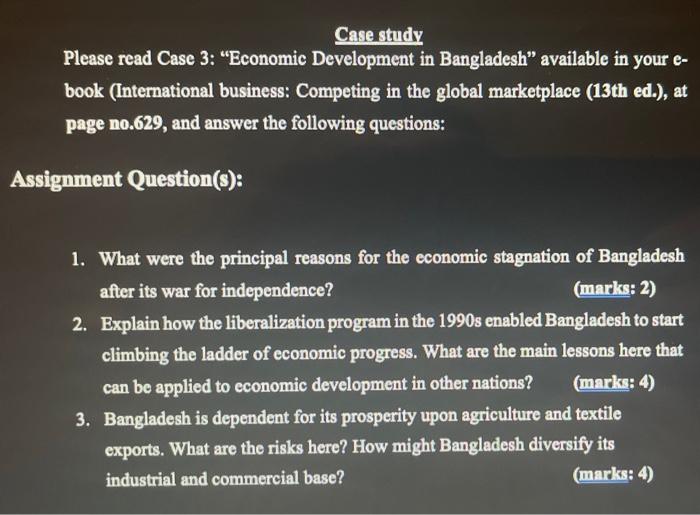
case study 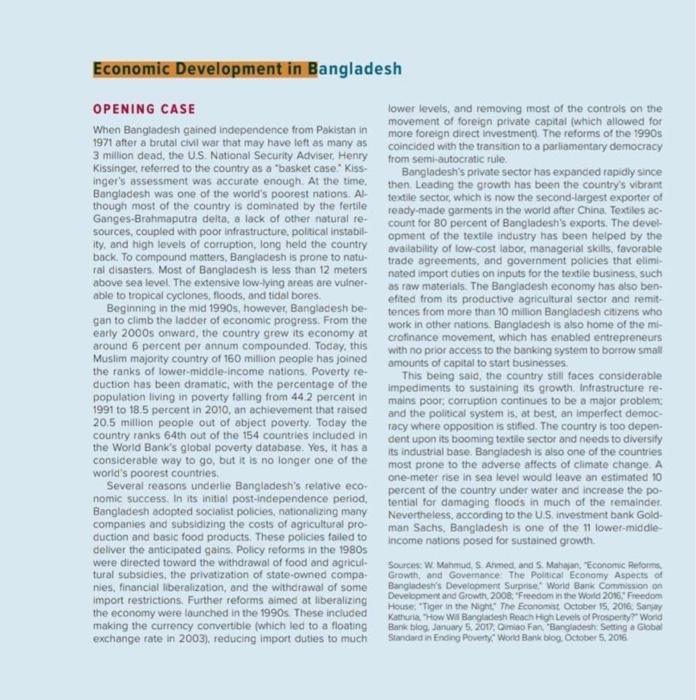
Case study Please read Case 3: Economic Development in Bangladesh" available in your e- book (International business: Competing in the global marketplace (13th ed.), at page no.629, and answer the following questions: Assignment Question(s): 1. What were the principal reasons for the economic stagnation of Bangladesh after its war for independence? (marks: 2) 2. Explain how the liberalization program in the 1990s enabled Bangladesh to start climbing the ladder of economic progress. What are the main lessons here that can be applied to economic development in other nations? (marks: 4) 3. Bangladesh is dependent for its prosperity upon agriculture and textile exports. What are the risks here? How might Bangladesh diversify its industrial and commercial base? (marks: 4) Economic Development in Bangladesh OPENING CASE When Bangladesh gained independence from Pakistan in 1971 after a brutal civil war that may have left as many as 3 million dead, the U.S. National Security Adviser. Henry Kissinger, referred to the country as a basket case. Kiss- Inger's assessment was accurate enough. At the time. Bangladesh was one of the world's poorest nations. Al- though most of the country is dominated by the fertile Ganges-Brahmaputra deita, a lack of other natural te sources, coupled with poor infrastructure, political instabil ity, and high levels of corruption, long held the country back. To compound matters, Bangladesh is prone to natu- ral disasters. Most of Bangladesh is less than 12 meters above sea level. The extensive low-lying areas are vulner- able to tropical cyclones, floods, and tidal bores. Beginning in the mid 1990s, however, Bangladesh be- gan to climb the ladder of economic progress. From the early 2000s onward, the country grew its economy at around 6 percent per annum compounded. Today, this Muslim majority country of 160 million people has joined the ranks of lower-middle-income nations. Poverty re- duction has been dramatic, with the percentage of the population living in poverty falling from 442 percent in 1991 to 18.5 percent in 2010, an achievement that raised 20,5 million people out of abject poverty. Today the country ranks 64th out of the 154 countries included in the World Bank's global poverty database. Yes, it has a considerable way to go, but it is no longer one of the world's poorest countries Several reasons underlie Bangladesh's relative eco- nomic success. In its initial post-independence period, Bangladesh adopted socialist policies, nationalizing many companies and subsidizing the costs of agricultural pro- duction and basic food products. These policies failed to deliver the anticipated gains. Policy reforms in the 1980s were directed toward the withdrawal of food and agricul tural subsidies, the privatization of state-owned compa nies, financial liberalization, and the withdrawal of some Import restrictions. Further reforms aimed at liberalizing the economy were launched in the 1990s. These included making the currency convertible (which led to a floating exchange rate in 2003), reducing import duties to much lower levels, and removing most of the controls on the movement of foreign private capital (which allowed for more foreign direct Investment. The reforms of the 1990s coincided with the transition to a parliamentary democracy from semi-autocratic rule. Bangladesh's private sector has expanded rapidly since then Leading the growth has been the country's vibrant textile sector, which is now the second-largest exporter of ready-made garments in the world after China, Textiles ac- count for 80 percent of Bangladesh's exports. The devel opment of the textile industry has been helped by the availability of low-cost labor managerial skills, favorable trade agreements, and government policies that elimi- nated import duties on inputs for the textile business, such as raw materials. The Bangladesh economy has also ben- efited from its productive agricultural sector and remit- tences from more than 10 million Bangladesh citizens who work in other nations. Bangladesh is also home of the mi crofinance movement, which has enabled entrepreneurs with no prior access to the banking system to borrow small amounts of capital to start businesses, This being said, the country still faces considerable impediments to sustaining its growth Infrastructure re- mains poor, corruption continues to be a major problem and the political system is, at best, an imperfect democ- racy where opposition is stifled. The country is too depen dent upon its booming textile sector and needs to diversity its industrial base. Bangladesh is also one of the countries most prone to the adverse affects of climate change. A one-meter rise in sea level would leave an estimated 10 percent of the country under water and increase the po. tential for damaging floods in much of the remainder Nevertheless, according to the US investment bank Gold- man Sachs, Bangladesh is one of the 11 lower-middie Income nations posed for sustained growth Sources: W. Mahmud, S Anmed, and S. Mahian. Economic Reforms Growth, and Governance. The Political Economy Aspects of Bangladesh's Development Surprise World Bank Commission on Development and Growth 2008, "Freedom in the World 2016,"Freedom House, Tiger in the Night The Economist October 15, 2016, Sanjay Kathura "How Wa Bangladesh Reach High Levels of Prosperity World Bank blog January 5, 2017 Qimio Fan, Bangladesh Setting a Global Standardin Ending Poverty World Bank blog, October 5, 2016 Step by Step Solution
There are 3 Steps involved in it
1 Expert Approved Answer
Step: 1 Unlock

Question Has Been Solved by an Expert!
Get step-by-step solutions from verified subject matter experts
Step: 2 Unlock
Step: 3 Unlock
 Study Help