







Question: Please help with step 2 questions 1-7 on this case study. Step 1: Please read the following: Japan Inc Introduction The case study in Unit
Please help with step 2 questions 1-7 on this case study. 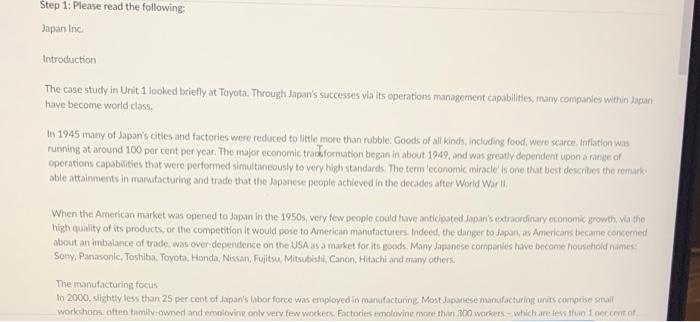
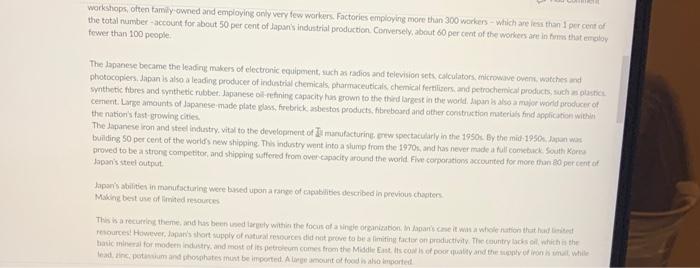
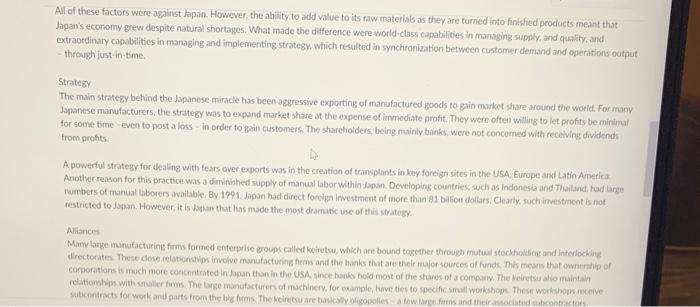
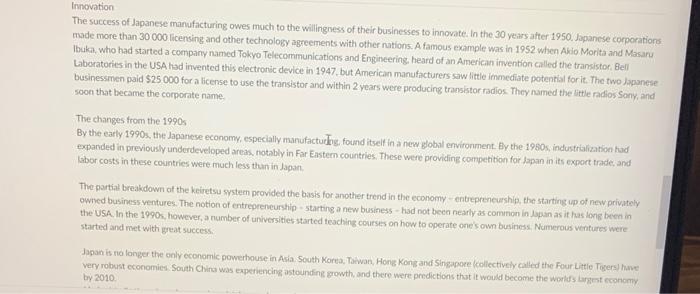
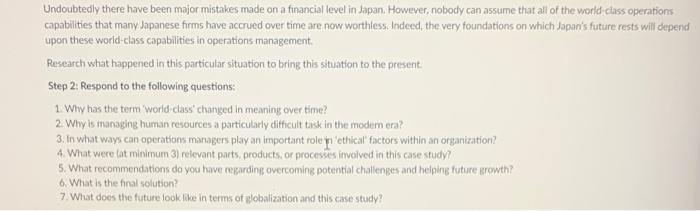
Step 1: Please read the following: Japan Inc Introduction The case study in Unit 1 looked briefly at Toyota. Through Japan's successes via its operations management capabilities, many companies within Japan have become world class In 1945 many of Japan's cities and factories were reduced to little more than rubble. Goods of all kinds, including food, were scarce, Inflation was running at around 100 per cent per year. The major economic traktormation began in about 1949, and was really dependent upon a range of operation capabilities that were performed simultaneously to very high standards. The term 'economic miracle is one that best describes the remark able attainments in martacturing and trade that the Japanese people achieved in the decades after World War II When the American market was opened to Japan in the 1950s very few people could have anticipated Japan's extraordinary economic growth, via the high quality of its products, or the competition it would pose to American manufacturers. Indeed, the danger to Japan, as Americans became concerned about an imbalance of trade was over dependence on the USA as a market for its goods. Many Japanese companies have become household names Sony, Panasonic Toshiba Toyota, Honda, Nissan, Fujitsu, Mitsubishi Canon, Hitachi and many others. The manufacturing focus In 2000, slightly less than 25 per cent of Japan's labor force was employed in manufacturing Most Japanese manufacturing units comprise small workchon often tamil-owned and emoloving only very few workers. Eactories emolovine more than 100 werkers - which aceless than or cent of workshops, otten tamily owned and employing only very few workers. Factories employing more than 300 workers - which are less than 1 percent of the total number -account for about 50 per cent of Japan's industrial production Conversely, about 60 per cent of the workers are interes that enco fewer than 100 people The Japanese became the leading makers of electronic coaliment, such as dis and television sets calculators encrowave oven watches and photocopiers Japan is also a leading producer of industrial chemical pharmaceutical chemical fertigers and petrochemical products, such plastic synthetic fibres and synthetic rubber Japanese refining capacity has grown to the third bargest in the world. Japanissa maior word produceret cement. Large amounts of Japanese-made plate ytas frebelick asbestos products, breboard and other construction materials find aplication within the nation's fast growing ches The Japanese won and steel industry, vital to the development of It marutacturing, wrew spectacularly in the 1950. By the mid-1950. Jan wat building 50 percent of the world's new shipping. This industry went into a slump from the 1970s, and has never made a full comeback, South Korea proved to be a strong competitor, and shippine suffered from our capacity around the world Five corporations accounted for more than 80 per cent of Japan's steel output Japan's abilities in manufacturing were twed upon a range of abilities described in previous chapters Makine best use of ited resources This wa recurring theme,indus been reply within the focus of a single organization, and case it wita whole nation that had tried resources. However, Joan's short supply of naturale did not prove to be a limitator ontbreductivity. The country to which the hat meal for modern industry and most of its per com comes from the Middle East is.com is poor and the only front while leadin portum and hates must be imported Amount of food is oported All of these factors were against Japan. However, the ability to add value to its raw materials as they are turned into finished products meant that Japan's economy grew despite natural shortages. What made the difference were world-class capabilities in managing supply, and quality, and extraordinary capabilities in managing and implementing strategy, which resulted in synchronization between customer demand and operations output - through just in time Strategy The main strategy behind the Japanese miracle has been aggressive exporting of manufactured goods to gain market share around the world. For many Japanese manufacturers, the strategy was to expand market share at the expense of immediate profit. They were often willing to let profits be minimal for some time even to post a loss - in order to gain customers. The shareholders, being mainly banks, were not concerned with receiving dividends from prohts A powerful strategy for dealing with tears over exports was in the creation of transplants in key foreign sites in the USA, Europe and Latin America Another reason for this practice was a diminished supply of manual labor within Japan Developing countries, such as Indonesia and Thailand. Pod urge numbers of manual laborers wollable. By 1991. Japan had direct foreign investment of more than 81 billion dollars. Clearly, soch investment is not restricted to Japan. However, it is Japan that has made the most dramatic use of this strategy Alliance Many large manufacturing firms formed enterprise groups called keiretsu, which are bound together through mutual stockholding and interlockine directorates. These close relationships involve manufacturing and the banks that are their major sources of funds. This means that ownership of Corporations is much more concentrated in Japan than in the USA since banks hold most of the shares of a company. The Veretsu ho maintain relationships with smaller firms. The large manufacturers of machinery, for example, have ties to specific small workshops. These workshops receive subcontracts for work and parts from the highes. The wires are basically oligopolles a few large forms and their acted subcontractors Innovation The success of Japanese manufacturing owes much to the willingness of their businesses to innovate. In the 30 years after 1950. Japanese corporations made more than 30 000 licensing and other technology agreements with other nations. A famous example was in 1952 when Akio Morita and Masaru Ibuka, who had started a company named Tokyo Telecommunications and Engineering, heard of an American invention called the transistor Bell Laboratories in the USA had invented this electronic device in 1947 but American manufacturers saw little immediate potential forit. The two Japanese businessmen paid $25 000 for a license to use the transistor and within 2 years were producing transistor radios They named the little radios Sony, and soon that became the corporate name, The changes from the 1990 By the early 1990s, the Japanese economy, especially manufactury, found itself in a new global environment. By the 1980s, industrialization had expanded in previously underdeveloped areas, notably in Far Eastern countries. These were providing competition for Japan in its export trade, and labor costs in these countries were much less than in Japan, The partial breakdown of the keirets system provided the basis for another trend in the economy-entrepreneurship, the starting up of new privately owned business ventures. The notion of entrepreneurship starting a new business - had not been nearly as common in Japan as itlus long been in the USA. In the 1990s, however, a number of universities started teaching courses on how to operate one's own business. Numerous ventures were started and moet with great success Japan is no longer the only economic powerhouse in Asia South Korea, Taiwan, Hong Kong and Singapore collectively called the Four Little Tigers have very robust economies South China was experiencing astounding growth, and there were predictions that it would become the world's largest economy by 2010 Undoubtedly there have been major mistakes made on a financial level in Japan. However, nobody can assume that all of the world-class operations capabilities that many Japanese firms have accrued over time are now worthless. Indeed, the very foundations on which Japan's future rests will depend upon these world-class capabilities in operations management Research what happened in this particular situation to bring this situation to the present Step 2: Respond to the following questions: 1. Why has the term world class changed in meaning over time? 2. Why is managing human resources a particularly difficult task in the modern era? 3. In what ways can operations managers play an important role yn 'ethical factors within an organization? 4. What were lat minimum 3) relevant parts products, or processes involved in this case study? 5. What recommendations do you have regarding overcoming potential challenges and helping future growth? 6. What is the final solution? 7. What does the future look like in terms of plobalization and this case study Step 1: Please read the following: Japan Inc Introduction The case study in Unit 1 looked briefly at Toyota. Through Japan's successes via its operations management capabilities, many companies within Japan have become world class In 1945 many of Japan's cities and factories were reduced to little more than rubble. Goods of all kinds, including food, were scarce, Inflation was running at around 100 per cent per year. The major economic traktormation began in about 1949, and was really dependent upon a range of operation capabilities that were performed simultaneously to very high standards. The term 'economic miracle is one that best describes the remark able attainments in martacturing and trade that the Japanese people achieved in the decades after World War II When the American market was opened to Japan in the 1950s very few people could have anticipated Japan's extraordinary economic growth, via the high quality of its products, or the competition it would pose to American manufacturers. Indeed, the danger to Japan, as Americans became concerned about an imbalance of trade was over dependence on the USA as a market for its goods. Many Japanese companies have become household names Sony, Panasonic Toshiba Toyota, Honda, Nissan, Fujitsu, Mitsubishi Canon, Hitachi and many others. The manufacturing focus In 2000, slightly less than 25 per cent of Japan's labor force was employed in manufacturing Most Japanese manufacturing units comprise small workchon often tamil-owned and emoloving only very few workers. Eactories emolovine more than 100 werkers - which aceless than or cent of workshops, otten tamily owned and employing only very few workers. Factories employing more than 300 workers - which are less than 1 percent of the total number -account for about 50 per cent of Japan's industrial production Conversely, about 60 per cent of the workers are interes that enco fewer than 100 people The Japanese became the leading makers of electronic coaliment, such as dis and television sets calculators encrowave oven watches and photocopiers Japan is also a leading producer of industrial chemical pharmaceutical chemical fertigers and petrochemical products, such plastic synthetic fibres and synthetic rubber Japanese refining capacity has grown to the third bargest in the world. Japanissa maior word produceret cement. Large amounts of Japanese-made plate ytas frebelick asbestos products, breboard and other construction materials find aplication within the nation's fast growing ches The Japanese won and steel industry, vital to the development of It marutacturing, wrew spectacularly in the 1950. By the mid-1950. Jan wat building 50 percent of the world's new shipping. This industry went into a slump from the 1970s, and has never made a full comeback, South Korea proved to be a strong competitor, and shippine suffered from our capacity around the world Five corporations accounted for more than 80 per cent of Japan's steel output Japan's abilities in manufacturing were twed upon a range of abilities described in previous chapters Makine best use of ited resources This wa recurring theme,indus been reply within the focus of a single organization, and case it wita whole nation that had tried resources. However, Joan's short supply of naturale did not prove to be a limitator ontbreductivity. The country to which the hat meal for modern industry and most of its per com comes from the Middle East is.com is poor and the only front while leadin portum and hates must be imported Amount of food is oported All of these factors were against Japan. However, the ability to add value to its raw materials as they are turned into finished products meant that Japan's economy grew despite natural shortages. What made the difference were world-class capabilities in managing supply, and quality, and extraordinary capabilities in managing and implementing strategy, which resulted in synchronization between customer demand and operations output - through just in time Strategy The main strategy behind the Japanese miracle has been aggressive exporting of manufactured goods to gain market share around the world. For many Japanese manufacturers, the strategy was to expand market share at the expense of immediate profit. They were often willing to let profits be minimal for some time even to post a loss - in order to gain customers. The shareholders, being mainly banks, were not concerned with receiving dividends from prohts A powerful strategy for dealing with tears over exports was in the creation of transplants in key foreign sites in the USA, Europe and Latin America Another reason for this practice was a diminished supply of manual labor within Japan Developing countries, such as Indonesia and Thailand. Pod urge numbers of manual laborers wollable. By 1991. Japan had direct foreign investment of more than 81 billion dollars. Clearly, soch investment is not restricted to Japan. However, it is Japan that has made the most dramatic use of this strategy Alliance Many large manufacturing firms formed enterprise groups called keiretsu, which are bound together through mutual stockholding and interlockine directorates. These close relationships involve manufacturing and the banks that are their major sources of funds. This means that ownership of Corporations is much more concentrated in Japan than in the USA since banks hold most of the shares of a company. The Veretsu ho maintain relationships with smaller firms. The large manufacturers of machinery, for example, have ties to specific small workshops. These workshops receive subcontracts for work and parts from the highes. The wires are basically oligopolles a few large forms and their acted subcontractors Innovation The success of Japanese manufacturing owes much to the willingness of their businesses to innovate. In the 30 years after 1950. Japanese corporations made more than 30 000 licensing and other technology agreements with other nations. A famous example was in 1952 when Akio Morita and Masaru Ibuka, who had started a company named Tokyo Telecommunications and Engineering, heard of an American invention called the transistor Bell Laboratories in the USA had invented this electronic device in 1947 but American manufacturers saw little immediate potential forit. The two Japanese businessmen paid $25 000 for a license to use the transistor and within 2 years were producing transistor radios They named the little radios Sony, and soon that became the corporate name, The changes from the 1990 By the early 1990s, the Japanese economy, especially manufactury, found itself in a new global environment. By the 1980s, industrialization had expanded in previously underdeveloped areas, notably in Far Eastern countries. These were providing competition for Japan in its export trade, and labor costs in these countries were much less than in Japan, The partial breakdown of the keirets system provided the basis for another trend in the economy-entrepreneurship, the starting up of new privately owned business ventures. The notion of entrepreneurship starting a new business - had not been nearly as common in Japan as itlus long been in the USA. In the 1990s, however, a number of universities started teaching courses on how to operate one's own business. Numerous ventures were started and moet with great success Japan is no longer the only economic powerhouse in Asia South Korea, Taiwan, Hong Kong and Singapore collectively called the Four Little Tigers have very robust economies South China was experiencing astounding growth, and there were predictions that it would become the world's largest economy by 2010 Undoubtedly there have been major mistakes made on a financial level in Japan. However, nobody can assume that all of the world-class operations capabilities that many Japanese firms have accrued over time are now worthless. Indeed, the very foundations on which Japan's future rests will depend upon these world-class capabilities in operations management Research what happened in this particular situation to bring this situation to the present Step 2: Respond to the following questions: 1. Why has the term world class changed in meaning over time? 2. Why is managing human resources a particularly difficult task in the modern era? 3. In what ways can operations managers play an important role yn 'ethical factors within an organization? 4. What were lat minimum 3) relevant parts products, or processes involved in this case study? 5. What recommendations do you have regarding overcoming potential challenges and helping future growth? 6. What is the final solution? 7. What does the future look like in terms of plobalization and this case study
Step by Step Solution
There are 3 Steps involved in it
1 Expert Approved Answer
Step: 1 Unlock

Question Has Been Solved by an Expert!
Get step-by-step solutions from verified subject matter experts
Step: 2 Unlock
Step: 3 Unlock
 Study Help