







Question: I need solutions for questions for case study from chapter 10 -strategizing,structuring, and learning around the world from the book Global strategy 4th edition by
 I need solutions for questions for case study from chapter 10 -strategizing,structuring, and learning around the world from the book Global strategy 4th edition by Peng
The title for the case study - Emerging markets: GE Innovates from the base of the pyramid
Subject - Organizational strategy
Questions are as follows,
1. How can MNCs such as GE be successful locally and internationally?
2. What are the challenges associated with reverse innovation? Please explain why you do or do not think GE will be successful in this approach in the long run.
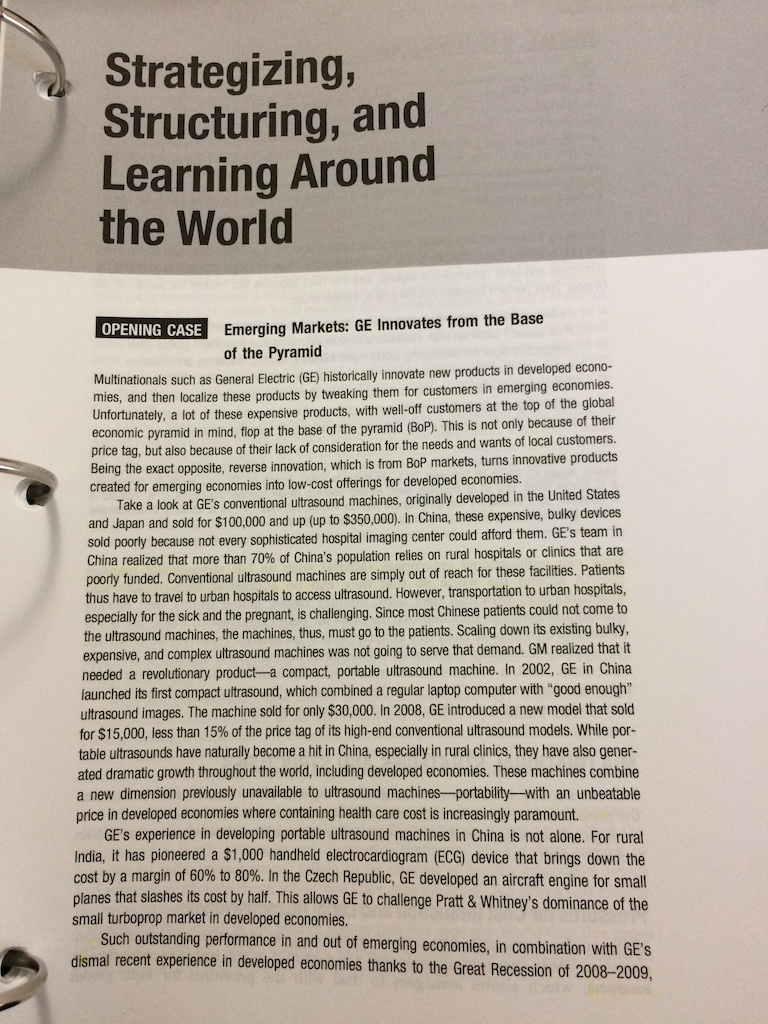
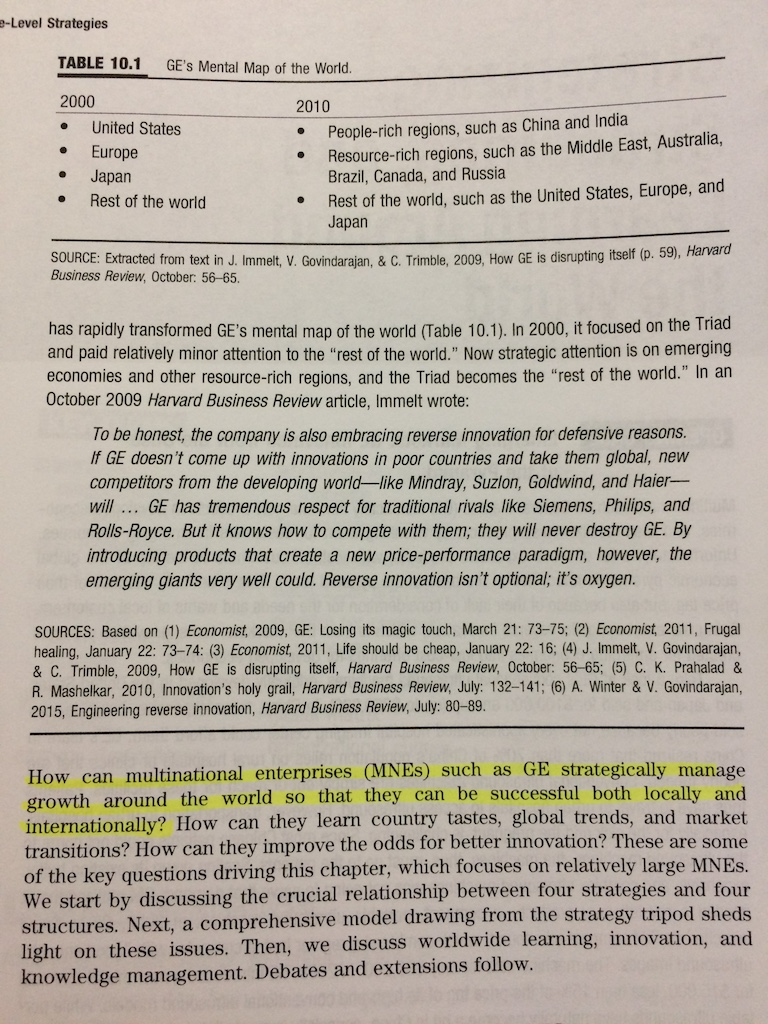
Strategizing, Structuring, and Learning Around the World OPENING CASE Emerging Markets: GE Innovates from the Base of the Pyramid Multinationals such as General Electric (GE) historically innovate new products in developed econo- mies, and then focalize these products by tweaking them for customers in emerging economies. Unfortunately, a lot of these expensive products, with well-off customers at the top of the global economic pyramid in mind, flop at the base of the pyramid (BOP). This is not only because of their price tag, but also because of their lack of consideration for the needs and wants of local customers. Being the exact opposite, reverse innovation, which is from Bop markets, turns innovative products created for emerging economies into low-cost offerings for developed economies. Take a look at GE's conventional ultrasound machines, originally developed in the United States and Japan and sold for $100,000 and up (up to $350,000). In China, these expensive, bulky devices sold poorly because not every sophisticated hospital imaging center could afford them. GE's team in China realized that more than 70% of China's population relies on rural hospitals or clinics that are poorly funded. Conventional ultrasound machines are simply out of reach for these facilities. Patients thus have to travel to urban hospitals to access ultrasound. However, transportation to urban hospitals, especially for the sick and the pregnant, is challenging. Since most Chinese patients could not come to the ultrasound machines, the machines, thus, must go to the patients. Scaling down its existing bulky, expensive, and complex ultrasound machines was not going to serve that demand. GM realized that it needed a revolutionary product-a compact, portable ultrasound machine. In 2002, GE in China launched its first compact ultrasound, which combined a regular laptop computer with "good enough" ultrasound images. The machine sold for only $30,000. In 2008, GE introduced a new model that sold for $15,000, less than 15% of the price tag of its high-end conventional ultrasound models. While por- table ultrasounds have naturally become a hit in China, especially in rural clinics, they have also gener- ated dramatic growth throughout the world, including developed economies. These machines combine a new dimension previously unavailable to ultrasound machines-portability--with an unbeatable price in developed economies where containing health care cost is increasingly paramount. GE's experience in developing portable ultrasound machines in China is not alone. For rural India, it has pioneered a $1,000 handheld electrocardiogram (ECG) device that brings down the cost by a margin of 60% to 80%. In the Czech Republic, GE developed an aircraft engine for small planes that slashes its cost by half. This allows GE to challenge Pratt & Whitney's dominance of the small turboprop market in developed economies. Such outstanding performance in and out of emerging economies, in combination with GE's dismal recent experience in developed economies thanks to the Great Recession of 2008-2009, e-Level Strategies TABLE 10.1 GE's Mental Map of the World. 2000 United States Europe Japan Rest of the world 2010 People-rich regions, such as China and India Resource-rich regions, such as the Middle East, Australia, Brazil, Canada, and Russia Rest of the world, such as the United States, Europe, and Japan SOURCE: Extracted from text in J. Immelt, V. Govindarajan, & C. Trimble, 2009, How GE is disrupting itself (p. 59), Harvard Business Review, October: 56-65. has rapidly transformed GE's mental map of the world (Table 10.1). In 2000, it focused on the Triad and paid relatively minor attention to the "rest of the world. Now strategic attention is on emerging economies and other resource-rich regions, and the Triad becomes the "rest of the world. In an October 2009 Harvard Business Review article, Immelt wrote: To be honest, the company is also embracing reverse innovation for defensive reasons. If GE doesn't come up with innovations in poor countries and take them global, new competitors from the developing worldlike Mindray, Suzlon, Goldwind, and Haier- will ... GE has tremendous respect for traditional rivals like Siemens, Philips, and Rolls-Royce. But it knows how to compete with them; they will never destroy GE. By introducing products that create a new price-performance paradigm, however, the emerging giants very well could. Reverse innovation isn't optional; it's oxygen. SOURCES: Based on (1) Economist, 2009, GE: Losing its magic touch, March 21: 73-75; (2) Economist, 2011, Frugal healing, January 22: 7374: (3) Economist, 2011, Life should be cheap, January 22: 16; (4) J. Immelt, V. Govindarajan, & C. Trimble, 2009, How GE is disrupting itself, Harvard Business Review, October: 56-65; (5) C. K. Prahalad & R. Mashelkar, 2010, Innovation's holy grail, Harvard Business Review, July: 132141; (6) A. Winter & V. Govindarajan, 2015, Engineering reverse innovation, Harvard Business Review, July: 80-89. How can multinational enterprises (MNEs) such as GE strategically manage growth around the world so that they can be successful both locally and internationally? How can they learn country tastes, global trends, and market transitions? How can they improve the odds for better innovation? These are some of the key questions driving this chapter, which focuses on relatively large MNEs. We start by discussing the crucial relationship between four strategies and four structures. Next, a comprehensive model drawing from the strategy tripod sheds light on these issues. Then, we discuss worldwide learning, innovation, and knowledge management. Debates and extensions followStep by Step Solution
There are 3 Steps involved in it
1 Expert Approved Answer
Step: 1 Unlock

Question Has Been Solved by an Expert!
Get step-by-step solutions from verified subject matter experts
Step: 2 Unlock
Step: 3 Unlock
 Study Help