







Question: I need solutions for these stats multiple choice questions (image attached) Linear Regression Concepts: Multiple Choice. (a) (3pt) (Circle all that apply.) In which of
I need solutions for these stats multiple choice questions (image attached)
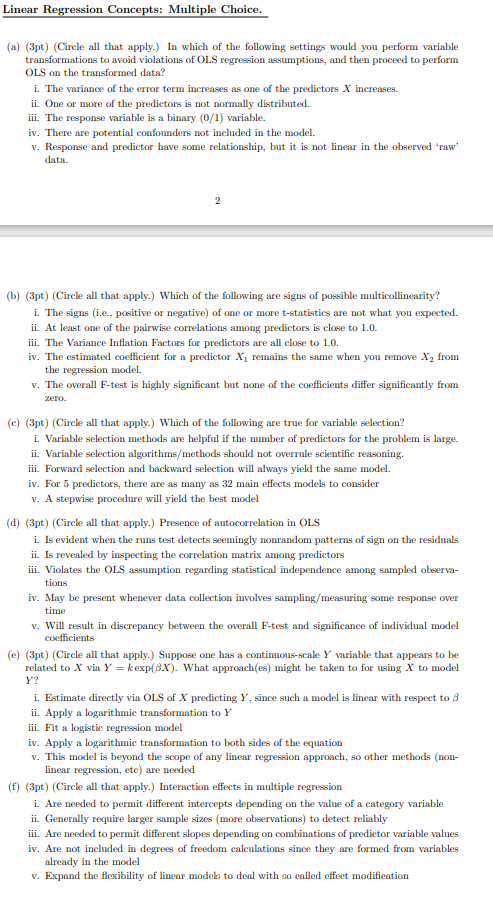
Linear Regression Concepts: Multiple Choice. (a) (3pt) (Circle all that apply.) In which of the following settings would you perform variable transformations to avoid violations of OLS regression assumptions, and then proceed to perform OLS on the transformed data? i. The variance of the error term increases as one of the predictors X increases. ii. One or more of the predictors is not normally distributed. iii. The response variable is a binary (0/1) variable. iv. There are potential confounders not included in the model. v. Response and predictor have some relationship, but it is not linear in the observed 'raw' data. 2 (b) (3pt) (Circle all that apply.) Which of the following are signs of possible multicollinearity? i. The signs (i.e., positive or negative) of one or more t-statistics are not what you expected. ii. At least one of the pairwise correlations among predictors is close to 1.0. iii. The Variance Inflation Factors for predictors are all close to 1.0. iv. The estimated coefficient for a predictor X, remains the same when you remove X, from the regression model. v. The overall F-test is highly significant but none of the coefficients differ significantly from zero. (c) (3pt) (Circle all that apply.) Which of the following are true for variable selection? i. Variable selection methods are helpful if the number of predictors for the problem is large. ii. Variable selection algorithms/methods should not overrule scientific reasoning. iii. Forward selection and backward selection will always yield the same model. iv. For 5 predictors, there are as many as 32 main effects models to consider v. A stepwise procedure will yield the best model (d) (3pt) (Circle all that apply.) Presence of autocorrelation in OLS i. Is evident when the runs test detects seemingly nonrandom patterns of sign on the residuals ii. Is revealed by inspecting the correlation matrix among predictors iii. Violates the OLS assumption regarding statistical independence among sampled observa- tions iv. May be present whenever data collection involves sampling/ measuring some response over time v. Will result in discrepancy between the overall F-test and significance of individual model coefficients (e) (3pt) (Circle all that apply.) Suppose one has a continuous-scale Y variable that appears to be related to X via Y = kexp(8X). What approach(es) might be taken to for using X to model Y? i. Estimate directly via OLS of X predicting Y', since such a model is linear with respect to A ii. Apply a logarithmic transformation to Y iii. Fit a logistic regression model iv. Apply a logarithmic transformation to both sides of the equation v. This model is beyond the scope of any linear regression approach, so other methods (non- linear regression, etc) are needed (f) (3pt) (Circle all that apply.) Interaction effects in multiple regression i. Are needed to permit different intercepts depending on the value of a category variable ii. Generally require larger sample sizes (more observations) to detect reliably iii. Are needed to permit different slopes depending on combinations of predictor variable values iv. Are not included in degrees of freedom calculations since they are formed from variables already in the model v. Expand the flexibility of linear models to deal with so called effect modification
Step by Step Solution
There are 3 Steps involved in it

Get step-by-step solutions from verified subject matter experts
 Study Help