







Question: I need step by step solution Two investigators are studying cooling of solid polyethylene spheres by placing spheres of different sizes in a low temperature
I need step by step solution
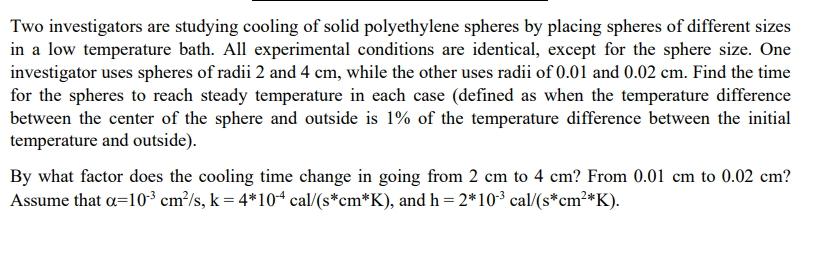
Two investigators are studying cooling of solid polyethylene spheres by placing spheres of different sizes in a low temperature bath. All experimental conditions are identical, except for the sphere size. One investigator uses spheres of radii 2 and 4cm, while the other uses radii of 0.01 and 0.02cm. Find the time for the spheres to reach steady temperature in each case (defined as when the temperature difference between the center of the sphere and outside is 1% of the temperature difference between the initial temperature and outside). By what factor does the cooling time change in going from 2cm to 4cm ? From 0.01cm to 0.02cm ? Assume that =103cm2/s,k=4104cal/(scmK), and h=2103cal/(scm2K). Two investigators are studying cooling of solid polyethylene spheres by placing spheres of different sizes in a low temperature bath. All experimental conditions are identical, except for the sphere size. One investigator uses spheres of radii 2 and 4cm, while the other uses radii of 0.01 and 0.02cm. Find the time for the spheres to reach steady temperature in each case (defined as when the temperature difference between the center of the sphere and outside is 1% of the temperature difference between the initial temperature and outside). By what factor does the cooling time change in going from 2cm to 4cm ? From 0.01cm to 0.02cm ? Assume that =103cm2/s,k=4104cal/(scmK), and h=2103cal/(scm2K)
Step by Step Solution
There are 3 Steps involved in it

Get step-by-step solutions from verified subject matter experts
 Study Help