







Question: I need the answers for this case study. 296 Part Two Information Technology Infrastructure INTERACTIVE SESSION: MANAGEMENT MONITORING EMPLOYEES ON NETWORKS: UNETHICAL OR GOOD BUSINESS?
I need the answers for this case study.
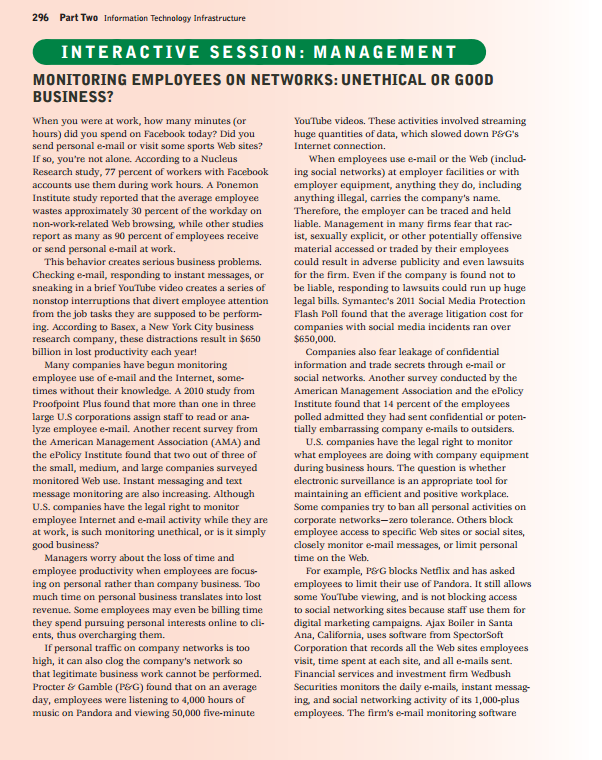
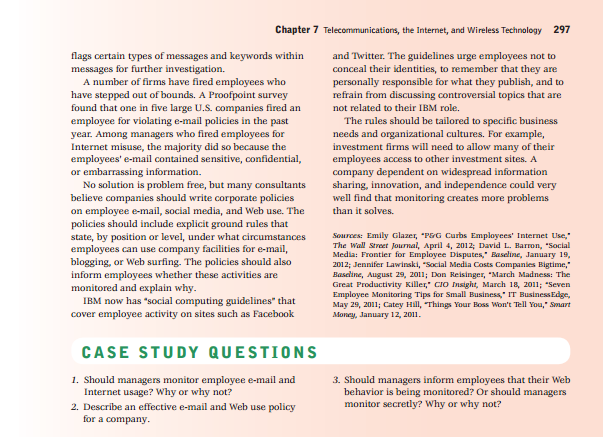
296 Part Two Information Technology Infrastructure INTERACTIVE SESSION: MANAGEMENT MONITORING EMPLOYEES ON NETWORKS: UNETHICAL OR GOOD BUSINESS? When you were at work, how many minutes (or YouTube videos. These activities involved streaming hours) did you spend on Facebook today? Did you huge quantities of data, which slowed down P&G's send personal e-mail or visit some sports Web sites? Internet connection. If so, you're not alone. According to a Nucleus When employees use e-mail or the Web (includ- Research study, 77 percent of workers with Facebook ing social networks) at employer facilities or with accounts use them during work hours. A Ponemon employer equipment, anything they do, including Institute study reported that the average employee anything illegal, carries the company's name. wastes approximately 30 percent of the workday on Therefore, the employer can be traced and held non-work-related Web browsing while other studies liable. Management in many firms fear that rac- report as many as 90 percent of employees receive ist, sexually explicit, or other potentially offensive or send personal e-mail at work. material accessed or traded by their employees This behavior creates serious business problems. could result in adverse publicity and even lawsuits Checking e-mail, responding to instant messages, or for the firm. Even if the company is found not to sneaking in a brief YouTube video creates a series of be liable, responding to lawsuits could run up huge nonstop interruptions that divert employee attention legal bills. Symantec's 2011 Social Media Protection from the job tasks they are supposed to be perform- Flash Poll found that the average litigation cost for ing. According to Basex, a New York City business companies with social media incidents ran over research company, these distractions result in $650 $650,000. billion in lost productivity each year! Companies also fear leakage of confidential Many companies have begun monitoring information and trade secrets through e-mail or employee use of e-mail and the Internet, some- social networks. Another survey conducted by the times without their knowledge. A 2010 study from American Management Association and the ePolicy Proofpoint Plus found that more than one in three Institute found that 14 percent of the employees large U.S corporations assign staff to read or ana- polled admitted they had sent confidential or poten- lyze employee e-mail. Another recent survey from tially embarrassing company e-mails to outsiders. the American Management Association (AMA) and U.S. companies have the legal right to monitor the ePolicy Institute found that two out of three of what employees are doing with company equipment the small, medium, and large companies surveyed during business hours. The question is whether monitored Web use. Instant messaging and text electronic surveillance is an appropriate tool for message monitoring are also increasing. Although maintaining an efficient and positive workplace. U.S.companies have the legal right to monitor Some companies try to ban all personal activities on employee Internet and e-mail activity while they are corporate networks-zero tolerance. Others block at work, is such monitoring unethical, or is it simply employee access to specific Web sites or social sites, good business? closely monitor e-mail messages, or limit personal Managers worry about the loss of time and time on the Web employee productivity when employees are focus For example, P&G blocks Netflix and has asked ing on personal rather than company business. Too employees to limit their use of Pandora. It still allows much time on personal business translates into lost some YouTube viewing, and is not blocking access revenue. Some employees may even be billing time to social networking sites because staff use them for they spend pursuing personal interests online to cli- digital marketing campaigns. Ajax Boiler in Santa ents, thus overcharging them. Ana, California, uses software from SpectorSoft If personal traffic on company networks is too Corporation that records all the Web sites employees high, it can also clog the company's network so visit, time spent at each site, and all e-mails sent. that legitimate business work cannot be performed. Financial services and investment firm Wedbush Procter & Gamble (P&G) found that on an average Securities monitors the daily e-mails, instant messag- day, employees were listening to 4,000 hours of ing, and social networking activity of its 1,000-plus music on Pandora and viewing 50,000 five-minute employees. The firm's e-mail monitoring software Chapter 7 Telecommunications, the Internet, and Wireless Technology 297 flags certain types of messages and keywords within and Twitter. The guidelines urge employees not to messages for further investigation. conceal their identities, to remember that they are A number of firms have fired employees who personally responsible for what they publish, and to have stepped out of bounds. A Proofpoint survey refrain from discussing controversial topics that are found that one in five large U.S. companies fired an not related to their IBM role. employee for violating e-mail policies in the past The rules should be tailored to specific business year. Among managers who fired employees for needs and organizational cultures. For example, Internet misuse, the majority did so because the investment firms will need to allow many of their employees' e-mail contained sensitive, confidential, employees access to other investment sites. A or embarrassing information. company dependent on widespread information No solution is problem free, but many consultants sharing, innovation, and independence could very believe companies should write corporate policies well find that monitoring creates more problems on employee e-mail, social media, and Web use. The than it solves. policies should include explicit ground rules that state, by position or level, under what circumstances Sources: Emily Glazer, "PG Curbs Employees' Internet use," employees can use company facilities for e-mail, The Wall Street Journal, April 4, 2012, David L. Barron, "Social Media: Frontier for Employee Disputes, Baseline, January 19, blogging, or Web surfing. The policies should also 2012; Jennifer Lawinski, "Social Media Costs Companies Bigtime," inform employees whether these activities are Baseline, August 29, 2011; Don Reisinger, "March Madness: The monitored and explain why. Great Productivity Killer,' CIO Insight, March 18, 2011; "Seven Employee Monitoring Tips for Small Business." IT Business Edge, IBM now has "social computing guidelines" that May 29, 2011; Catey Hill, Things Your Boss Won't Tell You," Smart cover employee activity on sites such as Facebook Money, January 12, 2011. CASE STUDY QUESTIONS 1. Should managers monitor employee e-mail and Internet usage? Why or why not? 2. Describe an effective e-mail and Web use policy for a company. 3. Should managers inform employees that their Web behavior is being monitored? Or should managers monitor secretly? Why or why notStep by Step Solution
There are 3 Steps involved in it
1 Expert Approved Answer
Step: 1 Unlock

Question Has Been Solved by an Expert!
Get step-by-step solutions from verified subject matter experts
Step: 2 Unlock
Step: 3 Unlock
 Study Help