







Question: I need the excel file using Solver for the solution question b and c , and also the explanation on how to do it ^
I need the excel file using Solver for the solution question b and c and also the explanation on how to do it
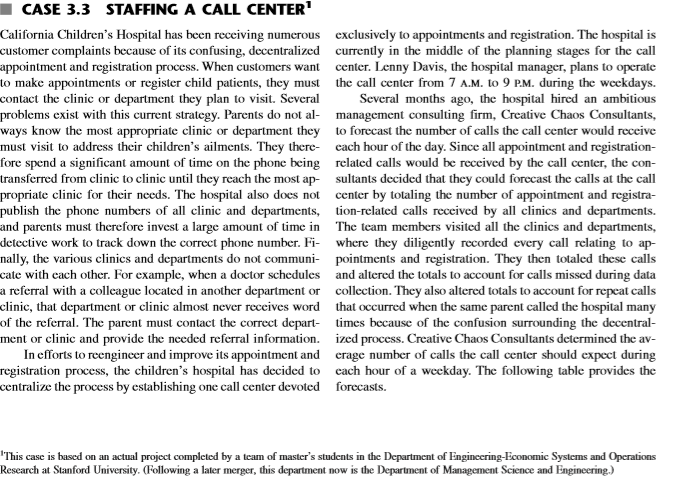
This case is based on an actual project completed by a team of master's students in the Department of EngineeringEconomic Systems and Operations
Research at Stanford University. Following a later merger, this department now is the Department of Management Science and Engineering.
After the consultants submitted these forecasts, Lenny be
came interested in the percentage of calls from Spanish
speakers since the hospital services many Spanish patients.
Lenny knows that he has to hire some operators who speak
Spanish to handle these calls. The consultants performed fur
ther data collection and determined that on average, per
cent of the calls were from Spanish speakers.
Given these call forecasts, Lenny must now decide how
to staff the call center during each hour shift of a weekday.
During the forecasting project, Creative Chaos Consultants
closely observed the operators working at the individual clin
ics and departments and determined the number of calls op
erators process per hour. The consultants informed Lenny that
an operator is able to process an average of six calls per hour.
Lenny also knows that he has both fulltime and parttime
workers available to staff the call center. A fulltime employee
works hours per day, but because of paperwork that must
also be completed, the employee spends only hours per day
on the phone. To balance the schedule, the employee alter
nates the hour shifts between answering phones and com
pleting paperwork. Fulltime employees can start their day ei
ther by answering phones or by completing paperwork on the
first shift. The fulltime employees speak either Spanish or
English, but none of them are bilingual. Both Spanishspeak
ing and Englishspeaking employees are paid $ per hour
for work before PM and $ per hour for work after PM
The fulltime employees can begin work at the beginning of
the AM to AM shift, AM to AM shift, AM to
PM shift, or PM to PM shift. The parttime employees
work for hours, only answer calls, and only speak English.
They can start work at the beginning of the PM to PM
shift or the PM to PM shift, and like the fulltime em
ployees, they are paid $ per hour for work before PM
and $ per hour for work after PM
For the following analysis consider only the labor cost
for the time employees spend answering phones. The cost
for paperwork time is charged to other cost centers.
a How many Spanishspeaking operators and how many English
speaking operators does the hospital need to staff the call cen
ter during each hour shift of the day in order to answer all
calls? Please provide an integer number since half a human op
erator makes no sense.
b Lenny needs to determine how many fulltime employees who
speak Spanish, fulltime employees who speak English, and part
time employees he should hire to begin on each shift. Creative
Chaos Consultants advise him that linear programming can be
used to do this in such a way as to minimize operating costs
while answering all calls. Formulate a linear programming
model of this problem.
c Obtain an optimal solution for the linear programming model
formulated in part b to guide Lenny's decision.
d Because many fulltime workers do not want to work late into the
evening, Lenny can find only one qualified Englishspeaking op
erator willing to begin work at PM Given this new constraint,
how many fulltime Englishspeaking operators, fulltime Spanish
speaking operators, and parttime operators should Lenny hire for
each shift to minimize operating costs while answering all calls?
e Lenny now has decided to investigate the option of hiring bilin
gual operators instead of monolingual operators. If all the op
erators are bilingual, how many operators should be working
during each hour shift to answer all phone calls? As in part
a please provide an integer answer.
f If all employees are bilingual, how many fulltime and parttime
employees should Lenny hire to begin on each shift to minimize
operating costs while answering all calls? As in part b for
mulate a linear programming model to guide Lenny's decision.
g What is the maximum percentage increase in the hourly wage
rate that Lenny can pay bilingual employees over monolingual
employees without increasing the total operating costs?
h What other features of the call center should Lenny explore to
improve service or minimize operating costs?
Step by Step Solution
There are 3 Steps involved in it
1 Expert Approved Answer
Step: 1 Unlock

Question Has Been Solved by an Expert!
Get step-by-step solutions from verified subject matter experts
Step: 2 Unlock
Step: 3 Unlock
 Study Help