







Question: I need three strong questions based on reading COMBAHEE RIVER COLLECTIVE A Black Feminist Statement (UNITED STATES, 1977) Like Sojourner Truth, Anna Julia Cooper, and
I need three strong questions based on reading 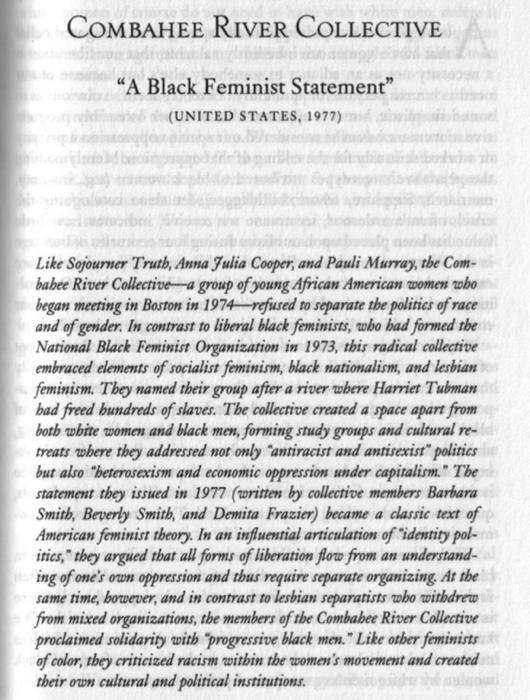
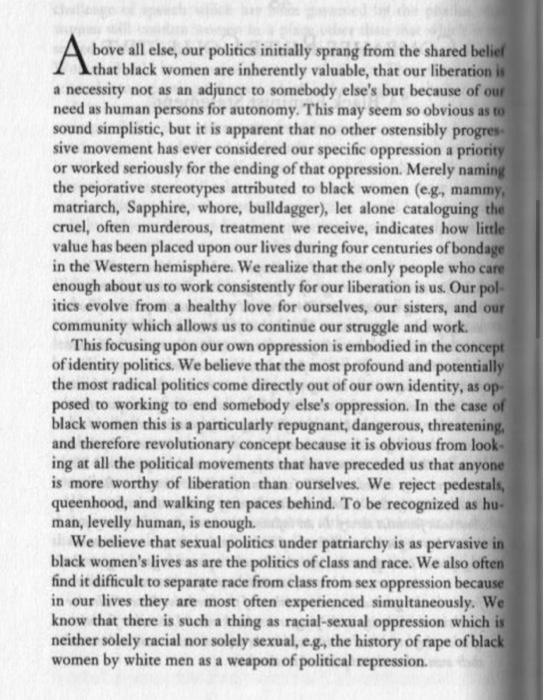
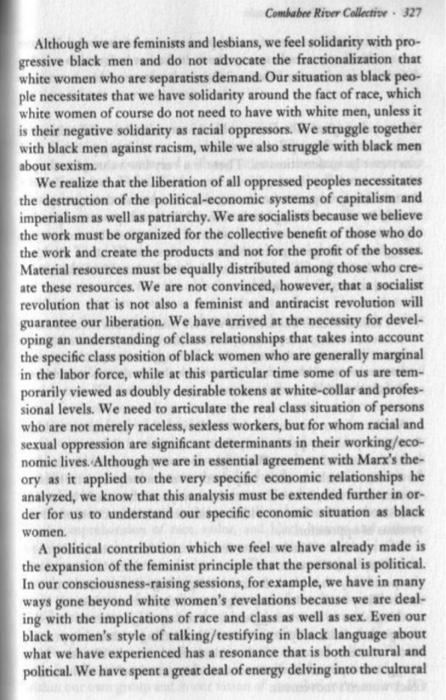
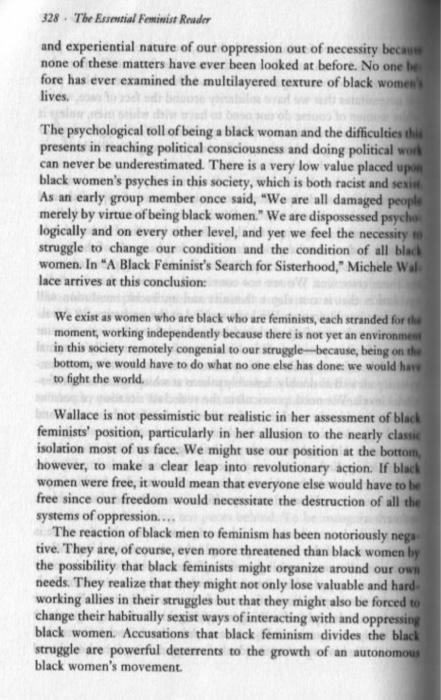
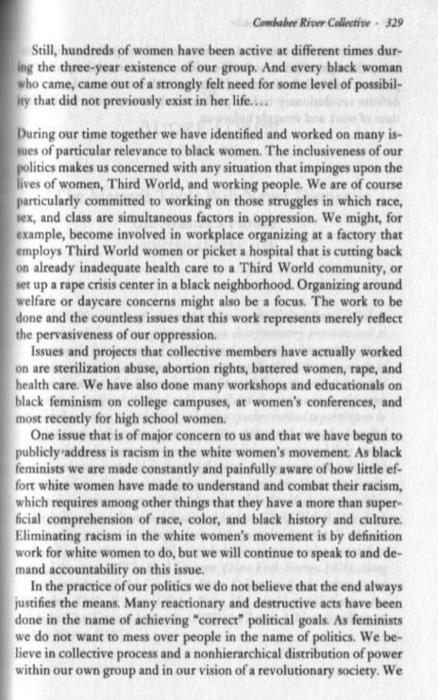
COMBAHEE RIVER COLLECTIVE "A Black Feminist Statement" (UNITED STATES, 1977) Like Sojourner Truth, Anna Julia Cooper, and Pauli Murray, the Com- babee River Collective-a group of young African American women who began meeting in Boston in 1974 refused to separate the politics of race and of gender. In contrast to liberal black feminists, who had formed the National Black Feminist Organization in 1973, this radical collective embraced elements of socialist feminism, black nationalism, and lesbian feminism. They named their group after a river where Harriet Tubman had freed hundreds of slaves. The collective created a space apart from both white women and black men, forming study groups and cultural re- treats where they addressed not only "antiracist and antisexist" politics but also "heterosexism and economic oppression under capitalism." The statement they issued in 1977 (written by collective members Barbara Smith, Beverly Smith, and Demita Frazier) became a classic text of American feminist theory. In an influential articulation of "identity pol- itics," they argued that all forms of liberation flow from an understand- ing of one's own oppression and thus require separate organizing. At the same time, bowever, and in contrast to lesbian separatists who withdrew from mixed organizations, the members of the Combabee River Collective proclaimed solidarity with "progressive black men." Like other feminists of color, they criticized racism within the women's movement and created their own cultural and political institutions. bove all else, our politics initially sprang from the shared belief that black women are inherently valuable, that our liberation is a necessity not as an adjunct to somebody else's but because of our need as human persons for autonomy. This may seem so obvious as to sound simplistic, but it is apparent that no other ostensibly progres sive movement has ever considered our specific oppression a priority or worked seriously for the ending of that oppression. Merely naming the pejorative stereotypes attributed to black women (eg, mammy, matriarch, Sapphire, whore, bulldagger), let alone cataloguing the cruel, often murderous, treatment we receive, indicates how little value has been placed upon our lives during four centuries of bondage in the Western hemisphere. We realize that the only people who care enough about us to work consistently for our liberation is us. Our pol- itics evolve from a healthy love for ourselves, our sisters, and our community which allows us to continue our struggle and work. This focusing upon our own oppression is embodied in the concept of identity politics. We believe that the most profound and potentially the most radical politics come directly out of our own identity, as op posed to working to end somebody else's oppression. In the case of black women this is a particularly repugnant, dangerous, threatening, and therefore revolutionary concept because it is obvious from look- ing at all the political movements that have preceded us that anyone is more worthy of liberation than ourselves . We reject pedestals, queenhood, and walking ten paces behind. To be recognized as hu- man, levelly human, is enough. We believe that sexual politics under patriarchy is as pervasive in black women's lives as are the politics of class and race. We also often find it difficult to separate race from class from sex oppression because in our lives they are most often experienced simultaneously. We know that there is such a thing as racial-sexual oppression which is neither solely racial nor solely sexual, e.g., the history of rape of black women by white men as a weapon of political repression. Comhabee River Collectio 327 Although we are feminists and lesbians, we feel solidarity with pro- gressive black men and do not advocate the fractionalization that white women who are separatists demand. Our situation as black peo- ple necessitates that we have solidarity around the fact of race, which white women of course do not need to have with white men, unless it is their negative solidarity as racial oppressors. We struggle together with black men against racism, while we also struggle with black men about sexism. We realize that the liberation of all oppressed peoples necessitates the destruction of the political-economic systems of capitalism and imperialism as well as patriarchy. We are socialists because we believe the work must be organized for the collective benefit of those who do the work and create the products and not for the profit of the bosses. Material resources must be equally distributed among those who cre- ate these resources. We are not convinced, however, that a socialist revolution that is not also a feminist and antiracist revolution will guarantee our liberation. We have arrived at the necessity for devel- oping an understanding of class relationships that takes into account the specific class position of black women who are generally marginal in the labor force, while at this particular time some of us are tem- porarily viewed as doubly desirable tokens ar white-collar and profes- sional levels. We need to articulate the real class situation of persons who are not merely raceless, sexless workers, but for whom racial and sexual oppression are significant determinants in their working/eco- nomic lives. Although we are in essential agreement with Marx's the ory as it applied to the very specific economic relationships he analyzed, we know that this analysis must be extended further in or der for us to understand our specific economic situation as black women. A political contribution which we feel we have already made is the expansion of the feminist principle that the personal is political. In our consciousness-raising sessions, for example, we have in many ways gone beyond white women's revelations because we are deal- ing with the implications of race and class as well as sex. Even our black women's style of talking/testifying in black language about what we have experienced has a resonance that is both cultural and political. We have spent a great deal of energy delving into the cultural 328 . The Essential Feminist Reader and experiential nature of our oppression out of necessity because none of these matters have ever been looked at before. No one le fore has ever examined the multilayered texture of black women's lives. The psychological toll of being a black woman and the difficulties til presents in reaching political consciousness and doing political work can never be underestimated. There is a very low value placed upon black women's psyches in this society, which is both racist and sexist As an early group member once said, "We are all damaged people merely by virtue of being black women." We are dispossessed psych logically and on every other level, and yet we feel the necessity t struggle to change our condition and the condition of all black women. In "A Black Feminist's Search for Sisterhood," Michele Wale lace arrives at this conclusion: We exist as women who are black who are feminists, each stranded for the moment, working independently because there is not yet an environment in this society remotely congenial to our struggle--because, being on the bottom, we would have to do what no one else has done we would be to fight the world Wallace is not pessimistic but realistic in her assessment of black feminists' position, particularly in her allusion to the nearly classic isolation most of us face. We might use our position at the bottom however, to make a clear leap into revolutionary action. If black women were free, it would mean that everyone else would have to be free since our freedom would necessitate the destruction of all the systems of oppression.... The reaction of black men to feminism has been notoriously nega tive. They are, of course, even more threatened than black women by the possibility that black feminists might organize around our own needs. They realize that they might not only lose valuable and hard working allies in their struggles but that they might also be forced to change their habitually sexist ways of interacting with and oppressing black women. Accusations that black feminism divides the black struggle are powerful deterrents to the growth of an autonomous black women's movement. Comkaber River Collective 329 Still, hundreds of women have been active at different times dur- ing the three-year existence of our group. And every black woman who came, came out of a strongly felt need for some level of possibil- ity that did not previously exist in her life.... During our time together we have identified and worked on many is- sues of particular relevance to black women. The inclusiveness of our politics makes us concerned with any situation that impinges upon the lives of women, Third World, and working people. We are of course particularly committed to working on those struggles in which race, sex, and class are simultaneous factors in oppression. We might, for example, become involved in workplace organizing at a factory that employs Third World women or picket a hospital that is cutting back on already inadequate health care to a Third World community, or set up a rape crisis center in a black neighborhood. Organizing around welfare or daycare concerns might also be a focus. The work to be done and the countless issues that this work represents merely reflect the pervasiveness of our oppression. Issues and projects that collective members have actually worked on are sterilization abuse, abortion rights, battered women, rape, and health care. We have also done many workshops and educationals on black feminism on college campuses, at women's conferences, and most recently for high school women. One issue that is of major concern to us and that we have begun to publicly address is racism in the white women's movement. As black feminists we are made constantly and painfully aware of how little ef- fort white women have made to understand and combat their racism, which requires among other things that they have a more than super- ficial comprehension of race, color, and black history and culture. Eliminating racism in the white women's movement is by definition work for white women to do, but we will continue to speak to and de- mand accountability on this issue. In the practice of our politics we do not believe that the end always justifies the means. Many reactionary and destructive acts have been done in the name of achieving "correct" political goals. As feminists we do not want to mess over people in the name of politics. We be- lieve in collective process and a nonhierarchical distribution of power within our own group and in our vision of a revolutionary society. We
Step by Step Solution
There are 3 Steps involved in it
1 Expert Approved Answer
Step: 1 Unlock

Question Has Been Solved by an Expert!
Get step-by-step solutions from verified subject matter experts
Step: 2 Unlock
Step: 3 Unlock
 Study Help