







Question: I need to create a logic circuit for a spin direction detector. Consider a system which consists of a spinning circular disk and stationary probes
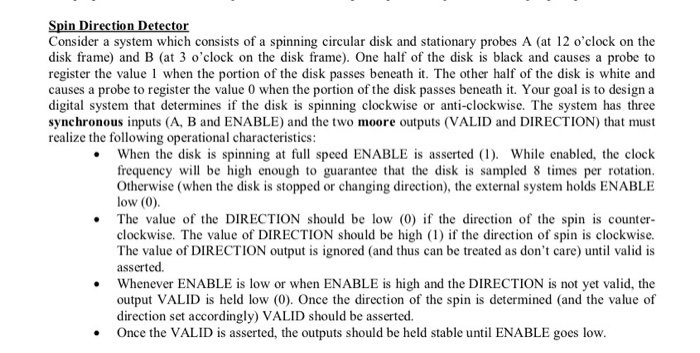

Consider a system which consists of a spinning circular disk and stationary probes A (at 12 o'clock on the disk frame) and B (at 3 o'clock on the disk frame). One half of the disk is black and causes a probe to register the value 1 when the portion of the disk passes beneath it. The other half of the disk is white and causes a probe to register the value 0 when the portion of the disk passes beneath it. Your goal is to design a digital system that determines if the disk is spinning clockwise or anti-clockwise. The system has three synchronous inputs (A, B and ENABLE) and the two moore outputs (VALID and DIRECTION) that must realize the following operational characteristics When the disk is spinning at full speed ENABLE is asserted (). While enabled, the clock frequency wll be high enough to guarantee that the disk is sampled 8 times per rotation Otherwise (when the disk is stopped or changing direction), the external system holds ENABLE low (0) The value of the DIRECTION should be low (0) if the direction of the spin is counter- clockwise. The value of DIRECTION should be high () if the direction of spin is clockwise. The value of DIRECTION output is ignored (and thus can be treated as don't care) until valid is asserted. Whenever ENABLE is low or when ENABLE is high and the DIRECTION is not yet valid, the output VALID is held low (0). Once the direction of the spin is determined (and the value of direction set accordingly) VALID should be asserted. Once the VALID is asserted, the outputs should be held stable until ENABLE goes low
Step by Step Solution
There are 3 Steps involved in it

Get step-by-step solutions from verified subject matter experts
 Study Help