







Question: I only need a matlab code for this question as solution. I don't need it numerically.( again i need it in matlab.) . Consider the
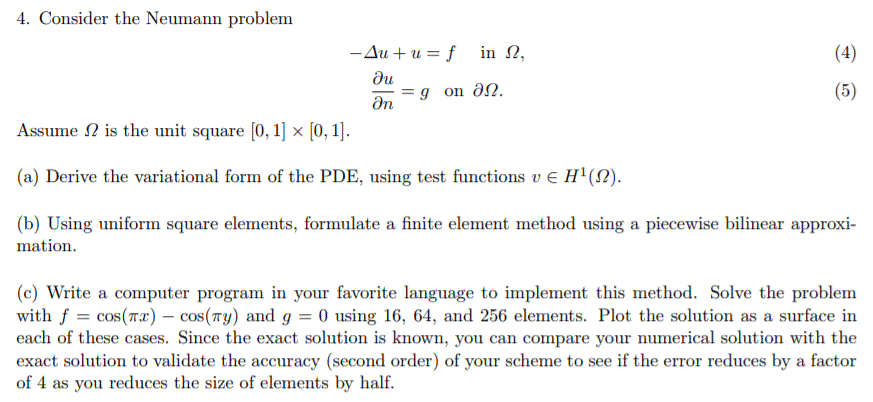 I only need a matlab code for this question as solution. I don't need it numerically.( again i need it in matlab.)
. Consider the Neumann problem -, on Q. Assume ? is the unit square [0, 1] [0,1]. (a) Derive the variational form of the PDE, using test functions v E H(2) (b) Using uniform square elements, formulate a finite element method using a piecewise bilinear approxi- mation. (c) Write a computer program in your favorite language to implement this method. Solve the problem with f = cos(mr)-cos(my) and g = 0 using 16, 64, and 256 elements. Plot the solution as a surface in each of these cases. Since the exact solution is known, you can compare your numerical solution with the exact solution to validate the accuracy (second order) of your scheme to see if the error reduces by a factor of 4 as you reduces the size of elements by half. . Consider the Neumann problem -, on Q. Assume ? is the unit square [0, 1] [0,1]. (a) Derive the variational form of the PDE, using test functions v E H(2) (b) Using uniform square elements, formulate a finite element method using a piecewise bilinear approxi- mation. (c) Write a computer program in your favorite language to implement this method. Solve the problem with f = cos(mr)-cos(my) and g = 0 using 16, 64, and 256 elements. Plot the solution as a surface in each of these cases. Since the exact solution is known, you can compare your numerical solution with the exact solution to validate the accuracy (second order) of your scheme to see if the error reduces by a factor of 4 as you reduces the size of elements by half
Step by Step Solution
There are 3 Steps involved in it

Get step-by-step solutions from verified subject matter experts
 Study Help