







Question: I prefer computer typed answer because I could not understand bad hand writing. Also, if you try to answer only part of question for taking
I prefer computer typed answer because I could not understand bad hand writing.
Also, if you try to answer only part of question for taking your score, I will report you to Chegg. Please do not take my question for free.
The question is related to 'Graph Theory and Non-Enumerative Combinatorics' course.
Thank you in advance and I apologize for being aggressive because of many free question takers.
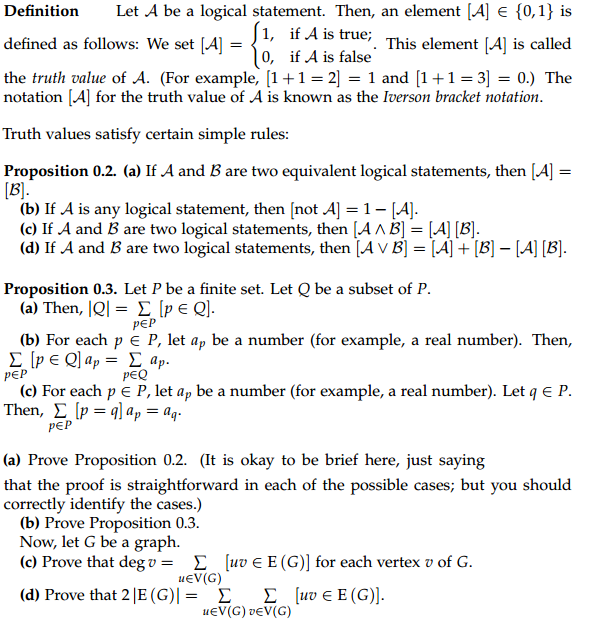
Definition Let A be a logical statement. Then, an element [A] e 10,1 is 1, if A is true defined as follows: We set Al This element [A) is called 0, if A is false the truth value of A. (For example, [1 +1 2 1 and L1 +1 3 0.) The notation [A] for the truth value of A is known as the Iverson bracket notation. Truth values satisfy certain simple rules: Proposition 0.2. (a) If A and Bare two equivalent logical statements, then LA] (b) If A is any logical statement, then not Al 1 Al. (c) If A and B are two logical statements, then LA A Bl LA] [B1. (d) If A and B are two logical statements, then LA VB] (Al +IB] LA] B. Proposition 0.3. Let P be a finite set. Let Q be a subset of P. (a) Then I [p E Q]. PEP (b) For each p E P, let ap be a number (for example, a real number). Then, PEP PEQ (c) For each p e P, let ap be a number (for example, a real number). Let q e P. Then, E.Ip alap a pEP (a) Prove Proposition 0.2. (It is okay to be brief here, just saying that the proof is straightforward in each of the possible cases; but you should correctly identify the cases.) (b) Prove Proposition 0.3. Now, let G be a graph. (c) Prove that deg v uv EE (G) for each vertex v of G. EV(G) (d) Prove that 2 E(G) Cuv E E (G)] Definition Let A be a logical statement. Then, an element [A] e 10,1 is 1, if A is true defined as follows: We set Al This element [A) is called 0, if A is false the truth value of A. (For example, [1 +1 2 1 and L1 +1 3 0.) The notation [A] for the truth value of A is known as the Iverson bracket notation. Truth values satisfy certain simple rules: Proposition 0.2. (a) If A and Bare two equivalent logical statements, then LA] (b) If A is any logical statement, then not Al 1 Al. (c) If A and B are two logical statements, then LA A Bl LA] [B1. (d) If A and B are two logical statements, then LA VB] (Al +IB] LA] B. Proposition 0.3. Let P be a finite set. Let Q be a subset of P. (a) Then I [p E Q]. PEP (b) For each p E P, let ap be a number (for example, a real number). Then, PEP PEQ (c) For each p e P, let ap be a number (for example, a real number). Let q e P. Then, E.Ip alap a pEP (a) Prove Proposition 0.2. (It is okay to be brief here, just saying that the proof is straightforward in each of the possible cases; but you should correctly identify the cases.) (b) Prove Proposition 0.3. Now, let G be a graph. (c) Prove that deg v uv EE (G) for each vertex v of G. EV(G) (d) Prove that 2 E(G) Cuv E E (G)]
Step by Step Solution
There are 3 Steps involved in it

Get step-by-step solutions from verified subject matter experts
 Study Help