



Question: I. (Representative Consumer Utility Maximization with Quasi-linear Quadratic Utility (and Linear Demand System) Consider a representative consumer with the following quasi-linear utility function over
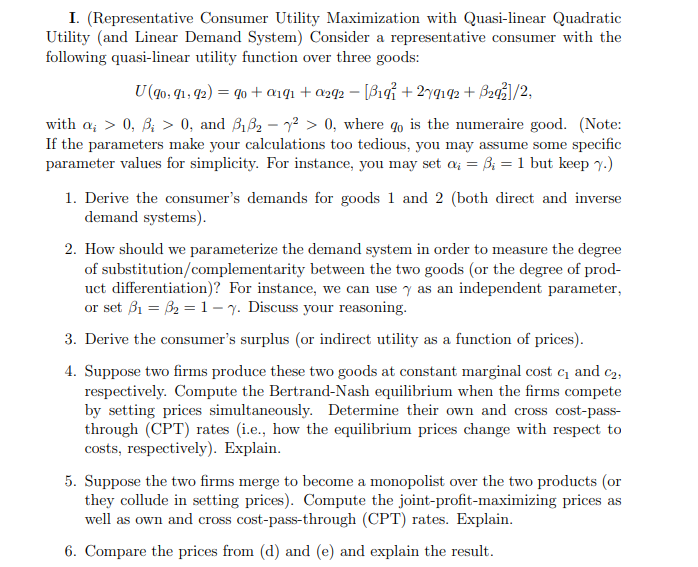
I. (Representative Consumer Utility Maximization with Quasi-linear Quadratic Utility (and Linear Demand System) Consider a representative consumer with the following quasi-linear utility function over three goods: U (90, 91, 92) = 9o + a191 + a292 - [Bigi +279192 +82931/2, with a > 0, ; > 0, and 3 7 > 0, where qo is the numeraire good. (Note: If the parameters make your calculations too tedious, you may assume some specific parameter values for simplicity. For instance, you may set a = 3; = 1 but keep y.) 1. Derive the consumer's demands for goods 1 and 2 (both direct and inverse demand systems). 2. How should we parameterize the demand system in order to measure the degree of substitution/complementarity between the two goods (or the degree of prod- uct differentiation)? For instance, we can use y as an independent parameter, or set 3= 3 = 1-7. Discuss your reasoning. 3. Derive the consumer's surplus (or indirect utility as a function of prices). 4. Suppose two firms produce these two goods at constant marginal cost c and c, respectively. Compute the Bertrand-Nash equilibrium when the firms compete by setting prices simultaneously. Determine their own and cross cost-pass- through (CPT) rates (i.e., how the equilibrium prices change with respect to costs, respectively). Explain. 5. Suppose the two firms merge to become a monopolist over the two products (or they collude in setting prices). Compute the joint-profit-maximizing prices as well as own and cross cost-pass-through (CPT) rates. Explain. 6. Compare the prices from (d) and (e) and explain the result.
Step by Step Solution
3.48 Rating (158 Votes )
There are 3 Steps involved in it
Here are the answers to the questions 1 Demand functions q1 a ... View full answer

Get step-by-step solutions from verified subject matter experts