







Question: I want the conclusion based on the data below Conclusion 1. Explain how the observations that were made were indicative of a chemical reaction. 2.
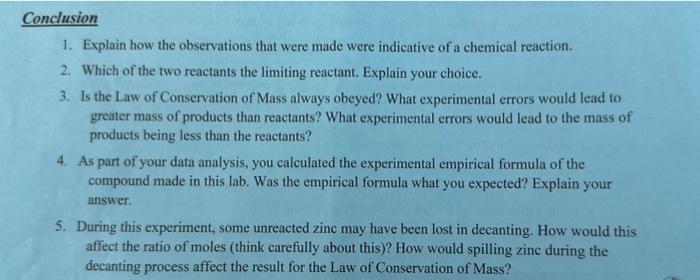
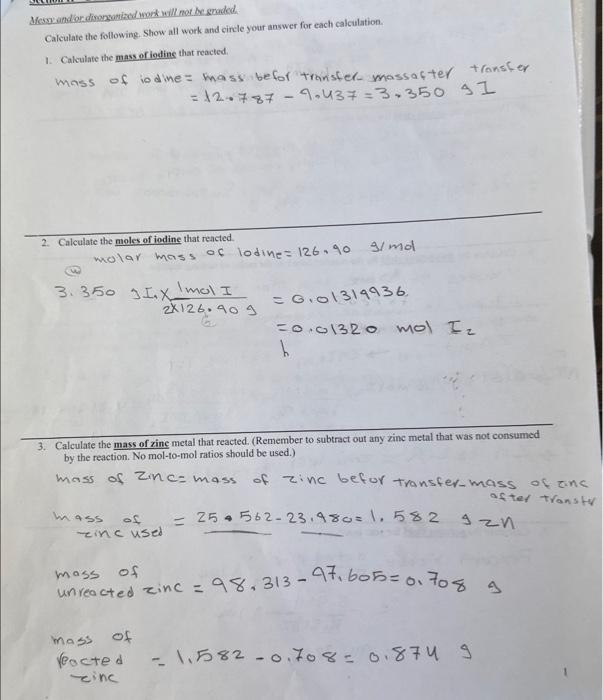
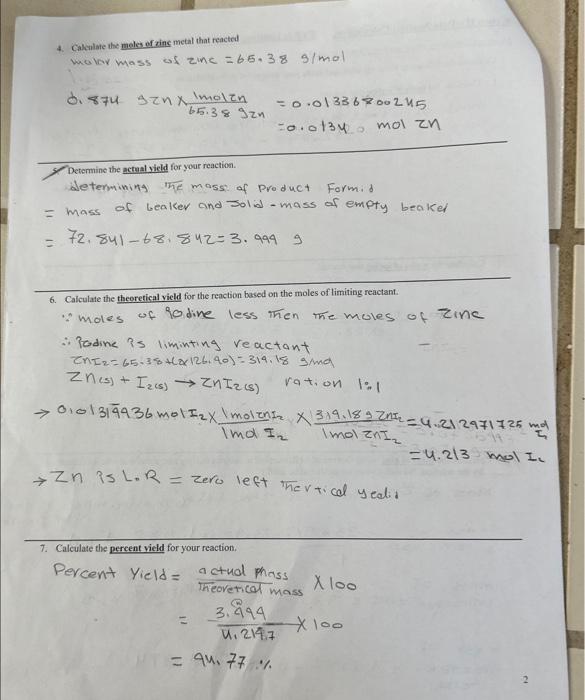
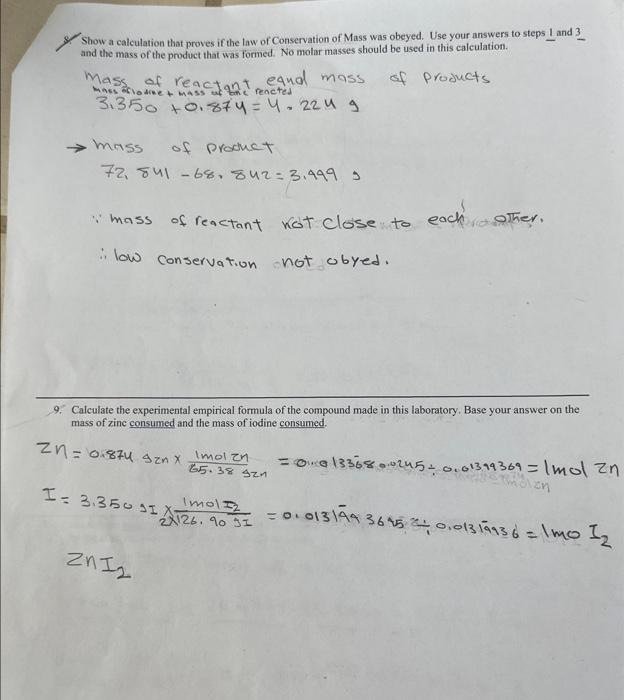
Conclusion 1. Explain how the observations that were made were indicative of a chemical reaction. 2. Which of the two reactants the limiting reactant. Explain your choice. 3. Is the Law of Conservation of Mass always obeyed? What experimental errors would lead to greater mass of products than reactants? What experimental errors would lead to the mass of products being less than the reactants? 4. As part of your data analysis, you calculated the experimental empirical formula of the compound made in this lab. Was the empirical formula what you expected? Explain your answer. 5. During this experiment, some unreacted zinc may have been lost in decanting. How would this affect the ratio of moles (think carefully about this)? How would spilling zine during the decanting process affect the result for the Law of Conservation of Mass? Messs and or disonsumiacd work will not be graded. Calculate the following. Show all work and cincle your answer for each calculation. 1. Cakeulate the mass of iodine that reacted. mass of iodine = mass befor transtee massacter transter =12.7879.437=3.350sI 2. Calculate the moles of iodine that reacted. molar mass of lodine =126,90g/mol 3.3503I2126.909molI=0.01319936=0.01320mol2h 3. Calculate the mass of zine metal that reacted. (Remember to subtract out any zinc metal that was not consumed by the reaction. No mol-to-mol ratios should be used.) mass of Zinc = mass of Zinc befor transfer-mass of oin massofzincused=25+56223.980=1.5829gn mass of unreacted zinc =98.31397.605=0.708s mass of rocted =1.5820.708=0.8749 4. Calenlate the meles of rinc metal that reacted. molar mass of zine =65.38s/mol d. 874Szn65.3892nlmolzn=0.013368002145 =0.0134. mol Zn Determine the actal yield for your reaction. determining the mass: of product formid = mass of beaker and Solid-mass of empty beokel =72.84168.842=3.9999 6. Calculate the theoretical vield for the reaction based on the moles of limiting reactant. moles of godine less then the moles of Zine Podine is liminting veactant in I2=65.38+(2126.40)=319.18 gind Zn(s)+I2(s)ZnI2(s) ration 1:1 0.01319936molI2lmdI2lmolinI2molZnI2319.189ZnI2=4.21297 =4.213 Zn is L.R = zero left thertical yeal: 7. Calculate the percent vield for your reaction: Percent Yield =Theoreticalmassactualphass100 =4.21473.494100=9u177% 9. Show a calculation that proves if the law of Conservation of Mass was obeyed. Use your answers to steps 1 and 3 and the mass of the product that was formed. No molar masses should be used in this calculation. Mass of reactint equal mass of products mass ofiodine + mass wh the rencted 3.350+0.874=42249 mmss of product 72,84168.842=3,9999 mass of reactant not close to each other. low conservation not obyed. 9. Calculate the experimental empirical formula of the compound made in this laboratory. Base your answer on the mass of zine consumed and the mass of iodine consumed. Zn=0.874szn65.38sznlmolzn=0.0133680.02450.01399369=1molzrI=3.350.9I2126.903I11molII=0.0131943645.10.013199361=1molI2 Conclusion 1. Explain how the observations that were made were indicative of a chemical reaction. 2. Which of the two reactants the limiting reactant. Explain your choice. 3. Is the Law of Conservation of Mass always obeyed? What experimental errors would lead to greater mass of products than reactants? What experimental errors would lead to the mass of products being less than the reactants? 4. As part of your data analysis, you calculated the experimental empirical formula of the compound made in this lab. Was the empirical formula what you expected? Explain your answer. 5. During this experiment, some unreacted zinc may have been lost in decanting. How would this affect the ratio of moles (think carefully about this)? How would spilling zine during the decanting process affect the result for the Law of Conservation of Mass? Messs and or disonsumiacd work will not be graded. Calculate the following. Show all work and cincle your answer for each calculation. 1. Cakeulate the mass of iodine that reacted. mass of iodine = mass befor transtee massacter transter =12.7879.437=3.350sI 2. Calculate the moles of iodine that reacted. molar mass of lodine =126,90g/mol 3.3503I2126.909molI=0.01319936=0.01320mol2h 3. Calculate the mass of zine metal that reacted. (Remember to subtract out any zinc metal that was not consumed by the reaction. No mol-to-mol ratios should be used.) mass of Zinc = mass of Zinc befor transfer-mass of oin massofzincused=25+56223.980=1.5829gn mass of unreacted zinc =98.31397.605=0.708s mass of rocted =1.5820.708=0.8749 4. Calenlate the meles of rinc metal that reacted. molar mass of zine =65.38s/mol d. 874Szn65.3892nlmolzn=0.013368002145 =0.0134. mol Zn Determine the actal yield for your reaction. determining the mass: of product formid = mass of beaker and Solid-mass of empty beokel =72.84168.842=3.9999 6. Calculate the theoretical vield for the reaction based on the moles of limiting reactant. moles of godine less then the moles of Zine Podine is liminting veactant in I2=65.38+(2126.40)=319.18 gind Zn(s)+I2(s)ZnI2(s) ration 1:1 0.01319936molI2lmdI2lmolinI2molZnI2319.189ZnI2=4.21297 =4.213 Zn is L.R = zero left thertical yeal: 7. Calculate the percent vield for your reaction: Percent Yield =Theoreticalmassactualphass100 =4.21473.494100=9u177% 9. Show a calculation that proves if the law of Conservation of Mass was obeyed. Use your answers to steps 1 and 3 and the mass of the product that was formed. No molar masses should be used in this calculation. Mass of reactint equal mass of products mass ofiodine + mass wh the rencted 3.350+0.874=42249 mmss of product 72,84168.842=3,9999 mass of reactant not close to each other. low conservation not obyed. 9. Calculate the experimental empirical formula of the compound made in this laboratory. Base your answer on the mass of zine consumed and the mass of iodine consumed. Zn=0.874szn65.38sznlmolzn=0.0133680.02450.01399369=1molzrI=3.350.9I2126.903I11molII=0.0131943645.10.013199361=1molI2
Step by Step Solution
There are 3 Steps involved in it

Get step-by-step solutions from verified subject matter experts
 Study Help