Question: Based on the article you read, write a reflection paper to share your thoughts and feelings about the tragic accidents of the Deepwater Horizon. Introduction.
- Based on the article you read, write a reflection paper to share your thoughts and feelings about the tragic accidents of the Deepwater Horizon.
- Introduction. Explain briefly what the article is all about. To include AT LEAST FIVE (5) important points.When writing the introduction, imagine that you have not read the full article yourself. Hence, when reading your own written introduction, you can get a little idea about the article. introduction should not be more than 350 words.
- content:
- First Paragraph. Write your opinion on what is the MAIN CAUSE of the oil spill.
- Second Paragraph. Based on your answer in paragraph 1, explain and justify your opinion (what makes you think that is the MAIN CAUSE).
- Based on the writing in the article, who should be blamed or held accountable for this oil spill accident. Explain / justify your answer. not less than 300 words.
- Conclusion. Conclude your writing by relating the article with any of the topics that you have learnt in your Safety and Health Administration class. (i.e. employers duty of care, safety awareness, safety training, safety communication, emergency management system etc.)
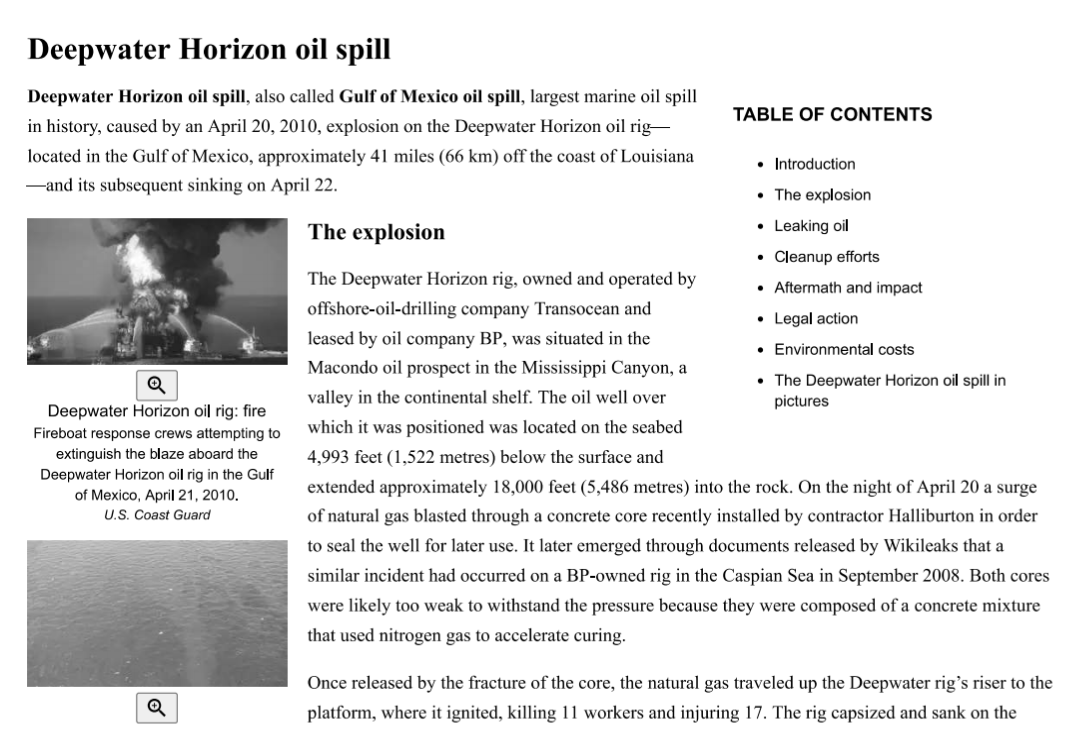
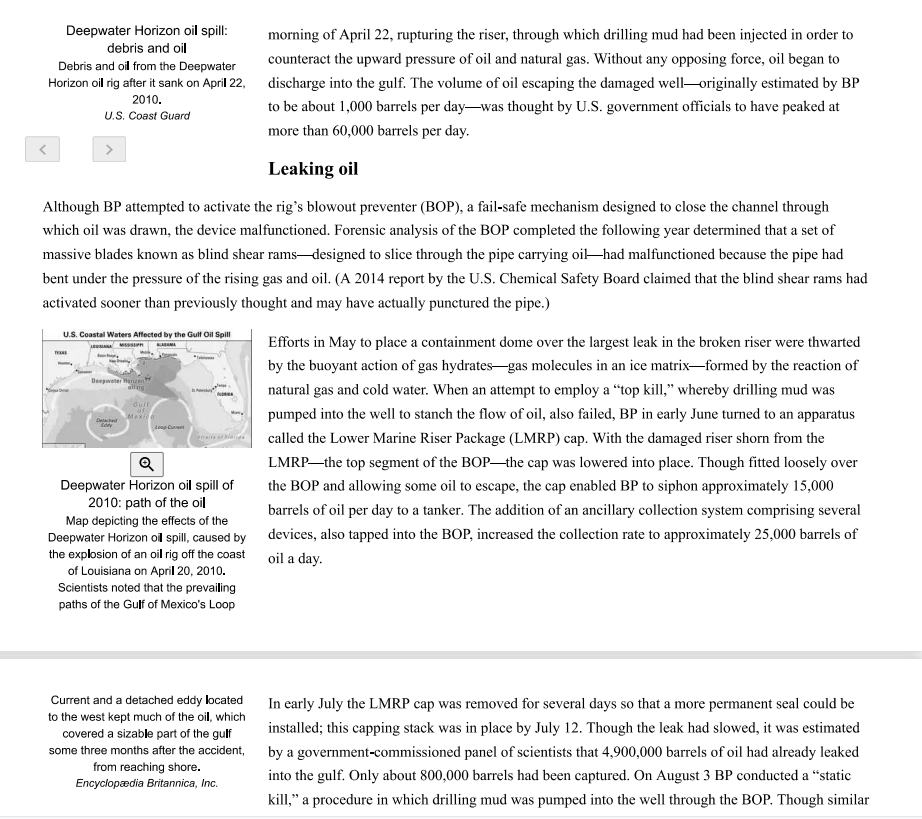
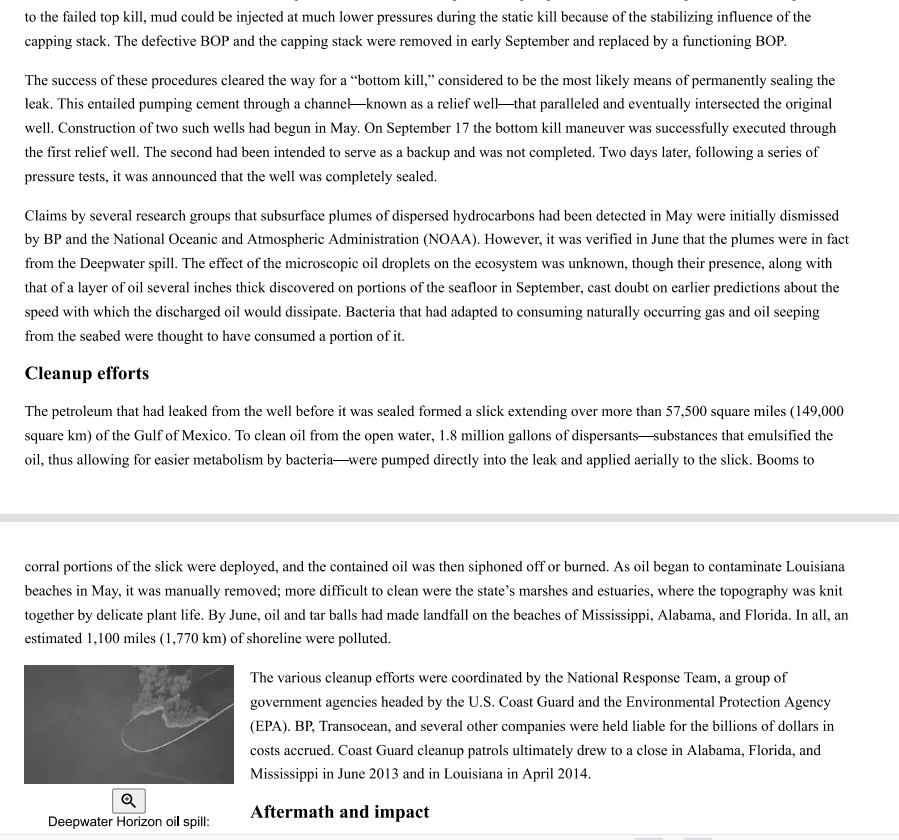
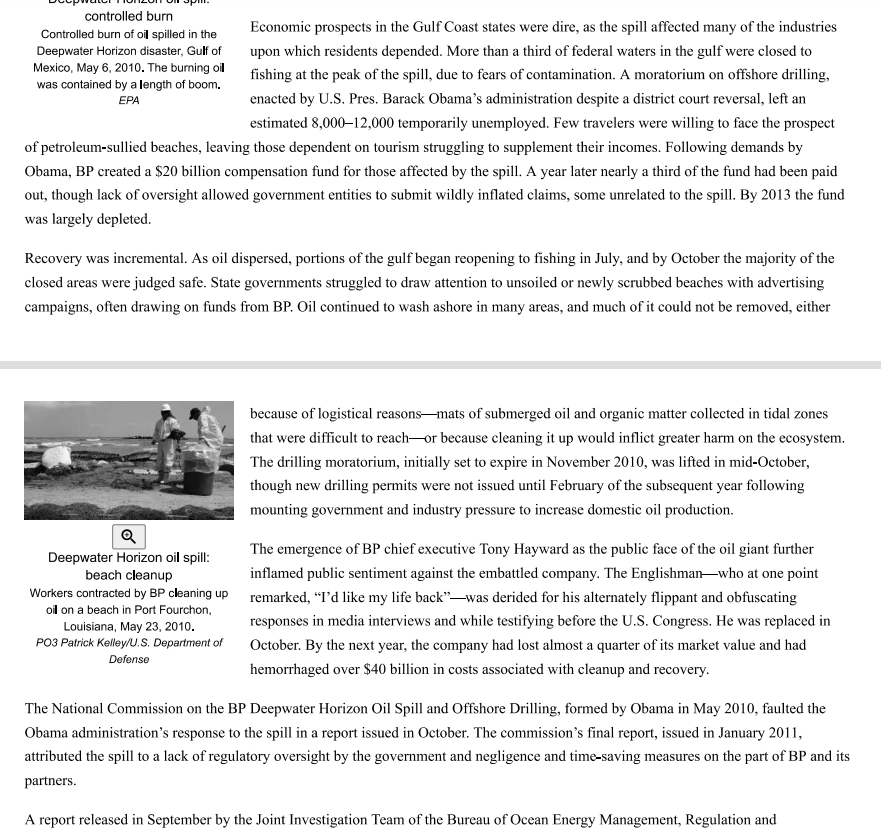
Deepwater Horizon oil spill . . Deepwater Horizon oil spill, also called Gulf of Mexico oil spill, largest marine oil spill TABLE OF CONTENTS in history, caused by an April 20, 2010, explosion on the Deepwater Horizon oil rig- located in the Gulf of Mexico, approximately 41 miles (66 km) off the coast of Louisiana Introduction and its subsequent sinking on April 22. The explosion The explosion Leaking oil Cleanup efforts The Deepwater Horizon rig, owned and operated by Aftermath and impact offshore-oil-drilling company Transocean and Legal action leased by oil company BP, was situated in the Environmental costs Macondo oil prospect in the Mississippi Canyon, a The Deepwater Horizon oil spill in valley in the continental shelf. The oil well over pictures Deepwater Horizon oil rig: fire Fireboat response crews attempting to which it was positioned was located on the seabed extinguish the blaze aboard the 4,993 feet (1,522 metres) below the surface and Deepwater Horizon oil rig in the Gulf of Mexico, April 21, 2010. extended approximately 18,000 feet (5,486 metres) into the rock. On the night of April 20 a surge U.S. Coast Guard of natural gas blasted through a concrete core recently installed by contractor Halliburton in order to seal the well for later use. It later emerged through documents released by Wikileaks that a similar incident had occurred on a BP-owned rig in the Caspian Sea in September 2008. Both cores were likely too weak to withstand the pressure because they were composed of a concrete mixture that used nitrogen gas to accelerate curing. . Once released by the fracture of the core, the natural gas traveled up the Deepwater rig's riser to the platform, where it ignited, killing 11 workers and injuring 17. The rig capsized and sank on the Deepwater Horizon oil spill: morning of April 22, rupturing the riser, through which drilling mud had been injected in order to debris and oil Debris and oil from the Deepwater counteract the upward pressure of oil and natural gas. Without any opposing force, oil began to Horizon oil rig after it sank on April 22, discharge into the gulf. The volume of oil escaping the damaged well-originally estimated by BP 2010. to be about 1,000 barrels per daywas thought by U.S. government officials to have peaked at U.S. Coast Guard more than 60,000 barrels per day. > Leaking oil Deepwater en biling Although BP attempted to activate the rig's blowout preventer (BOP), a fail-safe mechanism designed to close the channel through which oil was drawn, the device malfunctioned. Forensic analysis of the BOP completed the following year determined that a set of massive blades known as blind shear ramsdesigned to slice through the pipe carrying oilhad malfunctioned because the pipe had bent under the pressure of the rising gas and oil. (A 2014 report by the U.S. Chemical Safety Board claimed that the blind shear rams had activated sooner than previously thought and may have actually punctured the pipe.) U.S. Coastal Waters Affected by the Gulf Oil Spill Efforts in May to place a containment dome over the largest leak in the broken riser were thwarted by the buoyant action of gas hydratesgas molecules in an ice matrix-formed by the reaction of natural gas and cold water. When an attempt to employ a top kill," whereby drilling mud was pumped into the well to stanch the flow of oil, also failed, BP in early June turned to an apparatus called the Lower Marine Riser Package (LMRP) cap. With the damaged riser shorn from the a LMRPthe top segment of the BOPthe cap was lowered into place. Though fitted loosely over Deepwater Horizon oil spill of the BOP and allowing some oil to escape, the cap enabled BP to siphon approximately 15,000 2010: path of the oil barrels of oil per day to a tanker. The addition of an ancillary collection system comprising several Map depicting the effects of the Deepwater Horizon oil spill, caused by devices, also tapped into the BOP, increased the collection rate to approximately 25,000 barrels of the explosion of an oil rig off the coast oil a day. of Louisiana on April 20, 2010. Scientists noted that the prevailing paths of the Gulf of Mexico's Loop Gulr Mexico Duch Current and a detached eddy located to the west kept much of the oil, which covered a sizable part of the gulf some three months after the accident, from reaching shore. Encyclopdia Britannica, Inc. In early July the LMRP cap was removed for several days so that a more permanent seal could be installed; this capping stack was in place by July 12. Though the leak had slowed, it was estimated by a government-commissioned panel of scientists that 4,900,000 barrels of oil had already leaked into the gulf. Only about 800,000 barrels had been captured. On August 3 BP conducted a "static kill," a procedure in which drilling mud was pumped into the well through the BOP. Though similar to the failed top kill, mud could be injected at much lower pressures during the static kill because of the stabilizing influence of the capping stack. The defective BOP and the capping stack were removed in early September and replaced by a functioning BOP. The success of these procedures cleared the way for a bottom kill," considered to be the most likely means of permanently sealing the leak. This entailed pumping cement through a channel-known as a relief wellthat paralleled and eventually intersected the original well. Construction of two such wells had begun in May. On September 17 the bottom kill maneuver was successfully executed through the first relief well. The second had been intended to serve as a backup and was not completed. Two days later, following a series of pressure tests, it was announced that the well was completely sealed. Claims by several research groups that subsurface plumes of dispersed hydrocarbons had been detected in May were initially dismissed by BP and the National Oceanic and Atmospheric Administration (NOAA). However, it was verified in June that the plumes were in fact from the Deepwater spill. The effect of the microscopic oil droplets on the ecosystem was unknown, though their presence, along with that of a layer of oil several inches thick discovered on portions of the seafloor in September, cast doubt on earlier predictions about the speed with which the discharged oil would dissipate. Bacteria that had adapted to consuming naturally occurring gas and oil seeping from the seabed were thought to have consumed a portion of it. Cleanup efforts The petroleum that had leaked from the well before it was sealed formed a slick extending over more than 57,500 square miles (149,000 square km) of the Gulf of Mexico. To clean oil from the open water, 1.8 million gallons of dispersantssubstances that emulsified the oil, thus allowing for easier metabolism by bacteriawere pumped directly into the leak and applied aerially to the slick. Booms to corral portions of the slick were deployed, and the contained oil was then siphoned off or burned. As oil began to contaminate Louisiana beaches in May, it was manually removed; more difficult to clean were the state's marshes and estuaries, where the topography was knit together by delicate plant life. By June, oil and tar balls had made landfall on the beaches of Mississippi, Alabama, and Florida. In all, an estimated 1,100 miles (1,770 km) of shoreline were polluted. The various cleanup efforts were coordinated by the National Response Team, a group of government agencies headed by the U.S. Coast Guard and the Environmental Protection Agency (EPA). BP, Transocean, and several other companies were held liable for the billions of dollars in costs accrued. Coast Guard cleanup patrols ultimately drew to a close in Alabama, Florida, and Mississippi in June 2013 and in Louisiana in April 2014. a Deepwater Horizon oil spill: Aftermath and impact controlled burn Controlled burn of oil spilled in the Economic prospects in the Gulf Coast states were dire, as the spill affected many of the industries Deepwater Horizon disaster, Gulf of upon which residents depended. More than a third of federal waters in the gulf were closed to Mexico, May 6, 2010. The burning oil was contained by a length of boom. fishing at the peak of the spill, due to fears of contamination. A moratorium on offshore drilling, EPA enacted by U.S. Pres. Barack Obama's administration despite a district court reversal, left an estimated 8,00012,000 temporarily unemployed. Few travelers were willing to face the prospect of petroleum-sullied beaches, leaving those dependent on tourism struggling to supplement their incomes. Following demands by Obama, BP created a $20 billion compensation fund for those affected by the spill. A year later nearly a third of the fund had been paid out, though lack of oversight allowed government entities to submit wildly inflated claims, some unrelated to the spill. By 2013 the fund was largely depleted. Recovery was incremental. As oil dispersed, portions of the gulf began reopening to fishing in July, and by October the majority of the closed areas were judged safe. State governments struggled to draw attention to unsoiled or newly scrubbed beaches with advertising campaigns, often drawing on funds from BP. Oil continued to wash ashore in many areas, and much of it could not be removed, either because of logistical reasonsmats of submerged oil and organic matter collected in tidal zones that were difficult to reachor because cleaning it up would inflict greater harm on the ecosystem. The drilling moratorium, initially set to expire in November 2010, was lifted in mid-October, though new drilling permits were not issued until February of the subsequent year following mounting government and industry pressure to increase domestic oil production. Q Deepwater Horizon oil spill: beach cleanup Workers contracted by BP cleaning up oil on a beach in Port Fourchon, Louisiana, May 23, 2010. PO3 Patrick Kelley/U.S. Department of Defense The emergence of BP chief executive Tony Hayward as the public face of the oil giant further inflamed public sentiment against the embattled company. The Englishmanwho at one point remarked, I'd like my life backwas derided for his alternately flippant and obfuscating responses in media interviews and while testifying before the U.S. Congress. He was replaced in October. By the next year, the company had lost almost a quarter of its market value and had hemorrhaged over $40 billion in costs associated with cleanup and recovery. The National Commission on the BP Deepwater Horizon Oil Spill and Offshore Drilling, formed by Obama in May 2010, faulted the Obama administration's response to the spill in a report issued in October. The commission's final report, issued in January 2011, attributed the spill to a lack of regulatory oversight by the government and negligence and time-saving measures on the part of BP and its partners. A report released in September by the Joint Investigation Team of the Bureau of Ocean Energy Management, Regulation and Port TUTVU UTIVUI y II JUILIE HII VOUSULUI TAU VILI DurcuU VI VU LIIS IS TOIL, INUSUILLIOLI ALI Enforcement (BOEMRE) and the U.S. Coast Guard emphasized BP's ultimate responsibility for the disaster. (BOEMRE had supplanted the Minerals Management Agency, which had regulated drilling before the spill, in June 2010.) The report noted that, although the defective concrete cap had been installed by Halliburton, decisions about the installation process made by BP had been the cause of the failure. The investigation further found that BP and Transocean employees aboard the rig hadwhile engaged in testing procedures, ignored early indications of a problem and thus missed opportunities to prevent a full-scale blowout. Though representatives of BP conceded that the company was responsible for some of the factors contributing to the spill, they stressed that their partner companies were also to blame. Halliburton and Transocean similarly pointed to failures on the part of the other parties involved. In 2020, 10 years after the disaster, the former members of the National Commission on the BP Deepwater Horizon Oil Spill and Offshore Drilling noted that the U.S. Congress had failed to act on most of the recommendations in the final report. However, they did note that the oil industry had improved well containment capability. In addition, a study published in the journal Nature in 2020 found that fish in the Gulf of Mexico continued to show evidence of contamination by polycyclic aromatic hydrocarbons (PAH). Legal action Charges, settlements, and penalties A formal civil and criminal investigation into the spill was initiated in June 2010 by the U.S. Department of Justice (DOJ). In August 2010 Louisiana district court judge Carl Barbier was appointed to oversee the consolidated proceedings relating to the spill, which had prompted numerous lawsuits and precipitated a morass of complex legal entanglements, private and public. The DOJ sued BP, Transocean, and Anadarko, a minority owner of the well, in New Orleans civil court in December 2010 for violating the Clean Water Act and Oil Pollution Act In early March 2012 BP agreed to settle claims made by the plaintiffs steering committee, the consolidated representative body for many of the individual victims of the spill, for at least $7.8 billion. (The move followed the postponement of a trial scheduled in late February in Louisiana district court.) The monies were to be drawn from the compensation fund mandated by the Obama administration. Previously managed by lawyer Kenneth Feinbergwho had also overseen the compensation fund for victims of the September 11 attacksthe fund was transferred to court control as part of the accord. In addition to covering economic losses sustained in the wake of the spill, the settlement mandated the payment of medical claims (which had previously been denied by the fund) and provided for 21 years of further medical monitoring and care, allowing for the delayed onset of symptoms and illnesses. BP remained liable for substantial additional claims by local and state entities as well as by the federal government. An effort by the company to appeal the agreement, which received final approval in December 2012, was rejected by the U.S. Supreme Court in December 2014. In November 2012 BP reached an agreement with the DOJ to plead guilty to 14 criminal charges, among them 11 counts of felony manslaughter, and violations of the Clean Water and Migratory Bird Treaty acts. The agreement carried penalties and fines amounting to more than $4.5 billion, of which nearly $1.26 billion would go to a discretionary fund overseen by the DOJ, some $2.4 billion to the National Fish and Wildlife Foundation (NFWF), and $350 million to the National Academy of Sciences (NAS). BP also agreed to pay more than half a billion dollars to the Securities and Exchange Commission for misleading its shareholders about the magnitude of the oil spill. The deal was approved in January 2013. Later in November 2012, the EPA suspended BP from entering into any new federal contracts. That suspension, initially thought to be temporary, was reinforced in January 2013. In February the EPA also issued a separate suspension to the BP subsidiary that had operated the well, the Dallas-based BP Exploration & Production Inc., citing a violation of the Clean Water Act. In August 2013 the company filed suit against the EPA in Texas federal court, asking that the ban be lifted. It was not lifted until March 2014; the company successfully bid on 24 federal contracts later that month. In January 2013 Transocean agreed to a $1 billion civil penalty under the Clean Water Act. Approximately $800 million of that amount was earmarked for restoration projects in the gulf, and the remainder was paid to the federal government. The company also pled guilty to criminal violations of the Clean Water Act, resulting in a $400 million criminal penalty. Of that money, $300 million was evenly divided between restoration projects administered by the NFWF and an offshore oil safety research endowment administered by the NAS. The remainder funded a liability trust to be drawn upon in the event of later spills. In May 2015 Transocean resolved claims made by the plaintiffs' steering committee for some $211.7 million. In July 2013 Halliburton agreed to pay a $200,000 penalty after pleading guilty to criminal charges that its employees had destroyed evidence related to the spill. It settled claims with the plaintiffs" steering committee for some $1.1 billion in September 2014. In November 2015 Anadarko was judged liable for some $159.5 million in civil penalties for its role in the disaster. Charges against individuals In April 2012 the first criminal charges to come out of the disaster were filed against a former senior drilling engineer for BP. Kurt Mix, who had worked for BP until January 2012, was charged in federal court with obstructing justice for deleting hundreds of text messages concerning the flow rate of oil despite having received legal notification to preserve the correspondence. Some of the messages were forensically recovered; one contained a flow rate estimate three times higher than what BP had publicly attested to at the time. He was convicted in December 2013. a In November 2012 two senior officers on the Deepwater Horizon oil rig, Robert Kaluza and Donald Vidrine, were charged with manslaughter. David Rainey, the former vice president for exploration in the Gulf of Mexico, was charged with obstructing Congress and making false statements to law enforcement concerning the rate at which oil was leaking from the rig. The Supreme Court refused to hear a 2015 appeal by the latter official to dismiss the obstruction charge. To the dismay of many observers, none of the individuals who were charged with criminal offenses related to the spill ultimately received prison sentences. Rainey was acquitted in June 2015. Mix was granted a retrial owing to juror misconduct and instead pled guilty to misdemeanor computer fraud charges. He was sentenced to probation and community service in November 2015. The manslaughter charges against Kaluza and Vidrine were dropped in December 2015 at the request of the prosecution. Vidrine pled guilty to a misdemeanor charge of pollution under the Clean Water Act and in April 2016 was sentenced to probation, community service, and the payment of a fine. Kaluza pled not guilty to the same charge and was cleared in February 2016. The civil trial The civil trial of BP, Halliburton, and Transocean began in late February 2013 in New Orleans. The federal government, as well as individual states and entities, was among the plaintiffs. The trial was intended to determine liability under the Clean Water Act and Natural Resource Damage Assessments under the Oil Pollution Act, addressing charges not covered by previous settlement agreements. The proceedings were arranged in three phases. The first, which ended in April, was to assess the degrees to which the three companies were culpable. Of particular import was the distinction between gross negligence" and negligence"; the former designation would result in fines approximately four times higher than those assessed for the latter. The second phase of the trial, which began in late September, was intended to establish the volume of oil released by the spill and whether the preparedness and damage-control efforts of the involved parties were adequate. It ended in late October. The third phase, in which damages would be determined, finished in February 2015 The ruling on the first phase, announced in September 2014, found BP to be 67 percent culpable for the spill and thus grossly negligent. Transocean was held 30 percent liable and Halliburton 3 percent liable; both companies were deemed negligent. The ruling on the second phase, announced in January 2015, set the legal amount of oil for which the involved parties would be liable at 3.19 million barrels. BP had claimed that approximately 2.45 million barrels had leaked, while the U.S. government contended that 4.19 million barrels had spewed into the gulf. In July 2015, in the wake of a rejected Supreme Court appeal regarding the maximum fines for the disaster, a tentative settlement was reached between BP, the federal government, and the five states affected by the spill, with BP estimating that it would cost the company $18.7 billion. A finalized settlement of $20.8 billion was announced in October 2015, bringing the third phase to a close. It was the largest financial penalty ever leveled by the U.S. government against a single company. However, some observers noted that a substantial portion of the settlement could be written off on the company's taxes as a business expense and consequently questioned the severity of the punishment. The settlement was formally approved in April 2016. Environmental costs Thousands of birds, mammals, and sea turtles were plastered with leaked oil. There was speculation that a spike in cetacean strandings and deaths that was recorded by NOAA beginning in February 2010 was further exacerbated by the spill. Typical causes of such widespread fatalities, including morbillivirus and toxins from red tides, were ruled out, and there was an unusual incidence of Brucella infection in stranded dolphins, leading researchers to suspect that contaminants from the spill had made cetaceans more vulnerable to other environmental dangers. A December 2013 study of living dolphins in Barataria Bay, Louisiana, found that roughly half were extremely sick; many suffered from lung and adrenal disorders known to be linked to oil exposure. Some 1,400 whales and dolphins had been found stranded by the end of 2015, a figure representing only a tiny percentage of the animals affected. Though the number of dead animals had begun to taper off, substantial decreases in dolphin fertility persisted. It was thought that the strandings represented the largest mortality event to occur in the Gulf of Mexico. Birds were particularly vulnerable to the oil's effects, and many perishedfrom ingesting oil as they tried to clean themselves or because the substance interfered with their ability to regulate their body temperatures. The brown pelican, recently delisted as an endangered species, was among the species most affected. A 2014 study projected that perhaps 12 percent of the brown pelicans and more than 30 percent of the laughing gulls in the area hit by the spill had been wiped out. According to another 2014 study, up to 800,000 birds were thought to have died. Even individuals Deepwater Horizon oil spill: avian not directly contaminated by oil were affected. A 2012 study determined that white pelicans that casualty had migrated from the gulf to Minnesota to breed were producing eggs that contained discernible A dead bird covered in oil from the Deepwater Horizon oil spill in the Gulf amounts of compounds that were traceable to the BP spill. Eggs containing traces of contaminants of Mexico, East Grand Terre Island, were found in Iowa and Illinois as well. Louisiana, June 2010. Charlie RiedeAP/Shutterstock.com Animals that were found alive in the wake of the spill were transported to rehabilitation centres and, after being cleaned and medically evaluated, were released into oil-free areas. Concerns about the offspring of sea turtles that nested on the gulf coasts of Alabama and Florida led wildlife officials to dig up thousands of eggs and hatch them in a warehouse for later release on the Atlantic coast. By late 2012 some 1,700 turtles had been found dead. A long-term satellite tracking study released in May 2013 showed that the endangered Kemp's ridley sea turtle was likely severely affected, as its preferred foraging territory was within the rea damaged by the spill. It was estimated that up to 65,000 imperiled turtles had died during 2010 alone, mostly as a result of oil contamination. It was also estimated that some 300,000 turtles, some of which were originally from breeding populations in other parts









 Study Help