I would need some help answering these questions
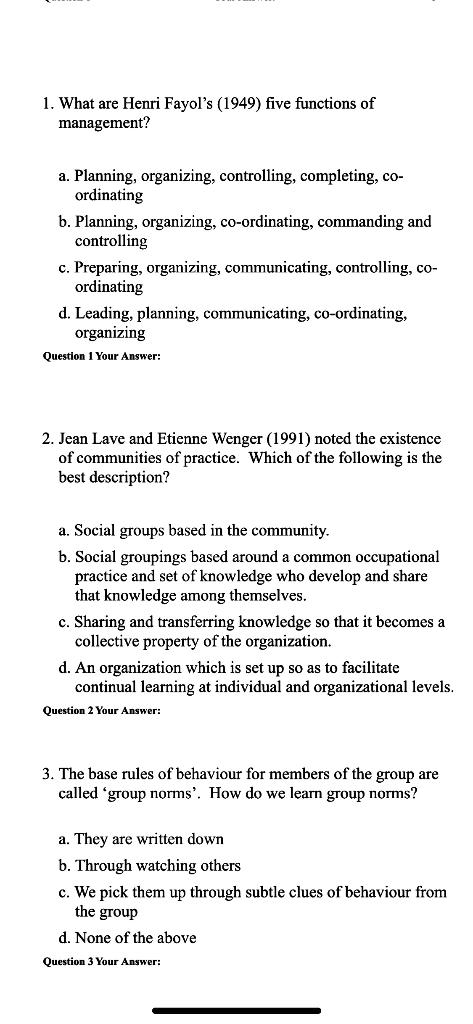
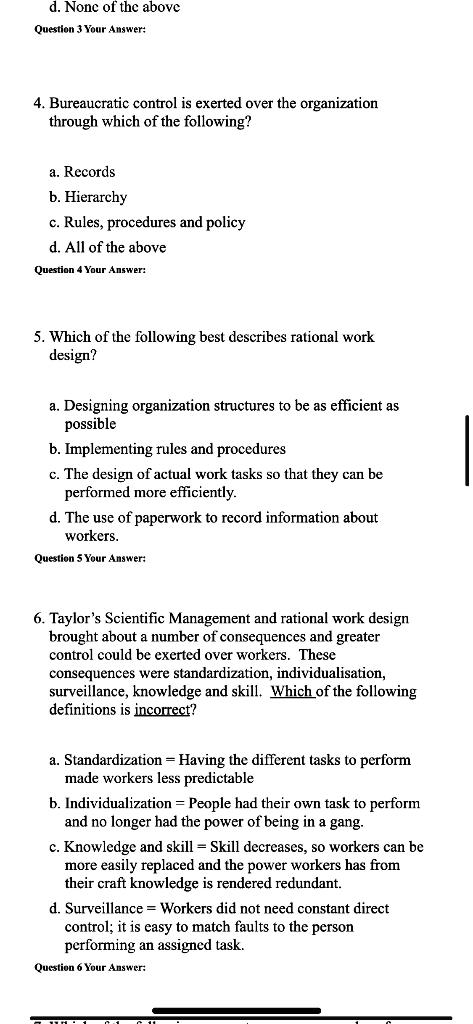
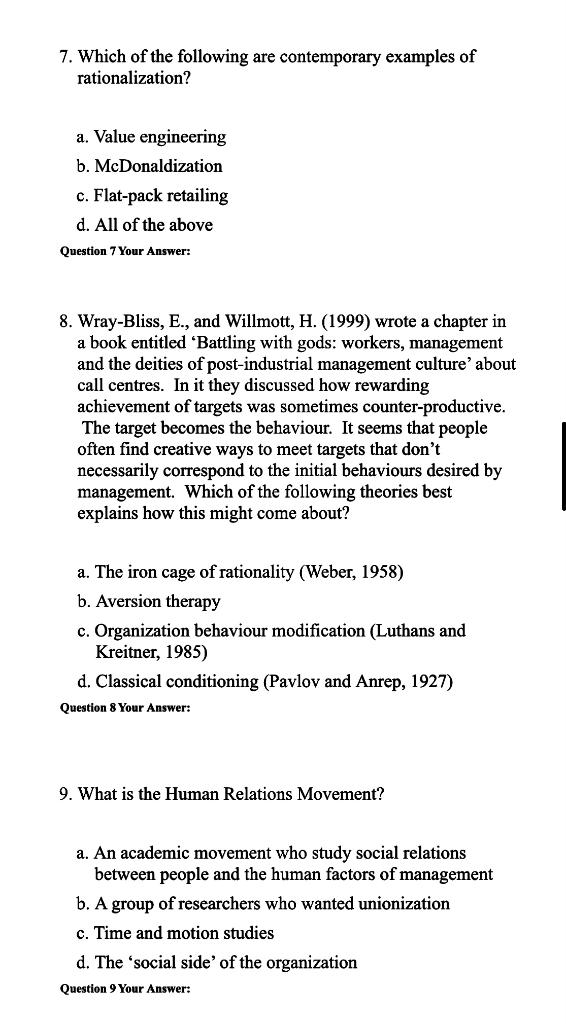
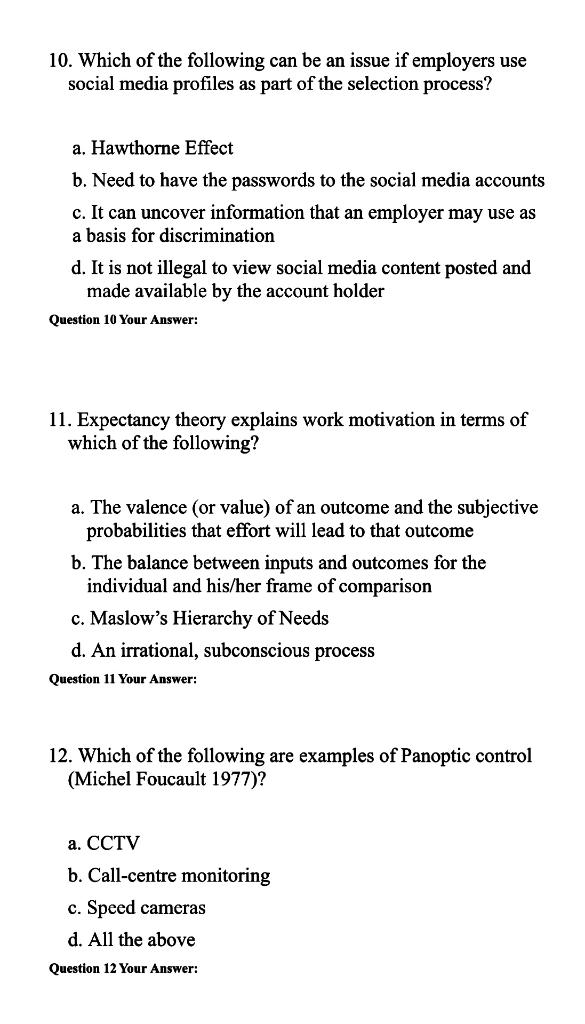
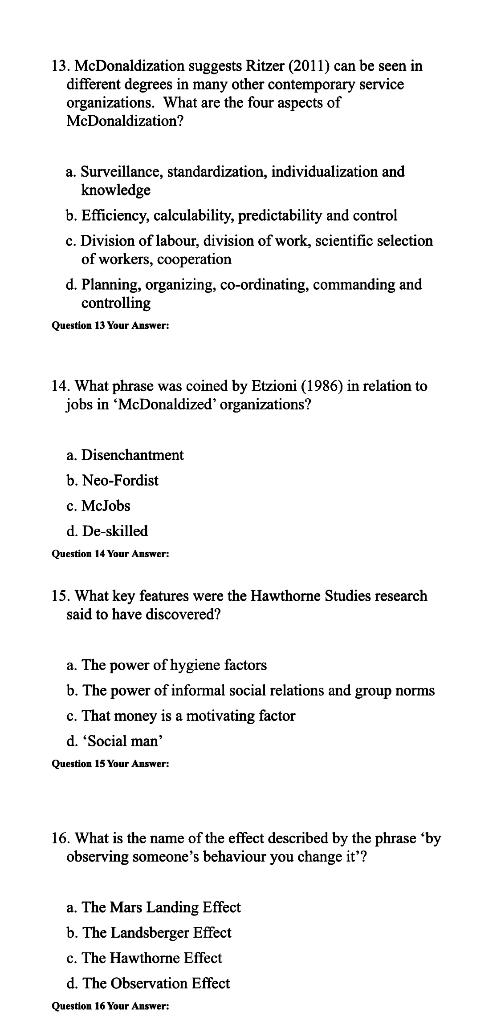
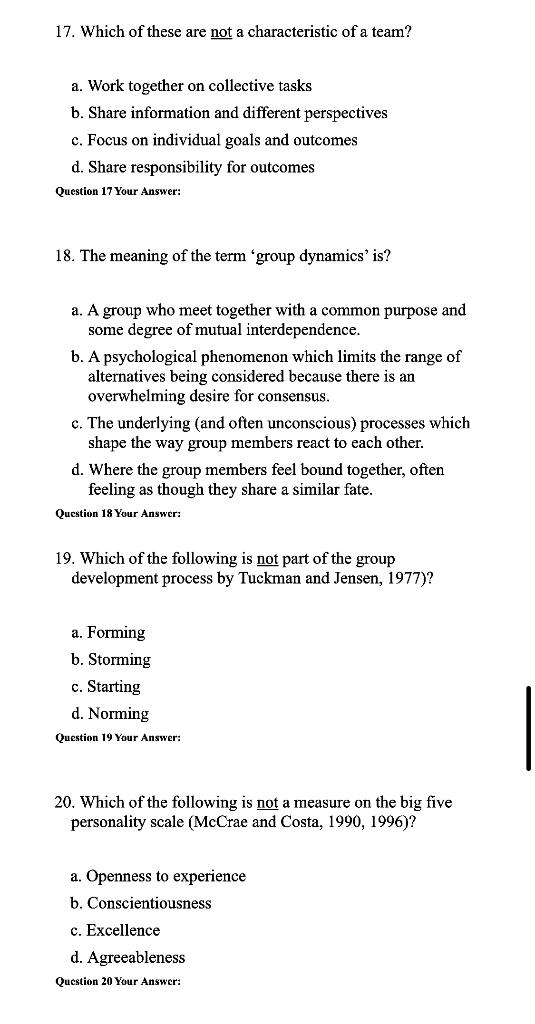
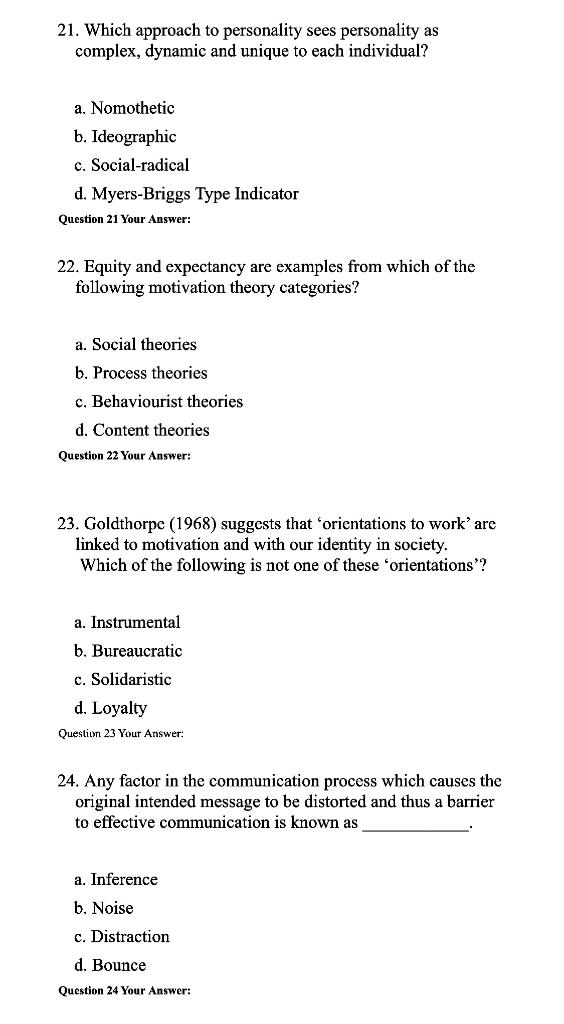
1. What are Henri Fayol's (1949) five functions of management? a. Planning, organizing, controlling, completing, co- ordinating b. Planning, organizing, co-ordinating, commanding and controlling c. Preparing, organizing, communicating, controlling, co- ordinating d. Leading, planning, communicating, co-ordinating, organizing Question 1 Your Answer: 2. Jean Lave and Etienne Wenger (1991) noted the existence of communities of practice. Which of the following is the best description? a. Social groups based in the community. b. Social groupings based around a common occupational practice and set of knowledge who develop and share that knowledge among themselves. c. Sharing and transferring knowledge so that it becomes a collective property of the organization. d. An organization which is set up so as to facilitate continual learning at individual and organizational levels. Question 2 Your Answer: 3. The base rules of behaviour for members of the group are called group norms'. How do we learn group norms? a. They are written down b. Through watching others c. We pick them up through subtle clues of behaviour from the group d. None of the above Question 3 Your Answer: d. None of the above Question 3 Your Answer: 4. Bureaucratic control is exerted over the organization through which of the following? a. Records b. Hierarchy c. Rules, procedures and policy d. All of the above Question 4 Your Answer: 5. Which of the following best describes rational work design? a. Designing organization structures to be as efficient as possible b. Implementing rules and procedures c. The design of actual work tasks so that they can be performed more efficiently. d. The use of paperwork to record information about workers. Question 5 Your Answer: 6. Taylor's Scientific Management and rational work design brought about a number of consequences and greater control could be exerted over workers. These consequences were standardization, individualisation, surveillance, knowledge and skill. Which of the following definitions is incorrect? a. Standardization = Having the different tasks to perform made workers less predictable b. Individualization = People had their own task to perform and no longer had the power of being in a gang. c. Knowledge and skill = Skill decreases, so workers can be more easily replaced and the power workers has from their craft knowledge is rendered redundant. d. Surveillance = Workers did not need constant direct control; it is easy to match faults to the person performing an assigned task. Question 6 Your Answer: 11111TI 7. Which of the following are contemporary examples of rationalization? a. Value engineering b. McDonaldization c. Flat-pack retailing d. All of the above Question 7 Your Answer: 8. Wray-Bliss, E., and Willmott, H. (1999) wrote a chapter in a book entitled 'Battling with gods: workers, management and the deities of post-industrial management culture' about call centres. In it they discussed how rewarding achievement of targets was sometimes counter-productive. The target becomes the behaviour. It seems that people often find creative ways to meet targets that don't necessarily correspond to the initial behaviours desired by management. Which of the following theories best explains how this might come about? a. The iron cage of rationality (Weber, 1958) b. Aversion therapy c. Organization behaviour modification (Luthans and Kreitner, 1985) d. Classical conditioning (Pavlov and Anrep, 1927) Question 8 Your Answer: 9. What is the Human Relations Movement? a. An academic movement who study social relations between people and the human factors management b. A group of researchers who wanted unionization c. Time and motion studies d. The 'social side of the organization Question 9 Your Answer: 10. Which of the following can be an issue if employers use social media profiles as part of the selection process? a. Hawthorne Effect b. Need to have the passwords to the social media accounts c. It can uncover information that an employer may use as a basis for discrimination d. It is not illegal to view social media content posted and made available by the account holder Question 10 Your Answer: 11. Expectancy theory explains work motivation in terms of which of the following? a. The valence (or value) of an outcome and the subjective probabilities that effort will lead to that outcome b. The balance between inputs and outcomes for the individual and his/her frame of comparison c. Maslow's Hierarchy of Needs d. An irrational, subconscious process Question 11 Your Answer: 12. Which of the following are examples of Panoptic control (Michel Foucault 1977)? a. CCTV b. Call-centre monitoring c. Speed cameras d. All the above Question 12 Your Answer: 13. McDonaldization suggests Ritzer (2011) can be seen in different degrees in many other contemporary service organizations. What are the four aspects of McDonaldization? a. Surveillance, standardization, individualization and knowledge b. Efficiency, calculability, predictability and control c. Division of labour, division of work, scientific selection of workers, cooperation d. Planning, organizing, co-ordinating, commanding and controlling Question 13 Your Answer: 14. What phrase was coined by Etzioni (1986) in relation to jobs in McDonaldized organizations? a. Disenchantment b. Neo-Fordist c. McJobs d. De-skilled Questiom 14 Your Answer: 15. What key features were the Hawthorne Studies research said to have discovered? a. The power of hygiene factors b. The power of informal social relations and group norms c. That money is a motivating factor d. 'Social man Question 15 Your Answer: 16. What is the name of the effect described by the phrase "by observing someone's behaviour you change it"? a. The Mars Landing Effect b. The Landsberger Effect c. The Hawthorne Effect d. The Observation Effect Question 16 Your Answer: 17. Which of these are not a characteristic of a team? a. Work together on collective tasks b. Share information and different perspectives c. Focus on individual goals and outcomes d. Share responsibility for outcomes Question 17 Your Answer: 18. The meaning of the term 'group dynamics' is? a. A group who meet together with a common purpose and some degree of mutual interdependence. b. A psychological phenomenon which limits the range of alternatives being considered because there is an overwhelming desire for consensus. c. The underlying (and often unconscious) processes which shape the way group members react to each other. d. Where the group members feel bound together, often feeling as though they share a similar fate. Question 18 Your Answer: 19. Which of the following is not part of the group development process by Tuckman and Jensen, 1977)? a. Forming b. Storming c. Starting d. Norming Question 19 Your Answer: 20. Which of the following is not a measure on the big five personality scale (McCrae and Costa, 1990, 1996)? a. Openness to experience b. Conscientiousness c. Excellence d. Agreeableness Question 20 Your Answer: 21. Which approach to personality sees personality as complex, dynamic and unique to each individual? a. Nomothetic b. Ideographic c. Social-radical d. Myers-Briggs Type Indicator Question 21 Your Answer: 22. Equity and expectancy are examples from which of the following motivation theory categories? a. Social theories b. Process theories c. Behaviourist theories d. Content theories Question 22 Your Answer: 23. Goldthorpe (1968) suggests that 'orientations to work are linked to motivation and with our identity in society. Which of the following is not one of these 'orientations'? a. Instrumental b. Bureaucratic c. Solidaristic d. Loyalty Question 23 Your Answer: 24. Any factor in the communication process which causes the original intended message to be distorted and thus a barrier to effective communication is known as a. Inference b. Noise c. Distraction d. Bounce Question 24 Your




