







Question: I would really appreciate some help on this question. Please identify the key issue (there is only one) and secondary issue (there are usually two
I would really appreciate some help on this question. 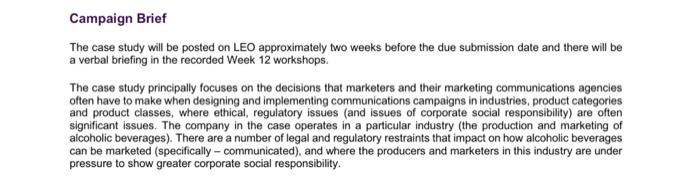
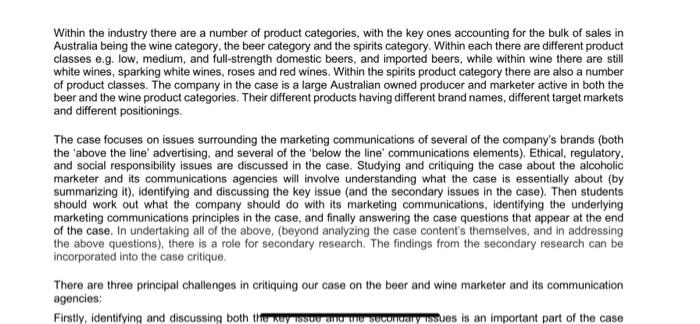
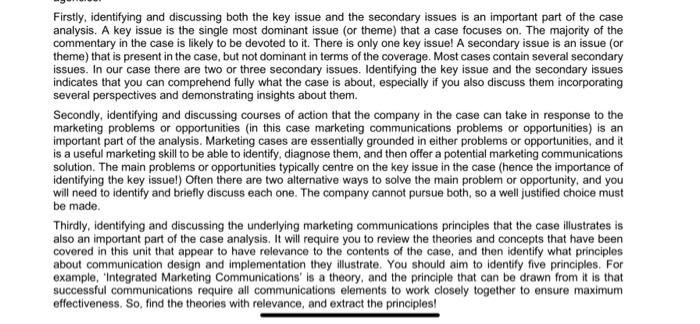
Campaign Brief The case study will be posted on LEO approximately two weeks before the due submission date and there will be a verbal briefing in the recorded Week 12 workshops. The case study principally focuses on the decisions that marketers and their marketing communications agencies often have to make when designing and implementing communications campaigns in industries, product categories and product classes, where ethical, regulatory issues and issues of corporate social responsibility) are often significant issues. The company in the case operates in a particular industry (the production and marketing of alcoholic beverages). There are a number of legal and regulatory restraints that impact on how alcoholic beverages can be marketed (specifically-communicated), and where the producers and marketers in this industry are under pressure to show greater corporate social responsibility. Within the industry there are a number of product categories, with the key ones accounting for the bulk of sales in Australia being the wine category, the beer category and the spirits category. Within each there are different product classes e.g. low, medium, and full-strength domestic beers, and imported beers, while within wine there are still white wines, sparking white wines, roses and red wines. Within the spirits product category there are also a number of product classes. The company in the case is a large Australian owned producer and marketer active in both the beer and the wine product categories. Their different products having different brand names, different target markets and different positionings. The case focuses on issues surrounding the marketing communications of several of the company's brands (both the above the line' advertising, and several of the below the line' communications elements). Ethical regulatory and social responsibility issues are discussed in the case. Studying and critiquing the case about the alcoholic marketer and its communications agencies will involve understanding what the case is essentially about (by summarizing it), identifying and discussing the key issue and the secondary issues in the case). Then students should work out what the company should do with its marketing communications, identifying the underlying marketing communications principles in the case, and finally answering the case questions that appear at the end of the case. In undertaking all of the above, (beyond analyzing the case content's themselves, and in addressing the above questions), there is a role for secondary research. The findings from the secondary research can be incorporated into the case critique. There are three principal challenges in critiquing our case on the beer and wine marketer and its communication agencies: Firstly, identifying and discussing both the muy su amo mu secondary issues is an important part of the case Firstly, identifying and discussing both the key issue and the secondary issues is an important part of the case analysis. A key issue is the single most dominant issue (or theme) that a case focuses on. The majority of the commentary in the case is likely to be devoted to it. There is only one key issuel A secondary issue is an issue (or theme) that is present in the case, but not dominant in terms of the coverage. Most cases contain several secondary issues. In our case there are two or three secondary issues. Identifying the key issue and the secondary issues indicates that you can comprehend fully what the case is about, especially if you also discuss them incorporating several perspectives and demonstrating insights about them. Secondly, identifying and discussing courses of action that the company in the case can take in response to the marketing problems or opportunities (in this case marketing communications problems or opportunities) is an important part of the analysis. Marketing cases are essentially grounded in either problems or opportunities, and it is a useful marketing skill to be able to identify, diagnose them, and then offer a potential marketing communications solution. The main problems or opportunities typically centre on the key issue in the case (hence the importance of identifying the key issue!) Often there are two alternative ways to solve the main problem or opportunity, and you will need to identify and briefly discuss each one. The company cannot pursue both, so a well justified choice must be made Thirdly, identifying and discussing the underlying marketing communications principles that the case illustrates is also an important part of the case analysis. It will require you to review the theories and concepts that have been covered in this unit that appear to have relevance to the contents of the case, and then identify what principles about communication design and implementation they illustrate. You should aim to identify five principles, For example, "Integrated Marketing Communications' is a theory, and the principle that can be drawn from it is that successful communications require all communications elements to work closely together to ensure maximum effectiveness. So, find the theories with relevance, and extract the principles! Campaign Brief The case study will be posted on LEO approximately two weeks before the due submission date and there will be a verbal briefing in the recorded Week 12 workshops. The case study principally focuses on the decisions that marketers and their marketing communications agencies often have to make when designing and implementing communications campaigns in industries, product categories and product classes, where ethical, regulatory issues and issues of corporate social responsibility) are often significant issues. The company in the case operates in a particular industry (the production and marketing of alcoholic beverages). There are a number of legal and regulatory restraints that impact on how alcoholic beverages can be marketed (specifically-communicated), and where the producers and marketers in this industry are under pressure to show greater corporate social responsibility. Within the industry there are a number of product categories, with the key ones accounting for the bulk of sales in Australia being the wine category, the beer category and the spirits category. Within each there are different product classes e.g. low, medium, and full-strength domestic beers, and imported beers, while within wine there are still white wines, sparking white wines, roses and red wines. Within the spirits product category there are also a number of product classes. The company in the case is a large Australian owned producer and marketer active in both the beer and the wine product categories. Their different products having different brand names, different target markets and different positionings. The case focuses on issues surrounding the marketing communications of several of the company's brands (both the above the line' advertising, and several of the below the line' communications elements). Ethical regulatory and social responsibility issues are discussed in the case. Studying and critiquing the case about the alcoholic marketer and its communications agencies will involve understanding what the case is essentially about (by summarizing it), identifying and discussing the key issue and the secondary issues in the case). Then students should work out what the company should do with its marketing communications, identifying the underlying marketing communications principles in the case, and finally answering the case questions that appear at the end of the case. In undertaking all of the above, (beyond analyzing the case content's themselves, and in addressing the above questions), there is a role for secondary research. The findings from the secondary research can be incorporated into the case critique. There are three principal challenges in critiquing our case on the beer and wine marketer and its communication agencies: Firstly, identifying and discussing both the muy su amo mu secondary issues is an important part of the case Firstly, identifying and discussing both the key issue and the secondary issues is an important part of the case analysis. A key issue is the single most dominant issue (or theme) that a case focuses on. The majority of the commentary in the case is likely to be devoted to it. There is only one key issuel A secondary issue is an issue (or theme) that is present in the case, but not dominant in terms of the coverage. Most cases contain several secondary issues. In our case there are two or three secondary issues. Identifying the key issue and the secondary issues indicates that you can comprehend fully what the case is about, especially if you also discuss them incorporating several perspectives and demonstrating insights about them. Secondly, identifying and discussing courses of action that the company in the case can take in response to the marketing problems or opportunities (in this case marketing communications problems or opportunities) is an important part of the analysis. Marketing cases are essentially grounded in either problems or opportunities, and it is a useful marketing skill to be able to identify, diagnose them, and then offer a potential marketing communications solution. The main problems or opportunities typically centre on the key issue in the case (hence the importance of identifying the key issue!) Often there are two alternative ways to solve the main problem or opportunity, and you will need to identify and briefly discuss each one. The company cannot pursue both, so a well justified choice must be made Thirdly, identifying and discussing the underlying marketing communications principles that the case illustrates is also an important part of the case analysis. It will require you to review the theories and concepts that have been covered in this unit that appear to have relevance to the contents of the case, and then identify what principles about communication design and implementation they illustrate. You should aim to identify five principles, For example, "Integrated Marketing Communications' is a theory, and the principle that can be drawn from it is that successful communications require all communications elements to work closely together to ensure maximum effectiveness. So, find the theories with relevance, and extract the principles
Please identify the key issue (there is only one) and secondary issue (there are usually two or three) and give reasons for them. You should then consider relationship with what is the main problem or opportunity in this marketing communications case. Is the case fundamentally about a problem (a negative) or an opportunity (a positive)?
Step by Step Solution
There are 3 Steps involved in it
1 Expert Approved Answer
Step: 1 Unlock

Question Has Been Solved by an Expert!
Get step-by-step solutions from verified subject matter experts
Step: 2 Unlock
Step: 3 Unlock
 Study Help