



Question: ICE tables are used for calculating changes in concentration in an equilibrium system. I represents the initial concentration, C the change in concentration between the
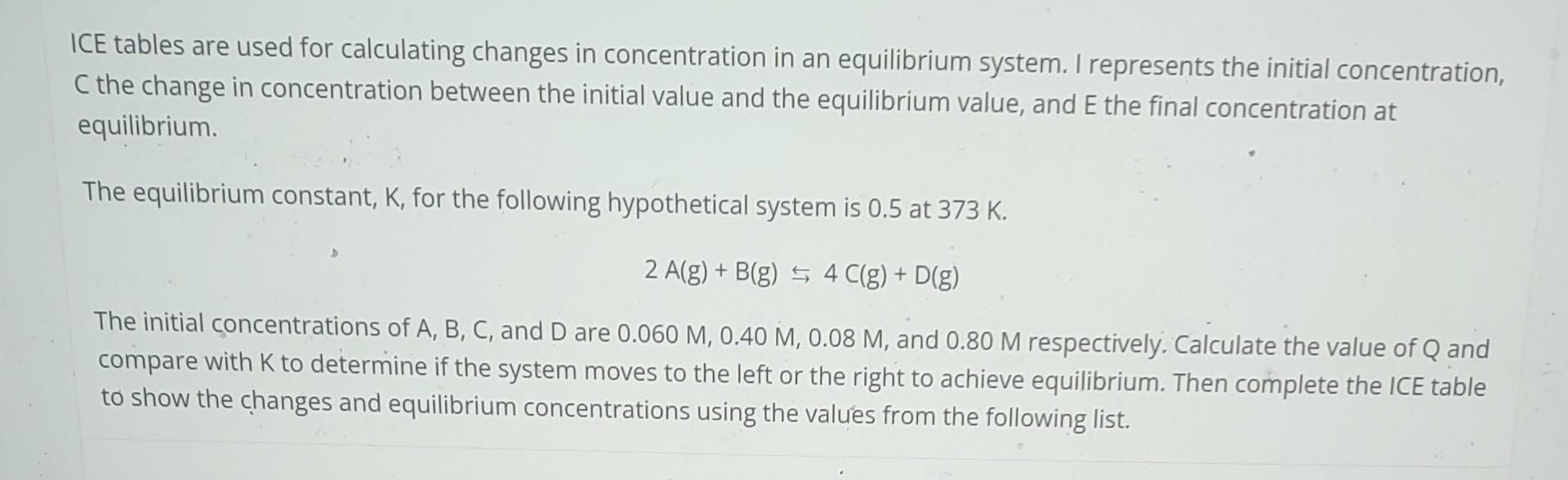
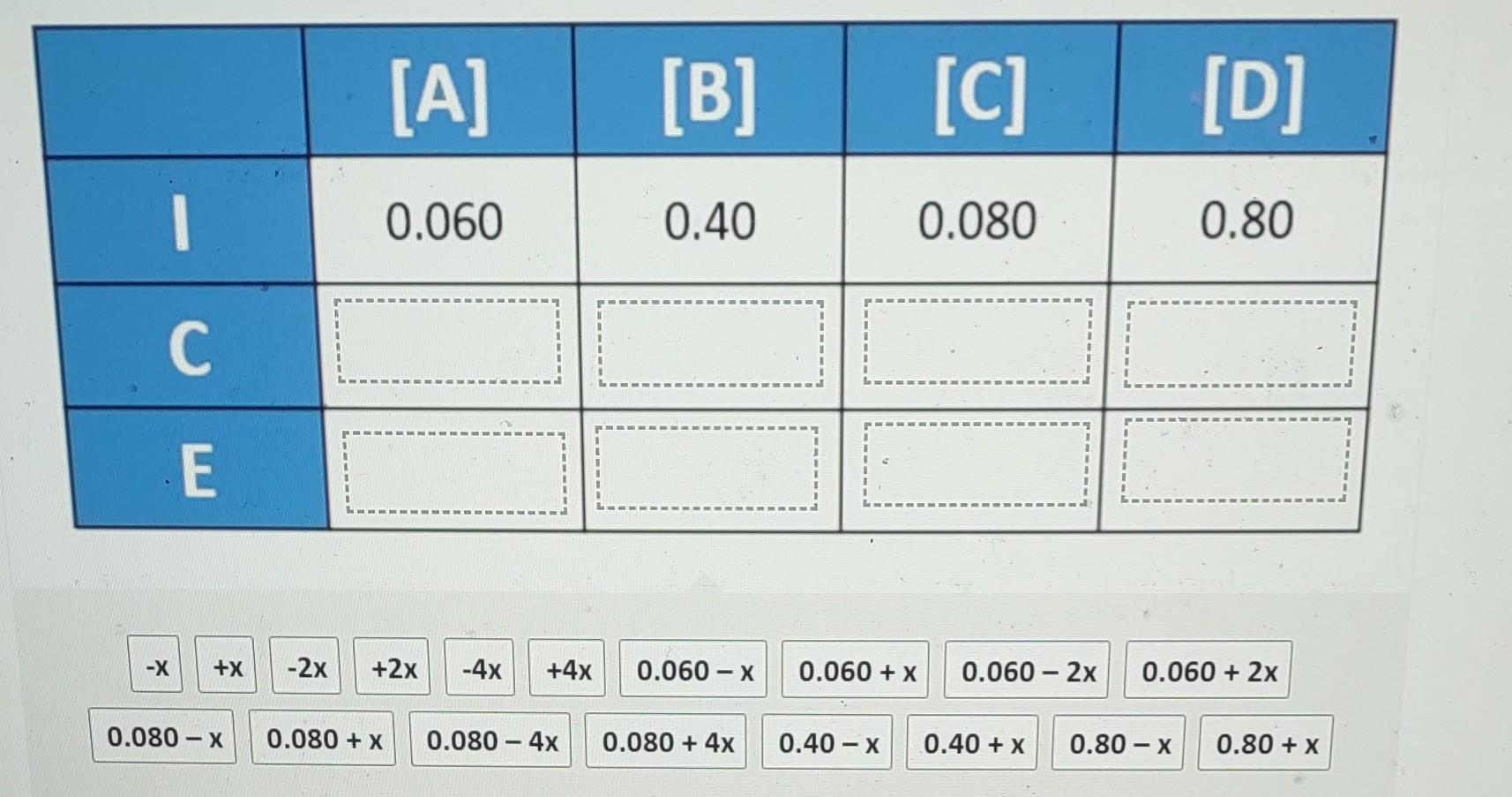
ICE tables are used for calculating changes in concentration in an equilibrium system. I represents the initial concentration, C the change in concentration between the initial value and the equilibrium value, and E the final concentration at equilibrium. The equilibrium constant, K, for the following hypothetical system is 0.5 at 373K. 2A(g)+B(g)4C(g)+D(g) The initial concentrations of A,B,C, and D are 0.060M,0.40M,0.08M, and 0.80M respectively. Calculate the value of Q and compare with K to determine if the system moves to the left or the right to achieve equilibrium. Then complete the ICE table to show the changes and equilibrium concentrations using the values from the following list. \begin{tabular}{|l|l|l|l|l|} \hline & {[A]} & {[B]} & [C] & [D] \\ \hline I & 0.060 & 0.40 & 0.080 & 0.80 \\ \hline C & & & & \\ \hline E & & & & \\ \hline \end{tabular}
Step by Step Solution
There are 3 Steps involved in it

Get step-by-step solutions from verified subject matter experts