Question: Identify the problems, Generate alternative solutions then Briefly describe your experience . Did applying the problem redefinition and alternative generating techniques change your perspective on
Identify the problems, Generate alternative solutions then Briefly describe your experience . Did applying the problem redefinition and alternative generating techniques change your perspective on the problem? Were you able to see a wider range of possible approaches ? 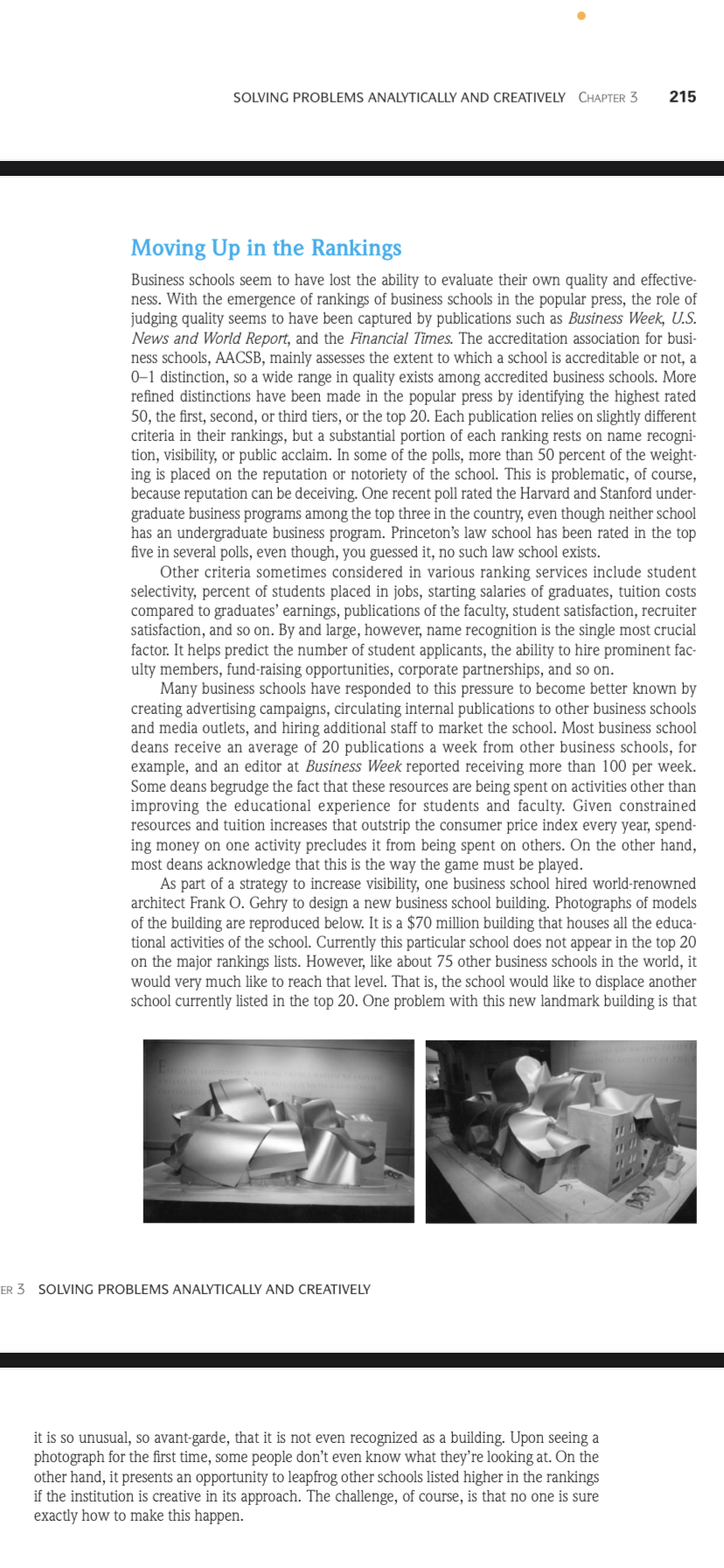
Moving Up in the Rankings Business schools seem to have lost the ability to evaluate their own quality and effectiveness. With the emergence of rankings of business schools in the popular press, the role of judging quality seems to have been captured by publications such as Business Week, U.S. News and World Report, and the Financial Times. The accreditation association for business schools, AACSB, mainly assesses the extent to which a school is accreditable or not, a 01 distinction, so a wide range in quality exists among accredited business schools. More refined distinctions have been made in the popular press by identifying the highest rated 50 , the first, second, or third tiers, or the top 20 . Each publication relies on slightly different criteria in their rankings, but a substantial portion of each ranking rests on name recognition, visibility, or public acclaim. In some of the polls, more than 50 percent of the weighting is placed on the reputation or notoriety of the school. This is problematic, of course, because reputation can be deceiving. One recent poll rated the Harvard and Stanford undergraduate business programs among the top three in the country, even though neither school has an undergraduate business program. Princeton's law school has been rated in the top five in several polls, even though, you guessed it, no such law school exists. Other criteria sometimes considered in various ranking services include student selectivity, percent of students placed in jobs, starting salaries of graduates, tuition costs compared to graduates' earnings, publications of the faculty, student satisfaction, recruiter satisfaction, and so on. By and large, however, name recognition is the single most crucial factor. It helps predict the number of student applicants, the ability to hire prominent faculty members, fund-raising opportunities, corporate partnerships, and so on. Many business schools have responded to this pressure to become better known by creating advertising campaigns, circulating internal publications to other business schools and media outlets, and hiring additional staff to market the school. Most business school deans receive an average of 20 publications a week from other business schools, for example, and an editor at Business Week reported receiving more than 100 per week. Some deans begrudge the fact that these resources are being spent on activities other than improving the educational experience for students and faculty. Given constrained resources and tuition increases that outstrip the consumer price index every year, spending money on one activity precludes it from being spent on others. On the other hand, most deans acknowledge that this is the way the game must be played. As part of a strategy to increase visibility, one business school hired world-renowned architect Frank O. Gehry to design a new business school building. Photographs of models of the building are reproduced below. It is a $70 million building that houses all the educational activities of the school. Currently this particular school does not appear in the top 20 on the major rankings lists. However, like about 75 other business schools in the world, it would very much like to reach that level. That is, the school would like to displace another school currently listed in the top 20 . One problem with this new landmark building is that R 3 SOLVING PROBLEMS ANALYTICALLY AND CREATIVELY it is so unusual, so avant-garde, that it is not even recognized as a building. Upon seeing a photograph for the first time, some people don't even know what they're looking at. On the other hand, it presents an opportunity to leapfrog other schools listed higher in the rankings if the institution is creative in its approach. The challenge, of course, is that no one is sure exactly how to make this happen









 Study Help