







Question: If you're not gonna answer the question and scowl me about the rules, then don't answer it and let someone else do it. I'm paying
If you're not gonna answer the question and scowl me about the rules, then don't "answer" it and let someone else do it. I'm paying money for your services, remember that.
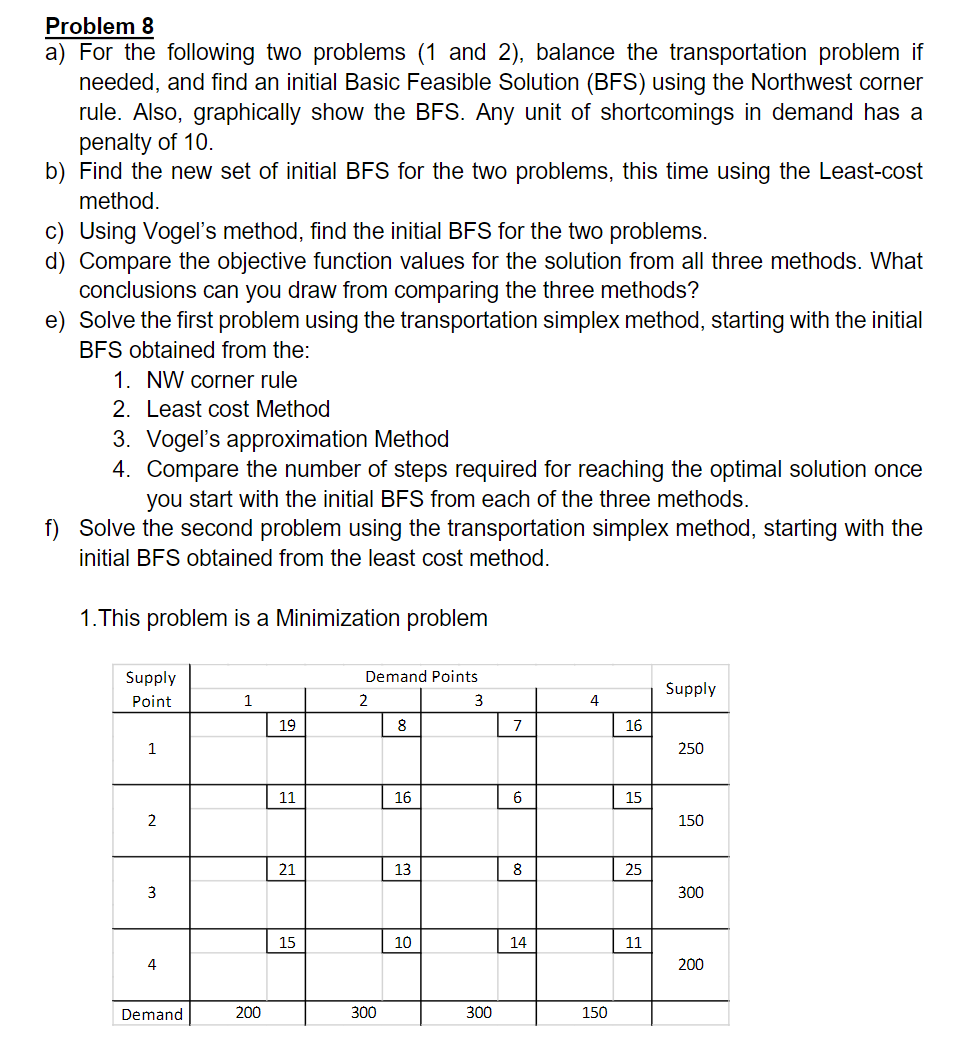
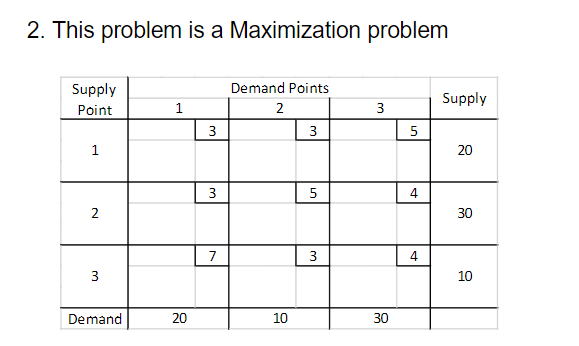
Problem 8 a) For the following two problems (1 and 2), balance the transportation problem if needed, and find an initial Basic Feasible Solution (BFS) using the Northwest corner rule. Also, graphically show the BFS. Any unit of shortcomings in demand has a penalty of 10. b) Find the new set of initial BFS for the two problems, this time using the Least-cost method. c) Using Vogel's method, find the initial BFS for the two problems. d) Compare the objective function values for the solution from all three methods. What conclusions can you draw from comparing the three methods? e) Solve the first problem using the transportation simplex method, starting with the initial BFS obtained from the: 1. NW corner rule 2. Least cost Method 3. Vogel's approximation Method 4. Compare the number of steps required for reaching the optimal solution once you start with the initial BFS from each of the three methods. f) Solve the second problem using the transportation simplex method, starting with the initial BFS obtained from the least cost method. 1. This problem is a Minimization problem Supply Point Supply 1 Demand Points 2 3 8 4 19 7 16 1 250 11 16 6 15 2 150 21 21 13 00 8 25 3 300 15 10 14 11 4 200 Demand 200 300 300 150 2. This problem is a Maximization problem Supply Point 1 Supply Demand Points 2 3 3 3 5 1 20 3 5 4 2 30 7 3 4 3 3 10 Demand 20 10 30 Problem 8 a) For the following two problems (1 and 2), balance the transportation problem if needed, and find an initial Basic Feasible Solution (BFS) using the Northwest corner rule. Also, graphically show the BFS. Any unit of shortcomings in demand has a penalty of 10. b) Find the new set of initial BFS for the two problems, this time using the Least-cost method. c) Using Vogel's method, find the initial BFS for the two problems. d) Compare the objective function values for the solution from all three methods. What conclusions can you draw from comparing the three methods? e) Solve the first problem using the transportation simplex method, starting with the initial BFS obtained from the: 1. NW corner rule 2. Least cost Method 3. Vogel's approximation Method 4. Compare the number of steps required for reaching the optimal solution once you start with the initial BFS from each of the three methods. f) Solve the second problem using the transportation simplex method, starting with the initial BFS obtained from the least cost method. 1. This problem is a Minimization problem Supply Point Supply 1 Demand Points 2 3 8 4 19 7 16 1 250 11 16 6 15 2 150 21 21 13 00 8 25 3 300 15 10 14 11 4 200 Demand 200 300 300 150 2. This problem is a Maximization problem Supply Point 1 Supply Demand Points 2 3 3 3 5 1 20 3 5 4 2 30 7 3 4 3 3 10 Demand 20 10 30Step by Step Solution
There are 3 Steps involved in it
1 Expert Approved Answer
Step: 1 Unlock

Question Has Been Solved by an Expert!
Get step-by-step solutions from verified subject matter experts
Step: 2 Unlock
Step: 3 Unlock
 Study Help