







Question: III. Given a directed graph G = (V,E),where V = {v1, v2, v3, v4, v5, v6}, and E = {(v1, v2), (v1, v3), (v1,
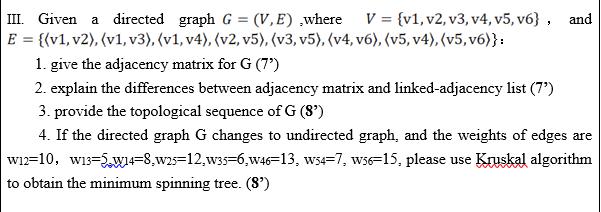
III. Given a directed graph G = (V,E),where V = {v1, v2, v3, v4, v5, v6}, and E = {(v1, v2), (v1, v3), (v1, v4), (v2, v5), (v3, v5), (v4, v6), (v5, v4), (v5, v6)}: 1. give the adjacency matrix for G (7') 2. explain the differences between adjacency matrix and linked-adjacency list (7") 3. provide the topological sequence of G (8') 4. If the directed graph G changes to undirected graph, and the weights of edges are |w12=10, W13=W14-8,w25=12,w35-6,w46-13, w54-7, w56-15, please use Kruskal algorithm to obtain the minimum spinning tree. (8')
Step by Step Solution
There are 3 Steps involved in it
Concept F1 RS Madhu 210420 D1 Taking v1 as the root node when we ... View full answer

Get step-by-step solutions from verified subject matter experts
 Study Help