





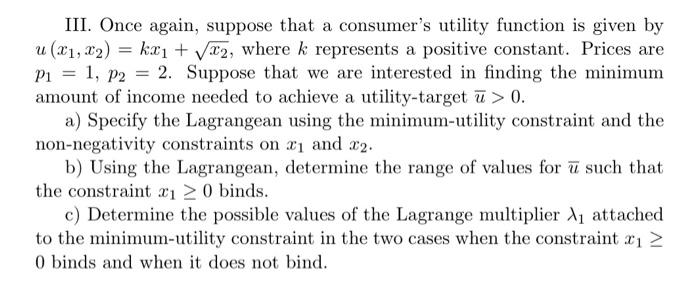
Question: III. Once again, suppose that a consumer's utility function is given by u (x1, x2) = kx1 + 22, where k represents a positive constant.
III. Once again, suppose that a consumer's
III. Once again, suppose that a consumer's utility function is given by u (x1, x2) = kx1 + 22, where k represents a positive constant. Prices are P1 = 1, P2 = 2. Suppose that we are interested in finding the minimum amount of income needed to achieve a utility-target > 0. a) Specify the Lagrangean using the minimum-utility constraint and the non-negativity constraints on xi and x2. b) Using the Lagrangean, determine the range of values for such that the constraint a > 0 binds. c) Determine the possible values of the Lagrange multiplier 11 attached to the minimum-utility constraint in the two cases when the constraint x1 > 0 binds and when it does not bind. III. Once again, suppose that a consumer's utility function is given by u (x1, x2) = kx1 + 22, where k represents a positive constant. Prices are P1 = 1, P2 = 2. Suppose that we are interested in finding the minimum amount of income needed to achieve a utility-target > 0. a) Specify the Lagrangean using the minimum-utility constraint and the non-negativity constraints on xi and x2. b) Using the Lagrangean, determine the range of values for such that the constraint a > 0 binds. c) Determine the possible values of the Lagrange multiplier 11 attached to the minimum-utility constraint in the two cases when the constraint x1 > 0 binds and when it does not bind

Step by Step Solution

There are 3 Steps involved in it

1 Expert Approved Answer
Step: 1 Unlock blur-text-image

Question Has Been Solved by an Expert!

Get step-by-step solutions from verified subject matter experts

Step: 2 Unlock
Step: 3 Unlock

Students Have Also Explored These Related General Management Questions!