







Question: III.C . ( a - 1 0 pts ) For the solidification of iron, calculate the critical radius ( mathrm { r }
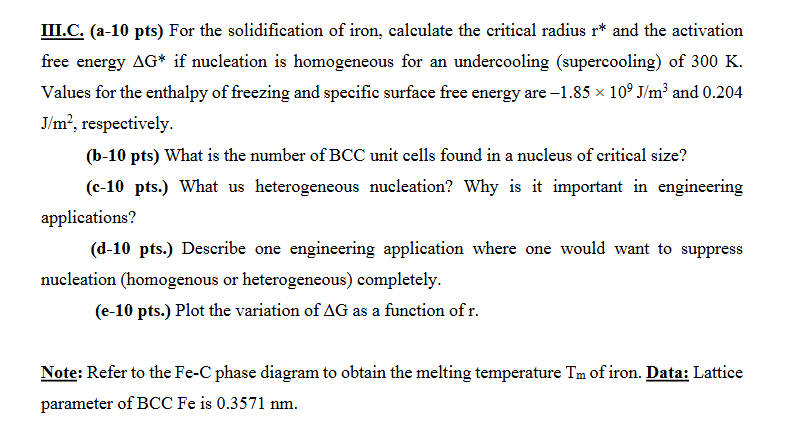
III.Ca pts For the solidification of iron, calculate the critical radius mathrmr and the activation free energy Delta mathrmG if nucleation is homogeneous for an undercooling supercooling of K Values for the enthalpy of freezing and specific surface free energy are times mathrm~Jmathrmm and mathrmJmathrmm respectively.
b pts What is the number of BCC unit cells found in a nucleus of critical size?
c pts What us heterogeneous nucleation? Why is it important in engineering applications?
d pts Describe one engineering application where one would want to suppress nucleation homogenous or heterogeneous completely.
e pts Plot the variation of Delta mathrmG as a function of r
Note: Refer to the FeC phase diagram to obtain the melting temperature mathrmTmathrmm of iron. Data: Lattice parameter of BCCFe is nm
Step by Step Solution
There are 3 Steps involved in it
1 Expert Approved Answer
Step: 1 Unlock

Question Has Been Solved by an Expert!
Get step-by-step solutions from verified subject matter experts
Step: 2 Unlock
Step: 3 Unlock
 Study Help