







Question: Im missing things that I thought would fit for my product, but I am not sure why they dont fit for my product. I am
Im missing things that I thought would fit for my product, but I am not sure why they dont fit for my product. I am missing marks on this component. I think I am on the right track just need to make sure Im applying the techniques correct. My math is off for my break even analysis. Is there any way to revise this so its clear?
Instructor Feedback
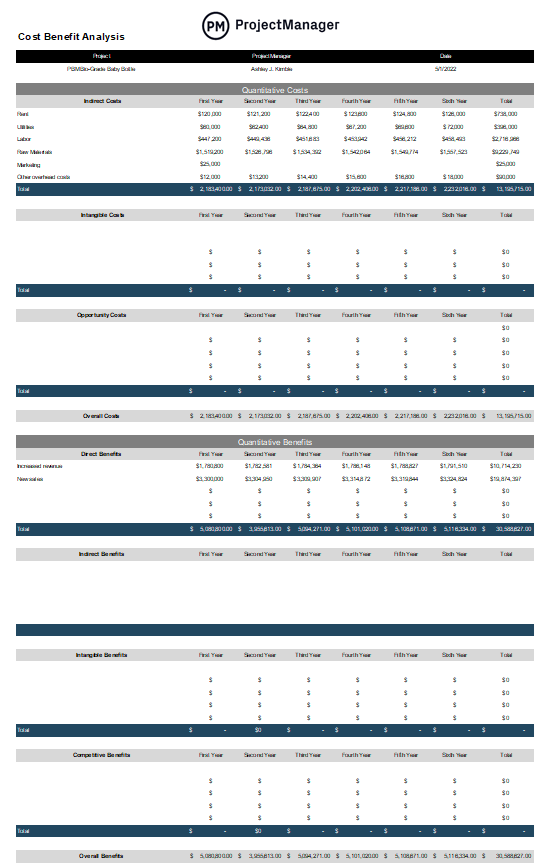
This is looking good but a few areas don't add up. A few areas that need further clarification or detail... how much for each bottle? $15.00? Your break even shows $15 for the sale price and $39.25 for variable costs. That would mean you never break even. If fixed costs are $192,000, then where are those costs in your CBA? I see rent, utilities, marketing, overhead = $217,000. What am I missing? Why is there both revenue and new sales? Aren't these the same things? This is only the costs and benefits attributable to the new bio bottle - right? You mentioned using marketing for your estimates but be sure you actually identify the project management estimation approach used for estimating costs and benefits and your corresponding confidence level in that estimate. Let me know if questions.
Financial Assessment and Resource Planning Brief
Economic Fit
In recent years there has been a big push for organizations to become more environmentally responsible. Lowering their economic footprint has been essential. More families have saw the need as well. Biodegradable plastics has been on the rise as well. Lowering our use of plastics has been needed due to the number of plastics found in the ocean. More parents care about how they feed their babies, not just what they fed them. Sustainable baby bottles are often made from non-toxic, plastic free, zero-waste, and eco-friendly materials. Now we add biodegradable plastic to that list.
This product fits economically with PBM plastics because we are also becoming more environmentally responsible. Launching this product aligns with our corporate values, as well as the values of our customers. This will keep us competitive as other baby manufacturers are also launching similar products. This new product will draw in consumers who are willing to pay more for environmentally friendly products, versus non environmentally friendly products. The success of this product can bring the development of other biodegradable products to our line of products.
Operational Costs
PLA is currently the market leader in the segment of bio-based and biodegradable plastics, and the same polymer that is generally estimated to come closest to conventional plastics in terms of its manufacturing costs. We will use corn grain as our feedstock for our raw material. Our production costs are strongly dependent on raw material prices. PLA has an estimated cost of $844-$1251 per ton. Our operating costs will consist of rent, utilities, raw materials, marketing, and other overhead costs. Most of our operating costs will be for our raw materials which costs $1,519,200 in the first year. We have the raw materials pricing increasing at 10% for the subsequent years. Our raw materials consist of agricultural plant feedstock since they are made from corn, so that feedstock price can fluctuate at any time. The total operational costs for the first year are $1,995,400.00. Since the new product will be added to our current product line, our operational costs don't include the machinery and molds which we already have accumulated. Our initial budgeted amount for this new product was $2M, we have come in below that, and have a little wiggle room for anything unexpected. We used active demand forecasting to estimate how much raw materials we will need to meet our initial orders. We used our marketing research to help us with those estimates.
Benefits
The benefit for our biodegradable bottle is projected to be huge. Market forecasts that the demand of biodegradable plastics (including our baby bottle), will increase to 550,000 tons globally by 2023. Major global retailers have adopted policies that promote environmental social responsibility. With our product we can help customers with that policy. We will not only attract new customers because of the new product, but also retain our current customers. As demand grows so will our production capacity will also grow. Production capacity is expected to grow by 36% over the period between 2020-2025. This growth will only help increase our output and revenue. We will also be one of the first manufacturers to bring a biodegradable baby bottle to market.
Cost Justification
Below we have a cost benefit analysis. We will also calculate ROI for our product and Break Even Point for the first year.
PM ProjectManager Cost Benefit Analysis Quantitative Costs Third Year Farth Tier Hither $121, 200 $124,800 Lids's $14 40 Tolaid $ 2 184 41000 230 40800 232014.00 5 Third Year Farth Tier Quantitative Benefits Dred Banelba Fired Tier Harth Tier 308080 000 39-180100 8 5014 2/100 8 3 3015820 Frad Tar Tood Intang bis Bonita Farth Tear En ES Overal Boneits
Step by Step Solution
There are 3 Steps involved in it

Get step-by-step solutions from verified subject matter experts
 Study Help