







Question: IMPORTANT: MUST SOLVE BY USING the zero boundary condition at join D , you can use fixed - roller end forces for member CD and
IMPORTANT: MUST SOLVE BY USING the zero boundary condition at join D you can use fixedroller end forces for member CD and remove the unknown joint displacement D With DKI and unknown joint displacements D D and D You need to show complete steps and compatibility states.
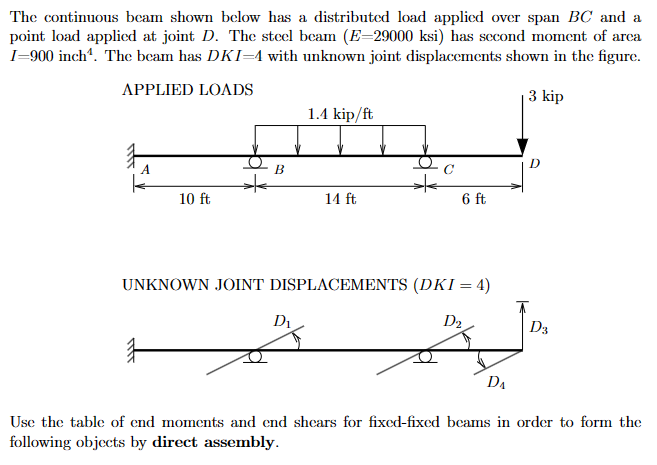
The continuous beam shown below has a distributed load applied over span and a
point load applied at joint The steel beam ksi has second moment of area
The beam has DKI with unknown joint displacements shown in the figure.
UNKNOWN JOINT DISPLACEMENTS
Use the table of end moments and end shears for fixedfixed beams in order to form the
following objects by direct assembly.
Step by Step Solution
There are 3 Steps involved in it
1 Expert Approved Answer
Step: 1 Unlock

Question Has Been Solved by an Expert!
Get step-by-step solutions from verified subject matter experts
Step: 2 Unlock
Step: 3 Unlock
 Study Help