







Question: In a computer system, integers are represented as a sequence of binary bits of 0 or 1. Binary is a base-2 number system instead of
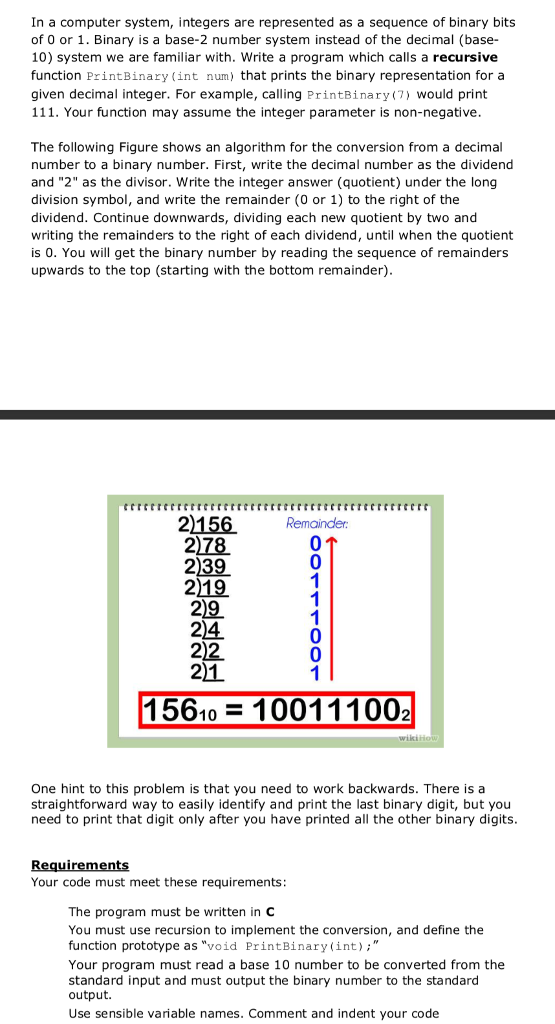
In a computer system, integers are represented as a sequence of binary bits of 0 or 1. Binary is a base-2 number system instead of the decimal (base- 10) system we are familiar with. Write a program which calls a recursive function PrintBinary (int num) that prints the binary representation for a given decimal integer. For example, calling PrintBinary(7) would print 111. Your function may assume the integer parameter is non-negativee The following Figure shows an algorithm for the conversion from a decimal number to a binary number. First, write the decimal number as the dividend and "2" as the divisor. Write the integer answer (quotient) under the long division symbol, and write the remainder (0 or 1) to the right of the dividend. Continue downwards, dividing each new quotient by two and writing the remainders to the right of each dividend, until when the quotient is 0. You will get the binary number by reading the sequence of remainders upwards to the top (starting with the bottom remainder) ccrstrterettcerettetrsttterttrtcrrtrecrsErccr 2156Reminder 278 239 219 29 24 0 0 0 0 21 1561 100111002 One hint to this problem is that you need to work backwards. There is a straightforward way to easily identify and print the last binary digit, but you need to print that digit only after you have printed all the other binary digits Your code must meet these requirements: The program must be written in C You must use recursion to implement the conversion, and define the function prototype as "void PrintBinary(int)" Your program must read a base 10 number to be converted from the standard input and must output the binary number to the standard output. Use sensible variable names. Comment and indent your code
Step by Step Solution
There are 3 Steps involved in it

Get step-by-step solutions from verified subject matter experts
 Study Help