







Question: In a limiting reactant problem, you are generally given the amounts of both (all) reactants. In the examples given so far, the amounts were given
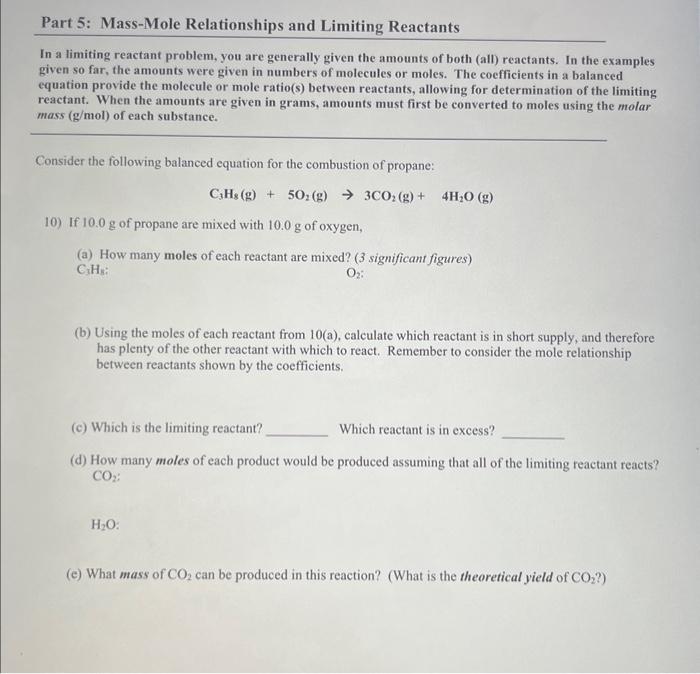
In a limiting reactant problem, you are generally given the amounts of both (all) reactants. In the examples given so far, the amounts were given in numbers of molecules or moles. The coefficients in a balanced equation provide the molecule or mole ratio(s) between reactants, allowing for determination of the limiting reactant. When the amounts are given in grams, amounts must first be converted to moles using the molar mass (g/mol) of each substance. Consider the following balanced equation for the combustion of propane: C3H8(g)+5O2(g)3CO2(g)+4H2O(g) 10) If 10.0g of propane are mixed with 10.0g of oxygen, (a) How many moles of each reactant are mixed? ( 3 significant figures) C3H8: O2: (b) Using the moles of each reactant from 10(a), calculate which reactant is in short supply, and therefore has plenty of the other reactant with which to react. Remember to consider the mole relationship between reactants shown by the coefficients. (c) Which is the limiting reactant? Which reactant is in excess? (d) How many moles of each product would be produced assuming that all of the limiting reactant reacts? CO2 : H2O: (e) What mass of CO2 can be produced in this reaction? (What is the theoretical yield of CO2 ?)
Step by Step Solution
There are 3 Steps involved in it

Get step-by-step solutions from verified subject matter experts
 Study Help