


Question: solve Limiting Reactants Involving Molarity 5 Fill In the Blank 1 point In this part of the activity, you will be solving a limiting reactant

solve
solve Limiting Reactants Involving Molarity 5
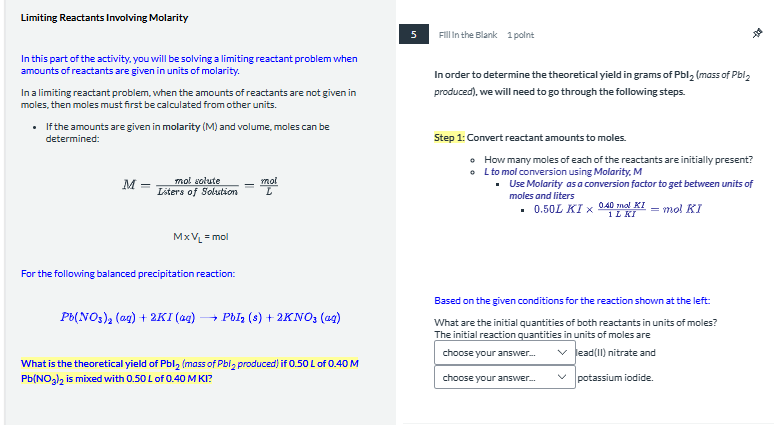
Limiting Reactants Involving Molarity 5 Fill In the Blank 1 point In this part of the activity, you will be solving a limiting reactant problem when amounts of reactants are given in units of molarity. In order to determine the theoretical yield in grams of Pbly (mass of Pbiz In a limiting reactant problem, when the amounts of reactants are not given in produced), we will need to go through the following steps. moles, then moles must first be calculated from other units. . If the amounts are given in molarity (M) and volume, moles can be determined: Step 1: Convert reactant amounts to moles. How many moles of each of the reactants are initially present? L to mol conversion using Molarity: M M = mol solute mol . Use Molarity as a conversion factor to get between units of Isters of Solution moles and liters . 0.50L KI x 940 mol KI = mol KI MxV = mol For the following balanced precipitation reaction: Based on the given conditions for the reaction shown at the left: Pb(NOs), (aq) + 2KI (aq) - Pbly (s) + 2KNO, (ag) What are the initial quantities of both reactants in units of moles? The initial reaction quantities in units of moles are choose your answer... V lead (II) nitrate and What is the theoretical yield of Pbly (mass of Pbiz produced) if 0.50 L of 0.40 M Pb(NO-)2 is mixed with 0.50 L of 0.40 M KI? choose your answer... potassium iodide

Step by Step Solution

There are 3 Steps involved in it

1 Expert Approved Answer
Step: 1 Unlock blur-text-image

Question Has Been Solved by an Expert!

Get step-by-step solutions from verified subject matter experts

Step: 2 Unlock
Step: 3 Unlock

Students Have Also Explored These Related Accounting Questions!