





Question: in a rush, please help Exercise 3. Digital Communications & Binary Hypothesis . (4Opts + 10pts(Extra)) (a) (20pts) Recall a digital communications example from class

in a rush, please help in a rush, please help Exercise 3. Digital
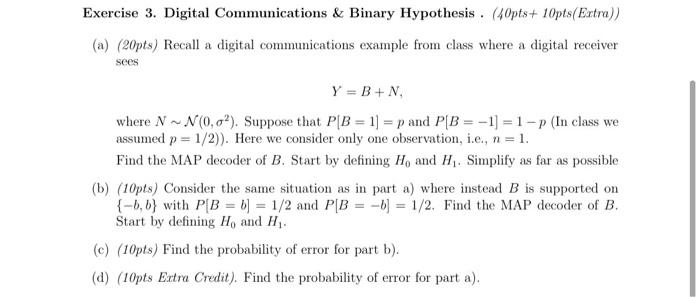
Exercise 3. Digital Communications & Binary Hypothesis . (4Opts + 10pts(Extra)) (a) (20pts) Recall a digital communications example from class where a digital receiver sees Y =B+N, where N N(0,0). Suppose that P[B = 1] = p and PCB = -1) = 1 -p (In class we assumed p = 1/2)). Here we consider only one observation, i.e., n=1. Find the MAP decoder of B. Start by defining H, and H. Simplify as far as possible (b) (10pts) Consider the same situation as in part a) where instead B is supported on {-1,0} with P[B = 6) = 1/2 and P[B = -b) = 1/2. Find the MAP decoder of B. Start by defining H, and H. (c) (10pts) Find the probability of error for part b). (d) (10pts Extra Credit). Find the probability of error for part a). Exercise 3. Digital Communications & Binary Hypothesis . (4Opts + 10pts(Extra)) (a) (20pts) Recall a digital communications example from class where a digital receiver sees Y =B+N, where N N(0,0). Suppose that P[B = 1] = p and PCB = -1) = 1 -p (In class we assumed p = 1/2)). Here we consider only one observation, i.e., n=1. Find the MAP decoder of B. Start by defining H, and H. Simplify as far as possible (b) (10pts) Consider the same situation as in part a) where instead B is supported on {-1,0} with P[B = 6) = 1/2 and P[B = -b) = 1/2. Find the MAP decoder of B. Start by defining H, and H. (c) (10pts) Find the probability of error for part b). (d) (10pts Extra Credit). Find the probability of error for part a)

Step by Step Solution

There are 3 Steps involved in it

1 Expert Approved Answer
Step: 1 Unlock blur-text-image

Question Has Been Solved by an Expert!

Get step-by-step solutions from verified subject matter experts

Step: 2 Unlock
Step: 3 Unlock

Students Have Also Explored These Related General Management Questions!