







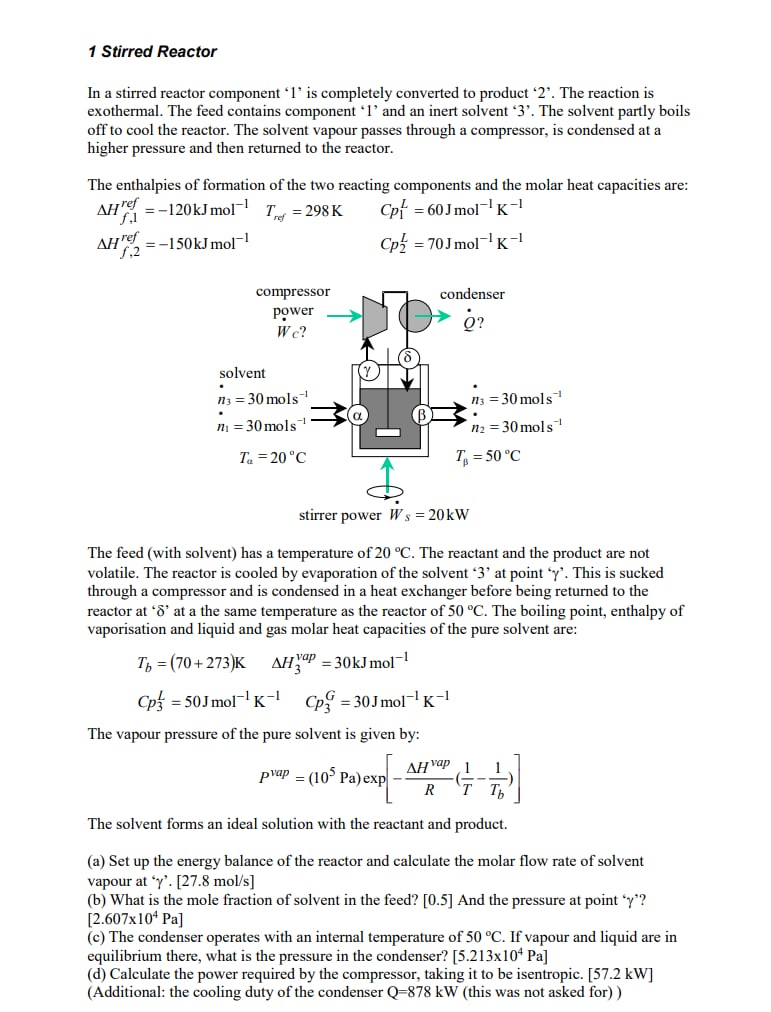
Question: In a stirred reactor component ' 1 ' is completely converted to product ' 2 ' . The reaction is exothermal. The feed contains component
In a stirred reactor component is completely converted to product The reaction is
exothermal. The feed contains component and an inert solvent The solvent partly boils
off to cool the reactor. The solvent vapour passes through a compressor, is condensed at a
higher pressure and then returned to the reactor.
The enthalpies of formation of the two reacting components and the molar heat capacities are:
The feed with solvent has a temperature of The reactant and the product are not
volatile. The reactor is cooled by evaporation of the solvent at point This is sucked
through a compressor and is condensed in a heat exchanger before being returned to the
reactor at at a the same temperature as the reactor of The boiling point, enthalpy of
vaporisation and liquid and gas molar heat capacities of the pure solvent are:
The vapour pressure of the pure solvent is given by:
The solvent forms an ideal solution with the reactant and product.
a Set up the energy balance of the reactor and calculate the molar flow rate of solvent
vapour at mols
b What is the mole fraction of solvent in the feed? And the pressure at point
c The condenser operates with an internal temperature of If vapour and liquid are in
equilibrium there, what is the pressure in the condenser?
d Calculate the power required by the compressor, taking it to be isentropic kW
Additional: the cooling duty of the condenser this was not asked for
Step by Step Solution
There are 3 Steps involved in it
1 Expert Approved Answer
Step: 1 Unlock

Question Has Been Solved by an Expert!
Get step-by-step solutions from verified subject matter experts
Step: 2 Unlock
Step: 3 Unlock
 Study Help