



Question: In both Situation A and B we make several assumptions. The flow is steady (i.e. timeindependent). The stir bar and the tank are so tall
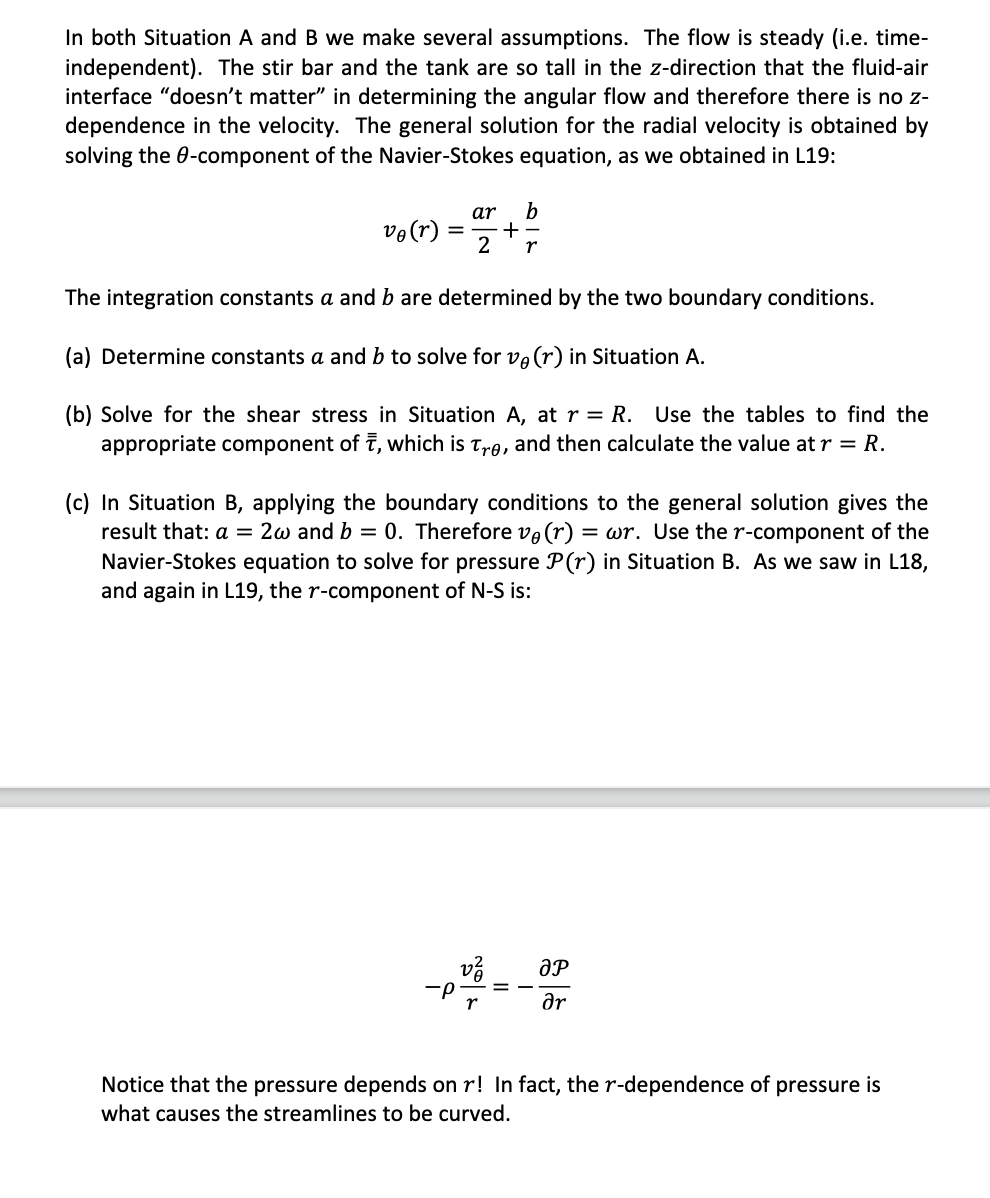
In both Situation A and B we make several assumptions. The flow is steady (i.e. timeindependent). The stir bar and the tank are so tall in the z-direction that the fluid-air interface "doesn't matter" in determining the angular flow and therefore there is no z dependence in the velocity. The general solution for the radial velocity is obtained by solving the -component of the Navier-Stokes equation, as we obtained in L19: v(r)=2ar+rb The integration constants a and b are determined by the two boundary conditions. (a) Determine constants a and b to solve for v(r) in Situation A. (b) Solve for the shear stress in Situation A, at r=R. Use the tables to find the appropriate component of , which is r, and then calculate the value at r=R. (c) In Situation B, applying the boundary conditions to the general solution gives the result that: a=2 and b=0. Therefore v(r)=r. Use the r-component of the Navier-Stokes equation to solve for pressure P(r) in Situation B. As we saw in L18, and again in L19, the r-component of NS is: rv2=rP Notice that the pressure depends on r ! In fact, the r-dependence of pressure is what causes the streamlines to be curved
Step by Step Solution
There are 3 Steps involved in it

Get step-by-step solutions from verified subject matter experts