







Question: In C++ please - 1. Arrays An array is basically of collection of related variables of the same type. For example, a collection of grades
In C++ please -
1. Arrays
An array is basically of collection of related variables of the same type. For example, a collection of grades of students, a collection of salary of employees of a company, etc. The following program allows the user to enter the height in inches of 12 students in a class and display their results.
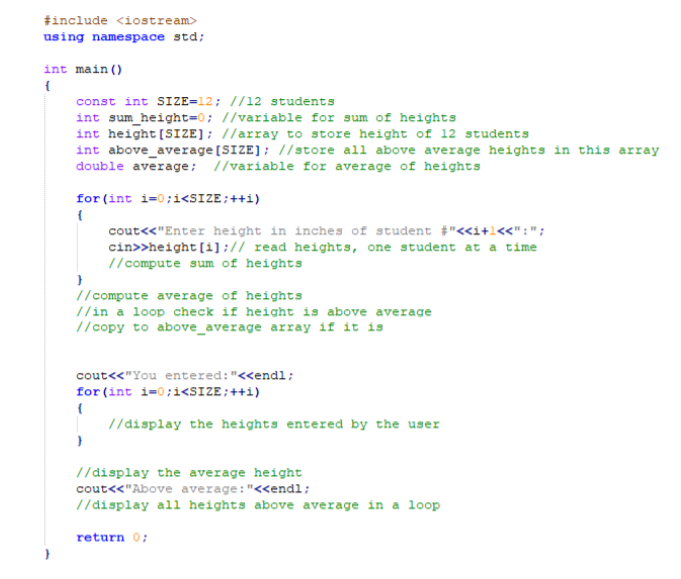
Modify the provided code as follows.
Declare another array of the same size and type and call it above_average.
Calculate the average height of the 12 students.
In a loop of your choice, check if the height of an individual student is larger than the average. If it is larger than the average, copy this element to the above _average array.
Note that the above_average array will most likely have a bigger number of elements than the original height array. This also means that the locations of a specific students height in the two arrays may not be the same after copying. So, you will need a separate counter to keep track of elements in the new array.
Display the content of the new array as well as the average with a suitable prompt. It is recommended that you write an algorithm and try to solve the problem on paper before attempting to write the code.
#include
Step by Step Solution
There are 3 Steps involved in it

Get step-by-step solutions from verified subject matter experts
 Study Help