







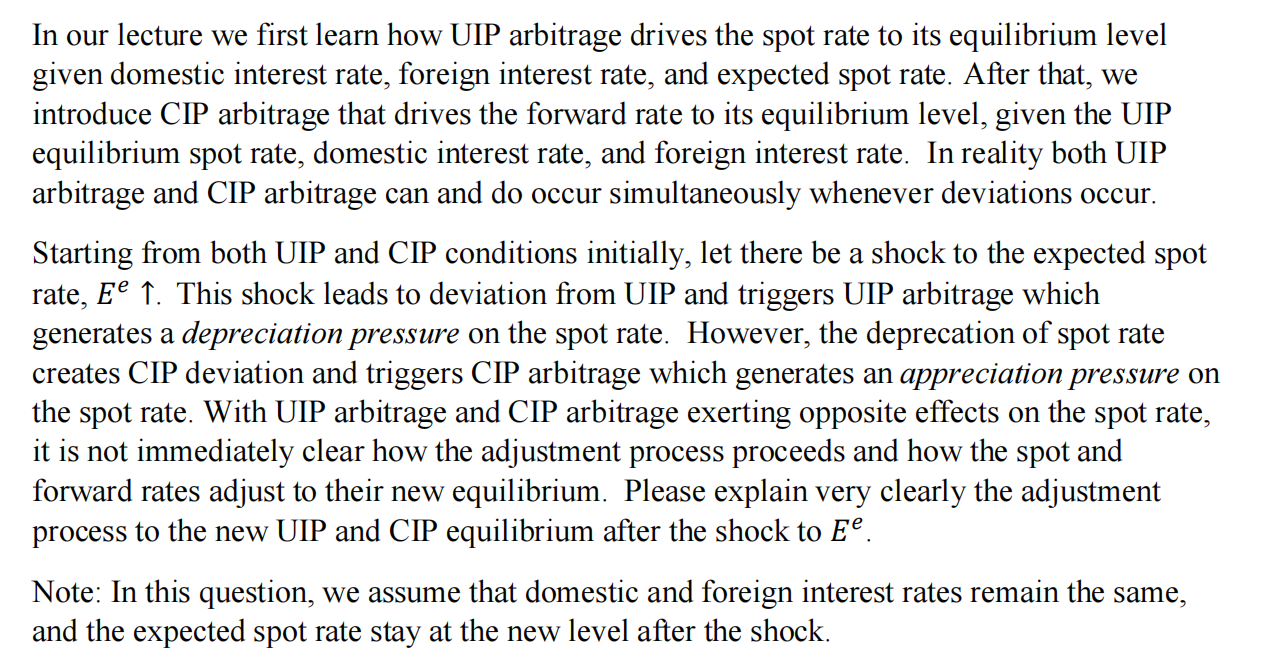
Question: In our lecture we first learn how UIP arbitrage drives the spot rate to its equilibrium level given domestic interest rate, foreign interest rate, and
In our lecture we first learn how UIP arbitrage drives the spot rate to its equilibrium level given domestic interest rate, foreign interest rate, and expected spot rate. After that, we introduce CIP arbitrage that drives the forward rate to its equilibrium level, given the UIP equilibrium spot rate, domestic interest rate, and foreign interest rate. In reality both UIP
arbitrage and CIP arbitrage can and do occur simultaneously whenever deviations occur.
Starting from both UIP and CIP conditions initially, let there be a shock to the expected spot rate, Eeuarr This shock leads to deviation from UIP and triggers UIP arbitrage which generates a depreciation pressure on the spot rate. However, the deprecation of spot rate creates CIP deviation and triggers CIP arbitrage which generates an appreciation pressure on the spot rate. With UIP arbitrage and CIP arbitrage exerting opposite effects on the spot rate, it is not immediately clear how the adjustment process proceeds and how the spot and forward rates adjust to their new equilibrium. Please explain very clearly the adjustment process to the new UIP and CIP equilibrium after the shock to Ee
Note: In this question, we assume that domestic and foreign interest rates remain the same, and the expected spot rate stay at the new level after the shock.
Step by Step Solution
There are 3 Steps involved in it
1 Expert Approved Answer
Step: 1 Unlock

Question Has Been Solved by an Expert!
Get step-by-step solutions from verified subject matter experts
Step: 2 Unlock
Step: 3 Unlock
 Study Help