







Question: in r code please 3. A multiple choice test has 30 questions. The first 20 questions have 4 answers and the next 10 questions have
in r code please
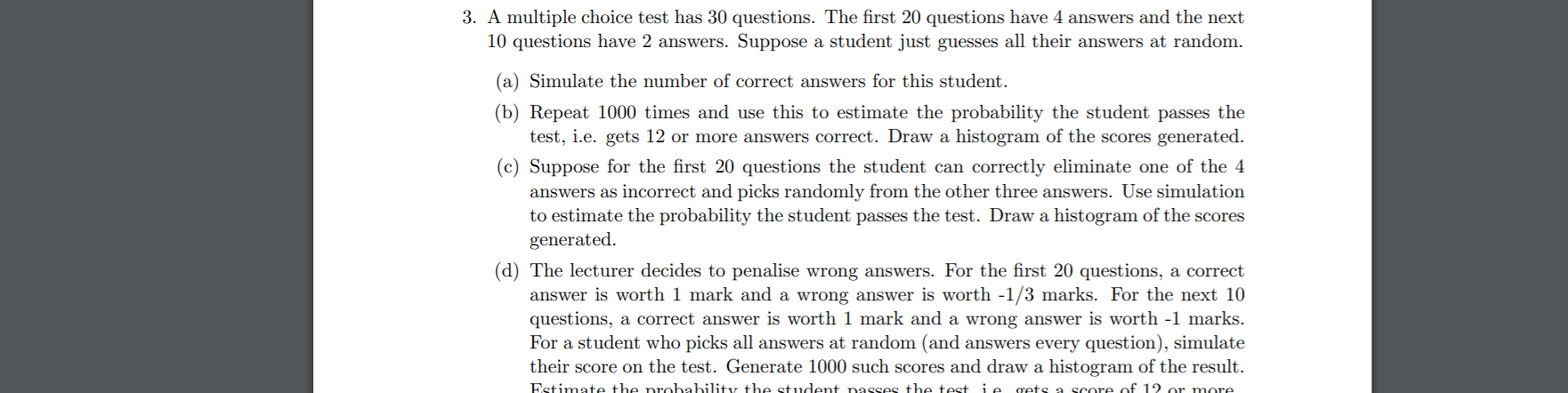
3. A multiple choice test has 30 questions. The first 20 questions have 4 answers and the next 10 questions have 2 answers. Suppose a student just guesses all their answers at random. (a) Simulate the number of correct answers for this student. (b) Repeat 1000 times and use this to estimate the probability the student passes the test, i.e. gets 12 or more answers correct. Draw a histogram of the scores generated. (c) Suppose for the first 20 questions the student can correctly eliminate one of the 4 answers as incorrect and picks randomly from the other three answers. Use simulation to estimate the probability the student passes the test. Draw a histogram of the scores generated. (d) The lecturer decides to penalise wrong answers. For the first 20 questions, a correct answer is worth 1 mark and a wrong answer is worth -1/3 marks. For the next 10 questions, a correct answer is worth 1 mark and a wrong answer is worth -1 marks. For a student who picks all answers at random (and answers every question), simulate their score on the test. Generate 1000 such scores and draw a histogram of the result. Estimate the probability the student passes the test je gets a score of 12 or more
Step by Step Solution
There are 3 Steps involved in it

Get step-by-step solutions from verified subject matter experts
 Study Help